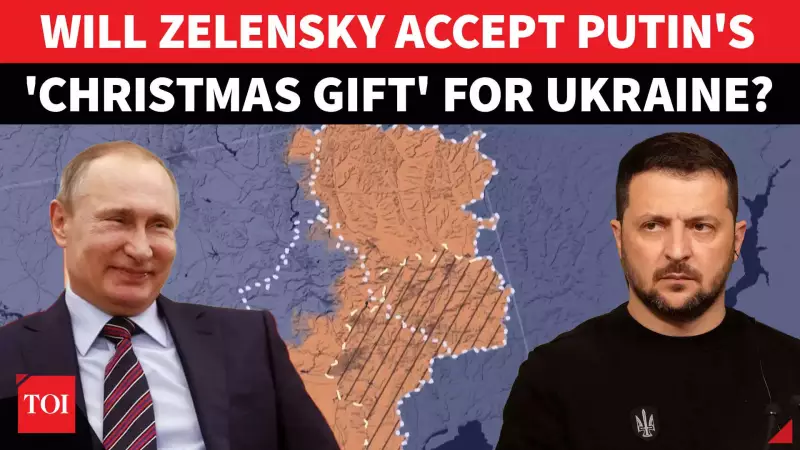
In a significant diplomatic development, Russian President Vladimir Putin has indicated a possible opening for a peace deal with Ukraine, involving a swap of territories. However, this offer comes with a major condition: the contested Donbas region must remain under Russian control. This move arrives as Ukrainian President Volodymyr Zelensky confirmed an upcoming high-level meeting with U.S. President Donald Trump, raising hopes for a breakthrough in the conflict that has stretched for nearly four years.
The Kremlin's Conditional Proposal
According to a recent report, President Putin has signalled that Russia could be open to a territory swap as part of a potential peace agreement. The critical detail, however, is that this proposal explicitly excludes the Donbas. Putin's position asserts that any land captured by Russian troops, apart from the Donbas region, could be on the negotiating table. This condition underscores the Kremlin's firm stance on holding onto the eastern Ukrainian territories it has occupied and partially recognized as independent since 2014.
The offer, described by some analysts as a strategic 'tease,' places immediate pressure on Kyiv. It creates a public framework where Russia appears flexible while anchoring its core territorial demand. The nearly four-year war has seen intense battlefield tensions persist, with recent attacks like the 'Xmas Hellfire' drone bombardment of Kharkiv market, involving over 130 Russian drones, highlighting the ongoing violence even during diplomatic manoeuvres.

Zelensky's Confirmation of Trump Meeting
Amid this complex backdrop, President Volodymyr Zelensky has provided a crucial update, confirming that a high-level meeting with U.S. President Donald Trump is imminent. This meeting, expected to take place at Trump's Mar-a-Lago estate, is being viewed as a potentially historic summit that could chart a new course for peace negotiations. The confirmation has fuelled fresh, albeit cautious, hope for tangible progress in ending the devastating war.
The diplomatic pressure is escalating on multiple fronts. As world leaders prepare for this critical engagement, the global community watches closely. The outcomes could redefine the future of European security, the fate of Ukraine's sovereignty, and the broader geopolitical landscape. Putin's aide, Maria Zakharova, has already ramped up rhetoric, accusing the EU of driving the war for monetary gain, calling European leaders 'warmongers.'
Global Repercussions and the Path Ahead
The intertwined developments of Putin's conditional offer and the planned Zelensky-Trump summit present a pivotal moment. The key questions now are:
- Will Ukraine ever accept a deal that formally cedes Donbas?
- Can the Mar-a-Lago meeting produce a framework acceptable to both Kyiv and Moscow?
- How will European allies, particularly nations like Germany which Putin has recently warned Russians against travelling to, react to these bilateral negotiations?
Putin has also publicly questioned Zelensky's readiness for peace, dismissing the Ukrainian leader's recent Christmas statements. With the war entering its fourth year, the human and economic cost continues to mount. The world now awaits to see if this combination of a public territorial proposal from Moscow and direct high-level talks involving Washington will finally create a path to peace, or if it is merely another chapter in a prolonged conflict.