

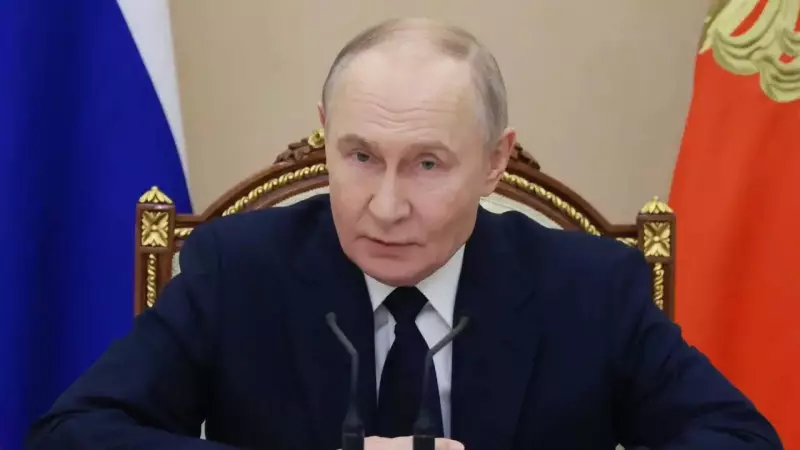
Russia has announced a significant escalation in its military objectives in northeastern Ukraine, with President Vladimir Putin personally ordering the expansion of a so-called "buffer zone" along the border. The directive, revealed on Wednesday, sets a 2026 timeline for the operation, which Moscow claims is necessary to protect its territory from Ukrainian attacks.
Putin's Directive and Russia's Military Claims
According to reports from Russian state news agencies, Chief of the General Staff Valery Gerasimov stated that President Putin has directed the military to widen the buffer zone within Ukraine's Sumy and Kharkiv regions. Gerasimov made these remarks during an inspection of the "North" troop grouping, a force specifically formed in early 2024 to operate in this sector of the front.
The Russian military claims its forces are currently advancing in the area. The stated goal of the "North" grouping has been to create a defensive strip along the border, pushing Ukrainian artillery and rocket systems farther away from Russian soil. President Putin has repeatedly justified this plan by citing cross-border shelling and drone strikes on Russian regions like Belgorod and Kursk.

Kyiv's Fierce Rejection and Accusations
The Ukrainian government has vehemently rejected Moscow's buffer zone plan. Kyiv views it not as a defensive measure but as a pretext for deeper incursions into Ukrainian territory. President Volodymyr Zelenskyy has previously labelled Moscow's intentions for Sumy and Kharkiv as "mad" and vowed that Ukraine would defend its regions.
Gerasimov's comments follow a recent allegation from Russia, made without providing evidence, of an attempted attack on Putin's residence. Ukraine denied the claim, suggesting it was a propaganda move aimed at derailing peace discussions as the war nears its fourth year. There was no immediate Ukrainian response to the latest buffer zone announcement, as reported by Reuters.
The Strategic Implications and Future Outlook
The order to expand the buffer zone by 2026 signals a long-term military commitment from the Kremlin in northeastern Ukraine. It suggests that Russia is preparing for sustained operations aimed at carving out and securing a larger area of Ukrainian land adjacent to its border. This move complicates any potential future negotiations, as it introduces a new, explicitly stated territorial objective beyond the currently occupied regions.
The situation presents a critical challenge for Ukrainian forces, who must now contend with a concentrated Russian push in the north while managing defensive lines across a vast frontline. The international community watches closely, as this development underscores the protracted and escalating nature of the conflict, with direct implications for regional and global security.






