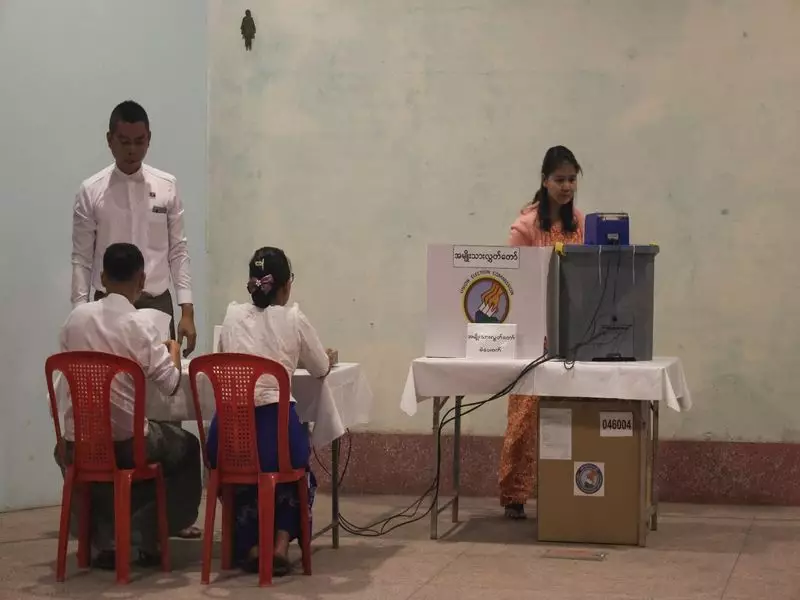
Myanmar's ruling military junta, known as the State Administration Council (SAC), has conducted its first electoral exercise since seizing power in a coup over three years ago. The regime held elections for vacant parliamentary seats on Sunday, a move widely seen as an attempt to project legitimacy despite intense nationwide resistance and a brutal civil war.
Limited Polling Amid Widespread Opposition
The elections were held for a limited number of seats across just 47 townships, a fraction of the country's total. Voting took place for seats in both the lower house, known as the Pyithu Hluttaw, and the upper house, the Amyotha Hluttaw. These seats had been left vacant following the military's violent crackdown on elected lawmakers from the National League for Democracy (NLD) party after the February 2021 coup.
The military council stated that the polls were a step towards its promised multi-party democracy. However, the process was met with derision and calls for boycott from the country's powerful pro-democracy and ethnic resistance forces. Major opposition groups, including the shadow National Unity Government (NUG) and the People's Defence Forces (PDF), had urged citizens to completely shun what they labeled a "sham" election.

Security was extremely tight at the few polling stations that opened, with reports of a heavy presence of soldiers and police. Voter turnout appeared to be extremely low, reflecting the public's rejection of the junta's authority and fear of reprisals from resistance groups. In many parts of the country, the elections were simply impossible to hold due to the junta's lack of territorial control.
A Nation Engulfed in Conflict
The election day was underscored by the severe ongoing conflict that has gripped Myanmar since the coup. Fierce clashes were reported between junta troops and various ethnic armed organizations (EAOs) and PDFs in multiple states, including Shan, Kayin, and Rakhine. In Rakhine State, the Arakan Army (AA) has made significant territorial gains, capturing numerous military bases and effectively controlling the majority of the region.
The civil war has created a massive humanitarian crisis, with over three million people displaced from their homes. The United Nations and international rights groups have repeatedly accused the Myanmar military of atrocities, including indiscriminate airstrikes on civilians, burning villages, and extrajudicial killings. The economic situation has also collapsed, pushing millions into poverty.
International Condemnation and Regional Implications
The military's electoral exercise has drawn sharp criticism from the international community. Western nations have consistently condemned the coup and the junta's violent rule. The Association of Southeast Asian Nations (ASEAN), of which Myanmar is a member, has been attempting to mediate a peace plan known as the Five-Point Consensus, but with little success. The junta has largely ignored ASEAN's efforts, and the bloc remains deeply divided on how to handle the crisis.
Analysts view these limited elections as a tactical move by the junta to create a facade of political normalcy and governance. The regime is seeking to validate its own political vehicle, the Union Solidarity and Development Party (USDP), and other proxy parties, while sidelining the hugely popular NLD, which won a landslide in the 2020 elections. The NLD's leader, Aung San Suu Kyi, remains imprisoned on what are widely considered trumped-up charges.
The results of these polls are expected to be a foregone conclusion, favoring military-aligned candidates. However, they are unlikely to confer any real legitimacy on the SAC, either domestically or internationally. Instead, they are seen as further entrenching the military's grip on power and exacerbating the conflict, as resistance forces vow to continue their fight until the junta is overthrown and federal democracy is restored.
The situation in Myanmar remains one of the world's most pressing and complex humanitarian and political crises, with no peaceful resolution in sight. The junta's election day has done little more than highlight the deep chasm between its ambitions for control and the reality of a nation in revolt.