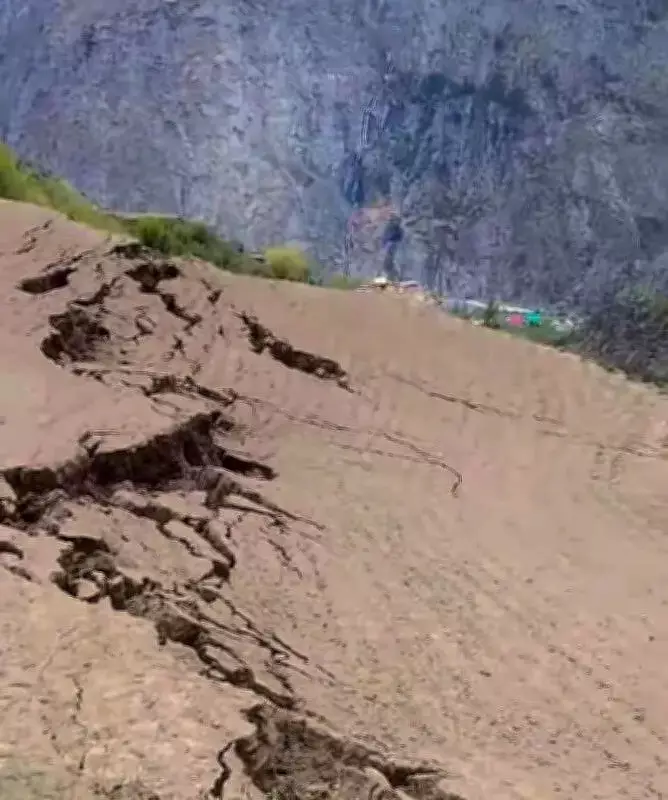
Two years after geologists recommended the rehabilitation of Lindur residents, the land subsidence crisis in this high-altitude village in Himachal Pradesh's tribal Lahaul-Spiti district has worsened, with the state government yet to relocate the villagers to a safer place. According to villagers, cracks in their houses and agricultural fields are widening, and more land has been damaged, becoming uncultivable.
“The cracks in the houses are spreading and deepening. The land is still sinking, and there seems to be no solution in sight. The people of Lindur village are living in miserable conditions,” said Hira Lal Rashpa, a resident who has been campaigning for relocation. He added that around 100 bighas of village land has been damaged and become uncultivable due to subsidence. The total village land measures approximately 500 bighas, including agricultural fields and pasture land.
In 2024, a revenue team assessed that around 38 bighas of village land had become uncultivable due to subsidence. However, villagers say the damage has increased significantly over the last year. In 2025, the Lahaul-Spiti administration identified around eight bighas of land at Norjom Got near Gohrma village for relocating the residents. The administration also forwarded a rehabilitation proposal to the state government, but no further progress has been made, and the process remains stalled.

The Lindur residents have been demanding relocation to a different patch of land in Aragot near their village, arguing that the site identified by the administration is too small and would leave them landless. The land they prefer has not received the required No Objection Certificate (NOC) from Gohrma village despite several meetings. Villagers claim that representatives of the Gohrma panchayat did not attend discussions convened on the issue.
“A clear political reluctance is evident here. Four local panchayats have rights over the land identified for rehabilitation in Aragot. If the administration wanted, we could have got the NOC from Gohrma village. Meetings were called, but representatives from Gohrma never turned up. The villagers have even met the chief minister, but nothing happened,” said Rashpa.
Sudershan Thakur, a lawyer and activist from Lahaul Spiti, said all plans for saving Lindur or relocating its residents exist only on paper. “The villagers have been facing the subsidence problem for more than four years, but no one is willing to do anything about the village — neither the bureaucrats nor the politicians. The residents of this sinking village have been left to cope with their fate. The speed at which this village land is sinking, nothing will be left of it in the coming years,” said Thakur.
Located at an altitude of around 3,300 metres in the remote Udaipur sub-division of Lahaul Spiti district, Lindur village has been facing severe land subsidence since 2023. Cracks have been widening in all 14 houses of the village and also on the walls of a monastery. Teams of scientists from the Geological Survey of India (GSI) and IIT-Mandi conducted investigations in November 2023 and concluded that the villagers needed rehabilitation. According to the GSI study, Lindur is situated on unstable moraine debris devoid of any rock base, while seepage from Jahlma Nullah, a glacial rivulet, and irrigation channels, as well as monsoon rains, are triggering land instability.
Anuradha Rana, the Congress MLA from Lahaul Spiti district, said the biggest hurdle in relocating the residents is the Forest Conservation Act (FCA), 1980. “Our hands are tied. The villagers themselves identified a patch of forest land for their rehabilitation, but we can't relocate them. Under the FCA, a state government cannot give forest land to people — even for rehabilitating victims of natural calamities — without prior approval from the central government,” said Rana, who visited the village last year. “The state government has been demanding amendments in the FCA to enable states to use forest land for rehabilitation. Even a resolution in this regard was passed in the state assembly in 2024. It's a problem of all the Himalayan states. The state government has been unable to provide land to families affected by recent natural disasters due to stringent FCA rules. Till the FCA is amended, the state governments will remain helpless,” she added.

Rana said that temporary shelters would be built near Lindur for emergencies, and channelisation work on the Jahlma Nullah is also being carried out. “We have already spent nearly Rs 1 crore, and another Rs 6-crore project is in the pipeline for securing the villages near the Jahlma nullah,” she said.
Timeline of the Sinking Village
- July 2023: Residents of Lindur village complain about cracks appearing in houses, agricultural fields, and pasture land as the land begins sinking.
- October 2023: The district administration proposes channelisation of the Jahlma Nullah.
- November 2023: A four-member IIT Mandi team visits Lindur and inspects cracked houses, damaged fields, and a nearly 2-km-long crack up to the boundary of the village. A team from the Geological Survey of India also visits and conducts an investigation.
- May 2024: The GSI and IIT Mandi conclude that Lindur residents need rehabilitation as the village is located on unstable moraine debris without a rock base. The teams also say the houses in Lindur are unsafe to live in.
- June 2024: Villagers identify a patch of forest land near Lindur for relocation, but the proposal gets stuck due to the absence of an NOC and FCA restrictions.
- November 2024: A revenue team assesses that around 38 bighas of village land has already become uncultivable due to land subsidence.
- June 2025: An NDRF team visits Lindur, inspects the sinking areas, and interacts with villagers regarding safety measures and emergency preparedness.
- July 2025: The district administration identifies around eight bighas of land at Norjom Got near Gohrma village for rehabilitation and forwards the proposal to the state government.
- May 2026: Villagers claim that nearly 100 bighas of land has been damaged and become uncultivable, while cracks in houses and fields continue to widen and deepen. Congress MLA Anuradha Rana says that the Forest Conservation Act is the biggest hurdle in relocating Lindur residents.