Israel Announces Targeted Airstrike in Tehran Eliminates Senior Iranian Intelligence Figures
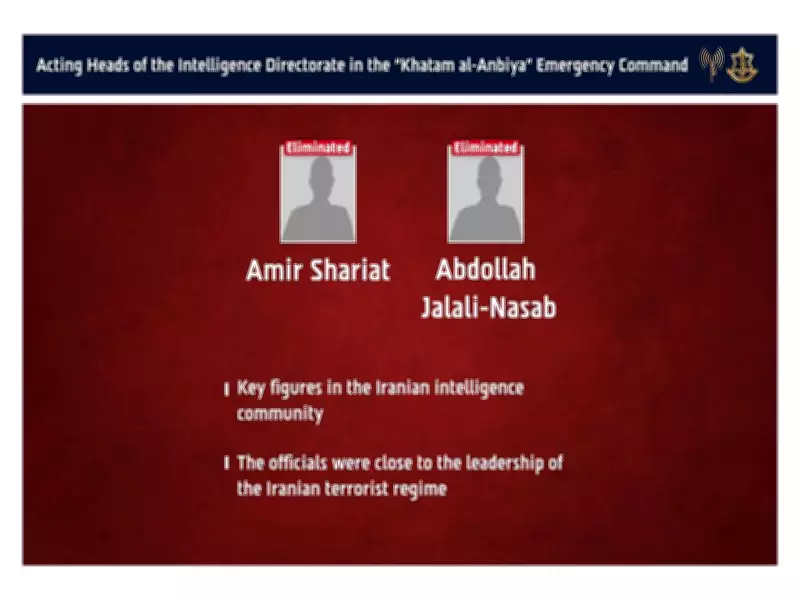
The Israel Defence Forces (IDF) has publicly claimed responsibility for a targeted airstrike conducted by the Israeli Air Force (IAF) in Tehran, resulting in the deaths of two senior Iranian intelligence officials. In a statement posted on the social media platform X, the IDF identified the eliminated individuals as Abdollah Jalali-Nasab and Amir Shariat, describing them as key commanders within Iran's "Khatam al-Anbiya" Emergency Command.
Details of the Strike and Its Significance
According to the IDF, the operation was executed with precise guidance from Israeli Military Intelligence. The two officials were characterized as pivotal figures in the Iranian intelligence community, with close ties to the leadership of what Israel labels a "terrorist regime." The Jerusalem Post reported that Jalali-Nasab and Shariat had recently been appointed as acting replacements in the intelligence division following the death of their predecessor, Saleh Asadi, during the early stages of Israel's Operation Roaring Lion.
The Khatam al-Anbiya emergency command is tasked with gathering and analyzing intelligence for senior Iranian security officials. These assessments play a crucial role in shaping Iran's military decision-making processes, particularly concerning actions against Israel. The strike appears to be a strategic move aimed at disrupting these command and intelligence networks.

Broader Military Campaign and Context
Israeli military spokesperson Brigadier General Effie Defrin stated that this operation is part of a broader, ongoing campaign targeting Iranian military infrastructure. Since the campaign's inception, hundreds of Israeli Air Force aircraft have reportedly struck numerous targets across Iran linked to the Iranian government. Defrin explained that the operation began with a surprise attack after Israeli military intelligence identified two gathering points in Tehran where senior Iranian security leaders had assembled.
This reported airstrike follows closely on the heels of an announcement from the Israeli military, which stated it had completed 20 waves of attacks against more than 150 Iranian government targets. This indicates an escalating effort by Israel to neutralize what it perceives as threats from Iran's military capabilities.
Statements from Israeli Officials on Future Operations
In an interview with ANI, IDF spokesperson Lieutenant Ben Cohen emphasized that joint military operations with the United States against Iran in the Middle East will continue until an "existential threat" to Israel is eliminated. Cohen noted that while Israel generally aims to avoid prolonged conflicts, operations against Iran's military infrastructure could take considerable time due to the scale of the threat.
"I'm not going to give any specific timeframe, but I'll tell you that we're going to keep going until we know that we've taken away that existential threat," Cohen stated, underscoring Israel's preparedness for a prolonged operation if necessary to safeguard its security and that of the wider region.
The situation remains tense as Israel intensifies its military actions against Iranian targets, highlighting ongoing geopolitical tensions in the Middle East.