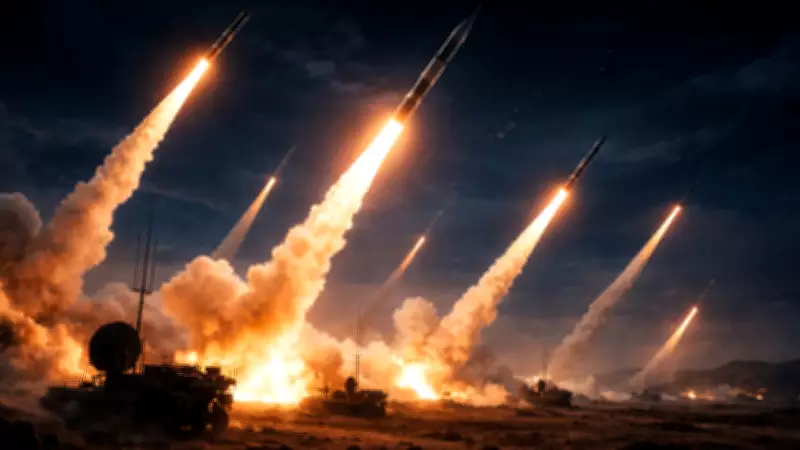
Iran's Ballistic Missile Arsenal Faces Severe Strain Amid Ongoing Conflict
The Middle East remains in a state of heightened tension following coordinated military operations by the United States and Israel targeting Iranian leadership and infrastructure. The death of long-time Iranian leader Ayatollah Ali Khamenei during these strikes has triggered a wave of retaliatory actions from Tehran across the region, yet new evidence suggests Iran's most formidable weapon system may be rapidly diminishing.
Drastic Reduction in Missile Launches
According to a comprehensive analysis by the Jewish Institute for National Security of America (JINSA), Iranian ballistic missile launches have experienced a staggering decline of approximately 90 percent since the conflict's inception. Attacks specifically targeting Israel have fallen by around 88 percent, indicating a significant degradation of Iran's offensive capabilities.
The report provides compelling comparative data: Iran fired more missiles during the first day of Israel's Operation Rising Lion last year than it managed to launch throughout the initial five days of the current combined US-Israeli operations. This dramatic reduction suggests that Operation Epic Fury (US) and Operation Roaring Lion (Israel) have achieved their objective of crippling Iran's missile infrastructure nearly three times faster than during the 2025 conflict.

Launcher Destruction Creates Critical Bottleneck
A primary factor behind this precipitous decline is the systematic destruction of missile launch platforms. JINSA estimates that approximately 75 percent of Iran's launch capacity has been eliminated within a remarkably short timeframe. Each missile launch provides US and Israeli forces with fresh intelligence to locate and destroy remaining systems, creating a self-reinforcing cycle of degradation.
This operational reality has forced Iran to shift from large-scale missile barrages to smaller, less frequent attacks. The destruction of launch platforms has become the critical bottleneck in Tehran's military strategy, fundamentally altering the conflict's dynamics.
Stockpile Pressure and Strategic Limitations
Iran entered this conflict with substantial missile reserves, including roughly 2,000 medium-range ballistic missiles capable of reaching Israel and between 6,000 to 8,000 short-range missiles for regional targets. However, ongoing strikes have not only destroyed significant numbers of missiles but have severely disrupted the logistical chains necessary to transport them from storage facilities to launch sites.
The loss of medium-range missiles presents particular strategic challenges for Tehran. These systems were specifically designed to target Israel and cannot be easily substituted with shorter-range alternatives. JINSA's analysis suggests that at current loss rates, Iran could lose much of its ability to fire these critical missiles at Israel within days to a week.
Strategic Shifts and Future Projections
Facing these mounting challenges, Iran has begun spreading its attacks across the broader region rather than concentrating solely on Israel. By targeting Gulf countries alongside Israeli objectives, Tehran appears to be attempting to increase political pressure on US allies and expand the conflict's geopolitical impact.
This diversified approach requires different missile systems—longer-range weapons for Israeli targets and shorter-range missiles for Gulf states—further complicating Iran's logistical challenges and resource allocation.
Increasing Reliance on Alternative Tactics
With its conventional missile capabilities diminishing, Iran is expected to increasingly turn to unmanned aerial vehicles (drones) and proxy militant groups to maintain pressure on adversaries. Organizations including Hezbollah in Lebanon, Iran-backed militias in Iraq, and the Houthis in Yemen are likely to play expanded roles in attacks targeting Israel, US forces, and Gulf nations.
While JINSA acknowledges Iran may still attempt occasional missile strikes or even a one-time large barrage, such actions would rapidly exhaust Tehran's remaining launch capacity. The overall trajectory suggests Iran's missile campaign will continue shrinking as US and Israeli strikes systematically destroy launch platforms and disrupt supply networks.

The evolving conflict dynamics point toward a future where Iran relies increasingly on asymmetric warfare tactics—drones and proxy forces—to sustain pressure against its adversaries while its conventional ballistic missile capabilities face continued erosion.