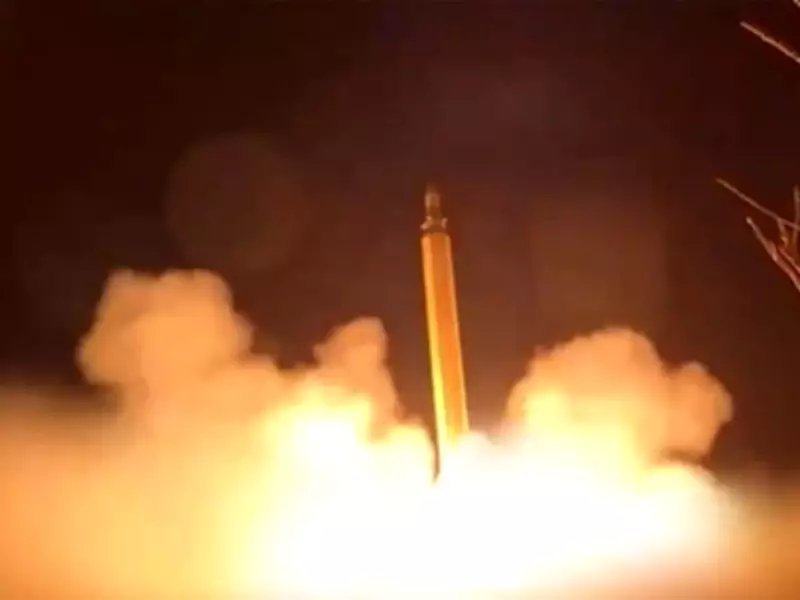
Iran Escalates Military Campaign with 80th Wave of Missile Strikes
In a significant escalation of regional tensions, Iran has publicly released footage showcasing the 80th wave of its ongoing military operation, codenamed Operation True Promise 4. This latest barrage involved the launch of missiles directed at US and Israeli positions across the Middle East, underscoring Tehran's persistent military posture despite diplomatic overtures from the United States.
Trump's Contradictory Statements on Negotiations
Simultaneously, US President Donald Trump has made statements indicating that negotiations with Iran are actively underway. He asserted that Iran is inclined towards reaching a negotiated settlement, citing the severe degradation of Iranian military capabilities. "We're in negotiations right now. I can tell you, they'd like to make a deal and who wouldn't if you were there? Look, their navy's gone, their air force is gone, their communications are gone. pretty much everything they have is gone," Trump stated. He further claimed overwhelming US dominance, noting, "We literally have planes flying over Tehran and other parts of their country. They can't do a thing about it... They are totally defeated... Militarily, they are dead."
Details of Iran's Recent Military Operations
Prior to this 80th wave, Iran's Islamic Revolutionary Guard Corps (IRGC) had announced the success of Wave 79 of Operation True Promise 4. This operation reportedly penetrated Israel's sophisticated layered air defense systems, striking key targets including:

- Intelligence facilities located in Tel Aviv and Beersheba.
- Military and commercial centers across the occupied Palestinian territories.
According to the IRGC's Public Relations Department, the operation, executed under the codename "O Kheyral Fatehin", utilized an arsenal of Kheibar Shekan, Emad, and Sejjil missiles, complemented by destructive drones from the IRGC Aerospace Force. Specific targets included secure locations of Israel's intelligence apparatuses in north and central Tel Aviv, commercial and support centers of the Israeli army in Ramat Gan and the Negev region, and the main logistics and southern military management center in Beersheba.
Iran's Diplomatic Stance at the United Nations
Amidst these military actions, Iran's deputy envoy to the United Nations, Reza Dehghani, articulated Iran's position during a session of the United Nations Conference on Disarmament. He strongly condemned the military strikes by the United States and Israel, emphasizing that Iran harbors no hostility towards its neighbors. However, he warned that countries allowing their territory to be used for attacks against Iran must be held accountable for the consequences.
Dehghani highlighted the ongoing civilian casualties in Iran, stating, "Every day a large number of innocent women and children lose their lives as a result of the blind attacks of the American and Israeli forces." He stressed that aggression and the use of force should not be normalized in international relations and asserted that no power has the right to supplant international law.
Reaffirming Iran's legal standing, Dehghani declared that Iran fully exercises its inherent right to self-defense under Article 51 of the United Nations Charter. He clarified that Iran's defensive actions are strictly limited to targeting the bases, military forces, and assets of the aggressor nations within the region, framing the operations as a legitimate response to ongoing aggression.