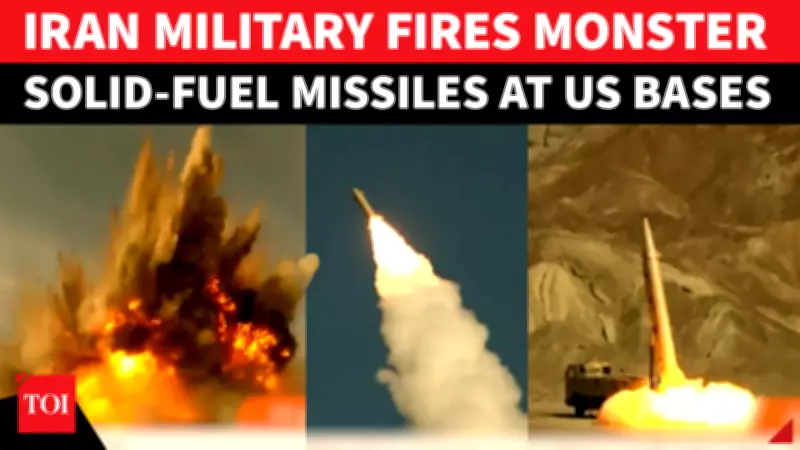
Iran has launched a fresh wave of retaliatory strikes against American targets across the Middle East, with state media and IRGC-linked outlets highlighting the use of advanced solid-fuel ballistic missiles, particularly the Kheibar Shekan. According to reports, the Islamic Revolutionary Guard Corps (IRGC) fired 11 such missiles in the latest operation, underscoring Iran's growing missile capabilities.
Details of the Attack
The strikes came after U.S. attacks targeted Iranian radar sites, coastal air defenses and military infrastructure near the Strait of Hormuz. Unlike older liquid-fueled missiles that require lengthy preparation and fueling procedures, solid-fuel systems such as the Kheibar Shekan remain permanently fueled and ready for launch at short notice. Mounted on highly mobile transporter-erector-launchers, these missiles can rapidly emerge from underground facilities, fire within minutes and relocate before counterstrikes arrive.
Strategic Implications
The use of solid-fuel missiles marks a significant shift in Iran's military doctrine, enabling faster response times and reduced vulnerability. The Kheibar Shekan, with a range of approximately 1,450 kilometers, can reach targets across the Middle East, including U.S. bases in Bahrain, Qatar, and the UAE. The IRGC has warned of more severe responses if attacks continue, raising tensions in the region.

International Reaction
The United States has not yet officially commented on the latest strikes, but previous incidents have led to heightened alert levels at American bases. The international community has called for restraint, with the United Nations urging both sides to avoid further escalation. Iran's actions are seen as a direct challenge to U.S. military presence in the region, particularly near the strategic Strait of Hormuz, through which a fifth of global oil passes.
Technical Capabilities
Solid-fuel technology offers several advantages over liquid-fuel systems. These missiles are easier to store, transport, and launch, making them ideal for surprise attacks. Iran has invested heavily in this technology, with the Kheibar Shekan being one of its most advanced models. The missile's accuracy and speed make it a formidable weapon, capable of evading most air defense systems.
Conclusion
The latest Iranian strikes represent a new phase in the ongoing conflict with the United States. By deploying solid-fuel missiles, Iran has demonstrated its ability to strike quickly and effectively, complicating U.S. military planning. As tensions continue to simmer, the risk of a wider war remains high, with both sides showing little willingness to back down.