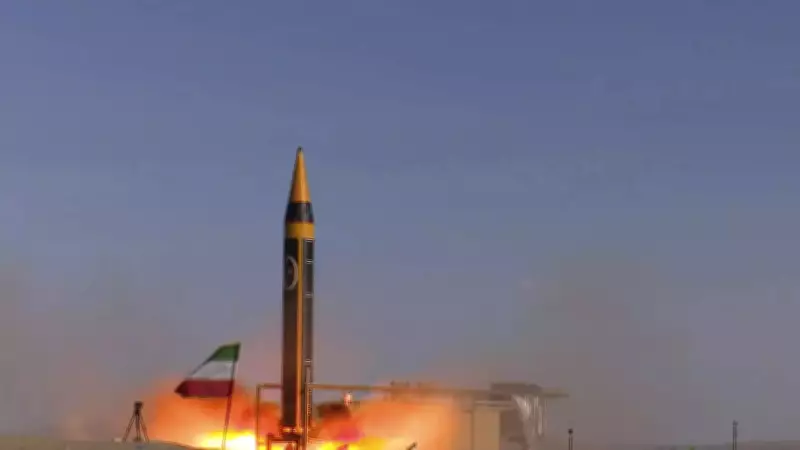
Iran Displays Advanced Khorramshahr-4 Ballistic Missile at Underground Military Site
Iran has publicly showcased the Khorramshahr-4 ballistic missile at a newly unveiled underground military facility, as reported by Fars News Agency, which maintains close ties to the Islamic Revolutionary Guard Corps (IRGC). The long-range missile, with an estimated operational range of approximately 2,000 kilometres and a warhead capable of carrying more than one tonne of high explosives, was among the key operational assets displayed during the inauguration of the site. Fars described the Khorramshahr-4 as one of Iran's more advanced medium to long-range ballistic missiles, highlighting its strategic importance.
Key Features and Origins of the Khorramshahr Missile
The Khorramshahr, also known as the Kheibar ballistic missile, is a liquid-fuelled system measuring about 13 metres in length, with a diameter of roughly 1.5 metres and a launch weight of around 20 tonnes. Its structural design includes a payload compartment for the warhead, upper and lower oxidiser tanks, an intertank section, and a fuel tank. Notably, the missile does not utilise grid fins; instead, its guidance equipment is housed in separate compartments located above the fuel and oxidiser tanks, reflecting a relatively simple yet robust architecture.
According to analyses, the Khorramshahr is derived from North Korea's Hwasong-10 intermediate-range ballistic missile, which itself is based on the Soviet-era R-27 submarine-launched ballistic missile design. US-based think tanks report that the Hwasong-10, also referred to as the Musudan, was transferred to Iran in the mid-2000s, forming the technological foundation for Tehran's Khorramshahr programme.

Advanced Guidance and Control Systems
The ballistic missile features an advanced guidance and control system designed to manoeuvre and adjust its trajectory beyond Earth's atmosphere. This system reportedly shuts down guidance mechanisms during re-entry, a measure intended to reduce vulnerability to electronic warfare countermeasures. Additionally, the control architecture eliminates the need for conventional slender-wing structures on the warhead, allowing it to carry a larger explosive payload compared to earlier designs.
Iranian claims indicate that the Kheibar has an impact endurance of about 280 seconds in ground conditions and 300 seconds in vacuum, underscoring its durability and operational capabilities.
Recent Usage and Escalating Tensions
The Khorramshahr-4 missile was reportedly used during a 12-day conflict in June, when Iran launched it toward Israel following US strikes on Iranian nuclear-related targets. This deployment comes amid escalating tensions between the United States and Iran over Tehran's nuclear programme and regional security concerns. The US has imposed fresh sanctions targeting Iran's defence and missile development sectors, while Washington has issued warnings against further ballistic missile tests and military escalation.
In response, Iran has criticised the US military presence in the region and reiterated that its missile programme is defensive in nature, aimed at safeguarding national security. The unveiling of the Khorramshahr-4 at the underground facility underscores Iran's ongoing efforts to enhance its military capabilities amidst international pressure and geopolitical challenges.