

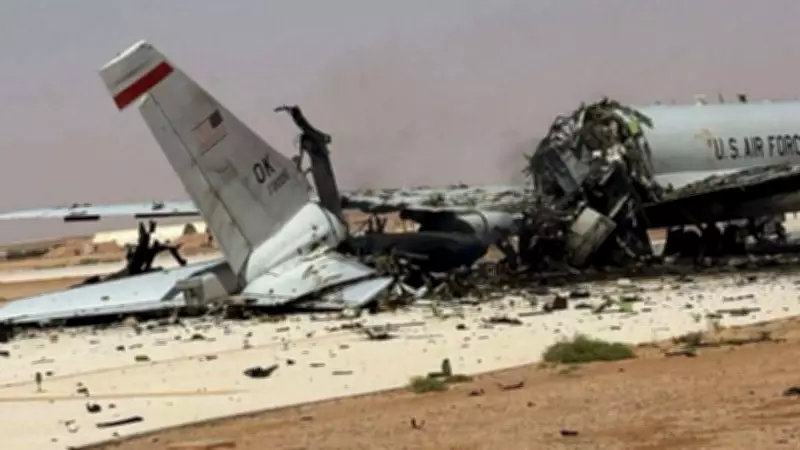
Iran Claims Major Strike: US E-3 Sentry AWACS Destroyed at Saudi Base
In a significant escalation of hostilities in the Middle East, Iran has asserted that it successfully destroyed a United States E-3 Sentry airborne warning and control system (AWACS) aircraft during a recent missile and drone assault. The attack targeted the strategically vital Prince Sultan Air Base located near Riyadh, Saudi Arabia, a key operational hub for American military forces in the region.
Images Reveal Devastating Damage to Critical Surveillance Platform
Visual evidence circulating on social media platforms depicts the aftermath of the strike, showing an E-3 Sentry aircraft with its rear fuselage completely burned out and surrounded by extensive debris. The aircraft, identified by reports as serial number 81-0005, was reportedly stationed on a taxiway at the time of the attack. While it remains unconfirmed whether the platform suffered a direct hit, defence analysts emphasize that even a proximate explosion could be sufficient to cause catastrophic damage due to shrapnel and fire risks, as noted by military publication Warzone.
Strategic Significance of the E-3 Sentry Loss
The potential destruction of an E-3 Sentry represents a substantial blow to US military capabilities, given the aircraft's pivotal role in modern warfare. This advanced AWACS platform serves as a critical airborne surveillance and battle management asset, capable of detecting and tracking aircraft, missiles, and other threats over a radius exceeding 250 miles. It plays an indispensable role in coordinating air defence responses and managing complex battlefield operations in real time, making its loss operationally significant.

The operational fleet of E-3 Sentry aircraft has already faced reductions in recent years, with remaining units grappling with ageing systems and heightened maintenance demands, amplifying the impact of this incident.
Context of Escalating Regional Conflict
This strike on Prince Sultan Air Base unfolds against the backdrop of a widening conflict involving Iran, the United States, and Israel, which ignited in late February following a joint military operation by Washington and Tel Aviv. Since that time, Iran has executed a series of retaliatory attacks across the Gulf region, specifically targeting assets associated with US military activities. The conflict has resulted in casualties on multiple sides, underscoring the volatile nature of the current geopolitical landscape.
The March 27 attack is reported to have inflicted significant damage to US military assets and infrastructure at the base, with at least 12 American service members sustaining injuries. This event marks a continued pattern of Iranian aggression aimed at countering US presence and influence in the Middle East, further destabilizing an already tense region.






