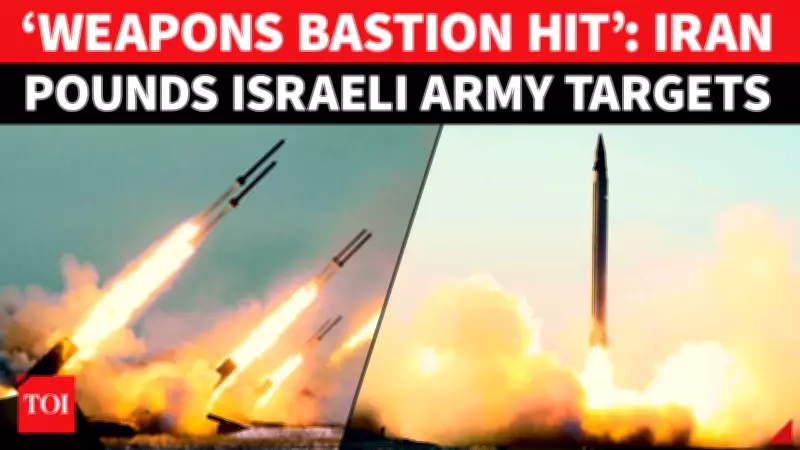
Iran's Revolutionary Guard Claims Major Drone Attack on Israeli Defense Infrastructure
In a significant escalation of regional hostilities, Iran's Islamic Revolutionary Guard Corps (IRGC) has asserted responsibility for a coordinated drone assault targeting critical Israeli defense manufacturing sites. According to official statements from Tehran, the operation specifically aimed at facilities operated by Rafael Advanced Defense Systems and Israel Aerospace Industries, two cornerstone entities of Israel's military-industrial complex.
Targeting the Backbone of Israeli Defense
The IRGC claims these strikes were a direct retaliation in the ongoing conflict, with the selected sites allegedly playing pivotal roles in producing advanced weapon systems. Rafael Advanced Defense Systems is renowned globally for developing the Iron Dome missile defense system, which has been crucial in intercepting rocket and drone attacks. Meanwhile, Israel Aerospace Industries is a major producer of combat drones and other aerospace technologies integral to Israel's defense strategy.
Iranian military officials emphasized that these facilities are not merely industrial sites but are central to Israel's ability to deploy and sustain its defensive and offensive capabilities. The strikes, described as an "explosive drone blitz," reportedly involved multiple unmanned aerial vehicles carrying explosive payloads, though independent verification of the attacks' success or extent of damage remains pending.

Context of a Widening Regional War
This latest development occurs against a backdrop of rapidly intensifying conflict across the Middle East. Since late February, Iran has launched numerous waves of missile and drone attacks targeting Israeli and United States assets in the region. The IRGC's claim marks a strategic shift, moving beyond military bases to directly assault the industrial underpinnings of Israel's defense apparatus.
The expanding war has seen heightened tensions, with various proxy groups and state actors becoming increasingly involved. Iranian actions are framed as retaliatory measures, responding to perceived aggressions and aiming to degrade enemy capabilities at their source. This approach underscores a broader strategy to challenge Israeli technological and military superiority through asymmetric warfare tactics.
Implications for Regional Security
The targeting of Rafael and Israel Aerospace Industries highlights the critical role of defense manufacturing in modern warfare. Disrupting these supply chains could potentially impact the availability and deployment of key systems like the Iron Dome, which has been instrumental in protecting Israeli cities from incoming threats. Moreover, such strikes may influence the dynamics of the conflict, prompting further escalations or diplomatic interventions.
As the situation unfolds, international observers are closely monitoring the veracity of Iran's claims and the potential responses from Israel and its allies. The use of explosive drones in this context reflects evolving warfare technologies, where unmanned systems are increasingly employed for precision strikes against high-value targets. This incident adds another layer of complexity to the already volatile geopolitical landscape of the Middle East, raising concerns about prolonged instability and the risk of broader regional conflagration.