

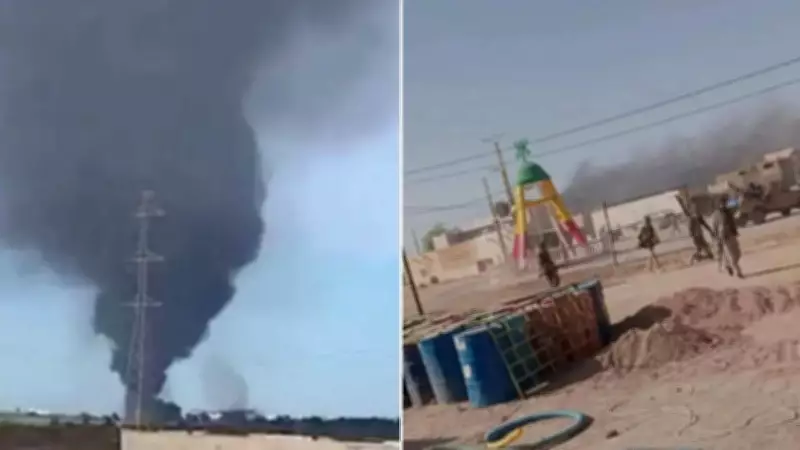
Fresh violence erupted across Mali early Saturday as gunfire and explosions were reported in multiple locations, including the capital Bamako, nearby towns, and the city's international airport, according to residents and authorities.
Military Confirms Assault
Mali's army confirmed the assault, stating that 'unidentified armed terrorist groups targeted certain locations and barracks' in Bamako and the interior early in the morning. The army added that soldiers were 'engaged in eliminating the attackers.'
Residents in Bamako reported sustained heavy weapons fire and automatic gunshots near the Modibo Keita International Airport, located about 15 km from the city centre, which shares space with an air base used by the Malian air force. Witnesses reported helicopters flying over nearby neighbourhoods as security forces responded.

Attacks Spread Beyond Capital
The violence was not confined to Bamako. In Kati, a key military town near the capital and home to Mali's main army base, residents were woken by loud explosions and gunfire. The town is also where military ruler General Assimi Goita resides. 'Heavy gunfire' was reported, with some residents sharing images of damaged homes on social media. 'We are holed up in Kati,' one resident told AFP, reflecting the fear gripping the area.
In northern cities such as Kidal and Gao, residents also reported gunfire and explosions, pointing to a wider, coordinated offensive. Videos circulating online showed armed men moving through deserted streets in trucks and on motorcycles, while others showed bodies lying on the ground after clashes. A video verified by Al Jazeera showed armed fighters from the Azawad Liberation Front entering the National Youth Camp in Kidal. The Tuareg-led separatist group has long sought to establish an independent state called Azawad in northern Mali. A former mayor of Kidal told the Associated Press that gunmen had entered the town and taken control of some neighbourhoods, leading to exchanges of fire with the army.
Defence Minister's House Reportedly Hit
Amid the escalating violence, residents in Kati said the house of defence minister General Sadio Camara was targeted in the attack. Two witnesses said that the residence was destroyed, while AFP reported that a powerful explosion had caused significant damage. However, Camara was not present at the time of the attack and is 'safe,' according to people close to him, as reported by Al Jazeera.
Residents described scenes of panic as the attacks unfolded. In Gao, one resident said the explosions were so powerful that 'the doors and windows of my house shake.' 'I'm scared out of my wits,' the resident told AP by phone.
US Embassy Issues Security Alert
The US Embassy in Bamako issued a security alert, warning of 'reports of explosions and gunfire near Kati and the Modibo Keita International Airport in Bamako' and advising American citizens to shelter in place and avoid travel.
While no group immediately claimed responsibility, four security sources told the agency that Jama'at Nusrat al-Islam wal-Muslimin (JNIM), a regional affiliate of al-Qaeda, was likely involved. Ulf Laessing, head of the Sahel programme at the Konrad Adenauer Foundation, said that the scale and coordination of the attacks are deeply concerning. 'It's especially concerning that JNIM apparently has been coordinating today's attacks with Tuareg rebels,' he told AP, noting that similar alliances had previously destabilised the region in 2012.
Mali has been grappling with insurgencies by groups linked to al-Qaida and the Islamic State, along with a separatist rebellion in the north. Despite a 2015 peace deal, violence has persisted and, in recent years, intensified. Along with neighbouring Niger and Burkina Faso, Mali has seen a surge in militant attacks, even as military-led governments in the region have shifted alliances away from Western partners towards Russia. The government has increasingly relied on Russian mercenaries for security support, while scaling back defence cooperation with Western nations. More recently, however, Bamako has explored renewed engagement with the United States. A Reuters report in March said Mali and Washington were close to an agreement that would allow US aircraft and drones to operate over Malian airspace for intelligence-gathering against jihadist groups.

The latest wave of attacks underscores the fragile security situation, with both militant groups and separatist forces appearing to escalate their operations simultaneously.





