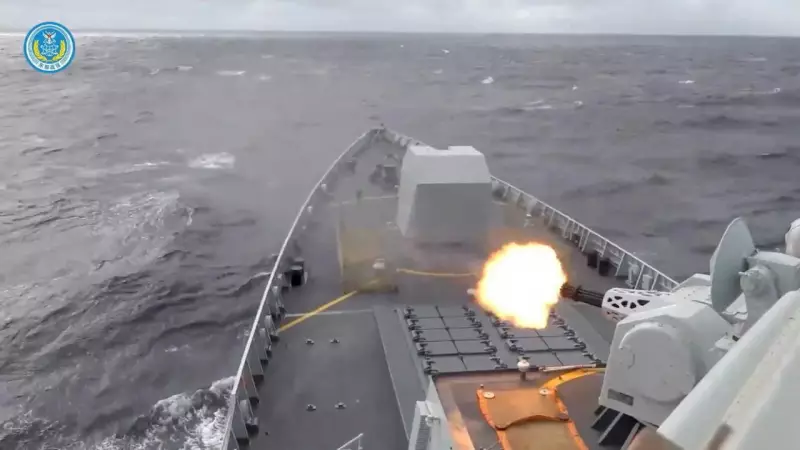
China has initiated a significant and expansive series of live-fire military drills encircling Taiwan, deploying a formidable array of warships, fighter jets, bombers, and drones. Beijing describes these manoeuvres, codenamed "Justice Mission 2025," as a direct and stern warning to forces advocating for Taiwanese independence and to foreign powers interfering in the region. In response, Taiwan has placed its military forces on high alert, activating defence mechanisms and vowing to protect its democratic way of life.
Scale and Scope of the Military Exercises
According to Taiwan's defence ministry, by 3 pm on Monday, it had detected a total of 89 Chinese military aircraft and unmanned aerial vehicles operating around the island. Of these, a substantial number—67 aircraft—entered what Taiwan designates as its air defence response zone. The exercises, coordinated by China's People's Liberation Army (PLA) Eastern Theatre Command, involve destroyers, frigates, aircraft, and rocket forces.
The drills include live-fire training on maritime targets to the north and southwest of Taiwan and are scheduled to continue into Tuesday. The operations feature simulated strikes and exercises focused on blockading key ports, such as Keelung in the north and Kaohsiung in the south. A senior Taiwanese security official revealed to Reuters that dozens of Chinese military assets were operating near the island, with some deliberately approaching Taiwan's contiguous zone, which extends 24 nautical miles from its coast.

Warnings and Responses from Both Sides
Spokesperson for the PLA Eastern Theatre Command, Shi Yi, stated unequivocally that the drills serve as a "serious warning to 'Taiwan Independence' separatist forces and external interference forces." Chinese state media released posters with aggressive slogans like "Shields of Justice: Smashing Illusions," underscoring the message.
Taiwan's response was swift and determined. The military established a response centre and deployed appropriate forces, also conducting a rapid response exercise. The defence ministry affirmed that all armed forces members "will remain highly vigilant and fully on guard, taking concrete action to defend the values of democracy and freedom." In a show of capability, Taiwan's defence ministry posted a video showcasing weapons, including U.S.-made HIMARS rocket systems that could target China's Fujian province in a conflict.
Taiwan's coast guard dispatched large vessels to monitor Chinese coast guard activity near its waters, coordinating with the military to minimise disruption to shipping and fishing. The aviation authority noted China had designated a temporary danger zone in Taipei's flight information region for Tuesday's drills, prompting assessments of alternative flight routes.
Broader Context and Regional Implications
These drills mark the sixth major round of Chinese war games around Taiwan since 2022. The timing is significant, coming just 11 days after the United States announced a substantial $11.1 billion arms sales package to Taiwan, a move that Beijing had protested vehemently, promising "forceful measures."
Security analysts point out that China's exercises are increasingly blurring the line between routine training and actual combat preparations, effectively reducing the warning time for Taiwan and its allies in the event of a real attack. The drills also follow heightened tensions between Beijing and Tokyo, after Japanese Prime Minister Sanae Takaichi suggested a Chinese attack on Taiwan could warrant a Japanese military response, leading Beijing to summon Japan's ambassador.
Despite the high-stakes military posturing, daily life in Taiwan showed resilience. The stock market rose 0.8% to a record high during morning trading. Public reaction was mixed, with Taipei teacher Lin Wei-ming, 31, remarking, "I think these drills are just meant to scare us... the political side of things can only be handled by Taiwan's current government."

China maintains its claim that Taiwan is an inalienable part of its territory and has never renounced the use of force to achieve unification. Taiwan's government firmly rejects this stance, asserting that the future of the island must be decided solely by its 23 million people.