US Deploys B-1B Lancer 'BONE' Bombers in Middle East Military Campaign
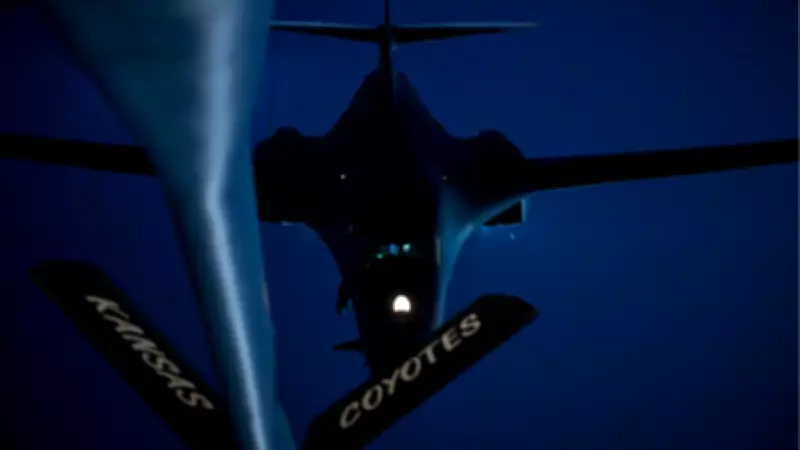
The United States Central Command (CENTCOM) has released compelling video footage showcasing B-1B Lancer strategic bombers conducting operations over the Middle East as part of Operation Epic Fury. This ongoing US-Israel military campaign targets Iranian military infrastructure and strategic assets across the region.
The recently shared footage, distributed by CENTCOM through social media platforms, provides a rare glimpse of the long-range bombers executing missions as Washington continues its aerial operations against Iranian targets. The visual documentation comes amid escalating tensions in the Gulf region following the initiation of coordinated strikes.
Operation Epic Fury: Background and Context
Operation Epic Fury commenced in late February when American and Israeli forces launched synchronized strikes across multiple locations in Iran. This military campaign resulted in significant developments, including the reported death of Iran's Supreme Leader Ayatollah Ali Khamenei. Since these initial operations, the United States has deployed substantial air and naval assets throughout the region as security concerns continue to intensify.

In their social media post accompanying the video release, CENTCOM officials highlighted the capabilities of these formidable aircraft: "B-1B Lancers – capable of carrying a payload of 75,000 pounds – have operated over the Middle East in support of Operation Epic Fury. Nicknamed the BONE, B-1Bs hold world records for speed, payload and range."
The Significance of the B-1B Lancer Strategic Bomber
The B-1B Lancer, affectionately known by its nickname "Bone," represents a long-range, multi-mission supersonic bomber that has served as a cornerstone of United States Air Force capabilities since its introduction in 1985. Originally conceived as a nuclear-capable strategic bomber during the Cold War era, the aircraft underwent significant conversion in the mid-1990s to transition to an exclusively conventional strike role.
Today, this versatile platform stands as one of the most powerful delivery systems for precision-guided conventional weapons in the American arsenal. The United States Air Force has outlined plans to maintain and sustain the B-1B Lancer fleet through 2040 and potentially beyond, ensuring its continued support for high-tempo global strike missions across various theaters of operation.

Key Features and Capabilities of the B-1B Lancer
- Massive Payload Capacity: The aircraft can transport up to 75,000 pounds (approximately 34,000 kilograms) of weapons, establishing it as one of the largest conventional payload carriers within the United States military inventory.
- Supersonic Performance: With the ability to reach speeds around Mach 1.2, the bomber can rapidly penetrate contested airspace and strike distant targets with exceptional responsiveness.
- Innovative Swing-Wing Design: The distinctive variable-sweep wing configuration allows the aircraft to adjust wing positions according to different flight conditions, enabling both high-speed penetration capabilities and efficient long-range cruising.
- Extended Operational Range: The B-1B can conduct intercontinental missions and remain airborne for prolonged periods when supported by aerial refueling operations.
- Conventional Weapons Focus: Unlike nuclear-capable bombers such as the B-2 Spirit, the contemporary B-1B primarily carries conventional precision weapons including Joint Direct Attack Munitions (JDAMs), cruise missiles, and various other guided munitions.
- Proven Combat Record: The bomber has seen extensive deployment in multiple conflicts including operations in Afghanistan, Iraq, and Syria, where its substantial payload capacity and endurance have enabled sustained close air support and long-range strike missions.
The deployment of these advanced strategic bombers in Operation Epic Fury underscores the United States' commitment to maintaining air superiority and strike capabilities in the volatile Middle East region. As tensions persist, the B-1B Lancer continues to demonstrate why it remains a critical component of American military power projection nearly four decades after its initial introduction.