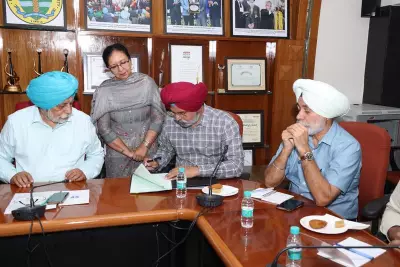
In a significant move to combat deteriorating air quality, Union Minister for Environment, Forest and Climate Change, Bhupender Yadav, convened a crucial high-level review meeting on Tuesday, December 16. The focus was on assessing and accelerating the action plans to tackle the rising pollution crisis in the key National Capital Region (NCR) cities of Gurugram and Faridabad.
Minister's Directives for On-Ground Action
This marked the minister's second review of anti-pollution strategies. Bhupender Yadav issued clear instructions for authorities to pinpoint specific pollution hotspots and conduct rigorous field inspections. He stressed the need to go beyond surface-level measures and deeply understand the root causes fuelling the poor air quality in these urban centres.
Expressing serious concern over the persistent high pollution levels, the minister highlighted intertwined issues like legacy waste dumps and chronic traffic congestion. He mandated officers to ensure their efforts lead to visible and measurable outcomes in eliminating pollution sources, moving from planning to tangible results.

Comprehensive Strategy: From Waste to Traffic
The Ministry's press release outlined a multi-pronged approach ordered by the minister. A major thrust was on the long-pending problem of Municipal Solid Waste (MSW). Municipal Commissioners of Gurugram and Faridabad were instructed to prepare integrated action plans to address legacy waste and expedite complete road paving to curb dust.
On the vehicular pollution front, authorities were directed to identify traffic congestion hotspots. Yadav called for short-term, executable measures like removing unnecessary police barricades, eliminating illegal parking, and creating structured parking facilities to smooth traffic flow and reduce emissions. Action was also ordered against unregistered and deregistered vehicles plying on roads.
Community Participation and Greening Drives
The minister advocated for a community-centric model to enhance urban cleanliness. He suggested launching urban cleanliness campaigns in "mission mode" by forming teams that converge Self-Help Groups (SHGs) and public representatives. Emphasizing behavioural change, he called for adopting technological solutions, building the capacity of sanitation workers (safai karamcharis), and strengthening public awareness initiatives to encourage mass participation, especially among youth.
Furthermore, Bhupender Yadav stressed the need to enhance the greening of open spaces in both Gurugram and Faridabad as a natural remedy to improve air quality. He instructed that Information, Education, and Communication (IEC) activities be tailored to specific target groups to raise awareness about relevant environmental laws and rules.
Accountability and Review Mechanism
To ensure continuous monitoring and accountability, the minister directed concerned officers to submit month-wise action taken reports. These reports will be reviewed at the Ministerial level, keeping the implementation of plans under close scrutiny.
The high-level meeting saw participation from the Chairman of the Commission for Air Quality Management (CAQM), senior officers from the Ministry of Environment, Forest and Climate Change, the Central Pollution Control Board (CPCB), the Chairman of the Uttar Pradesh State Pollution Control Board (UP SPCB), as well as the District Magistrates and Municipal Commissioners of Gurugram, Faridabad, and Manesar.