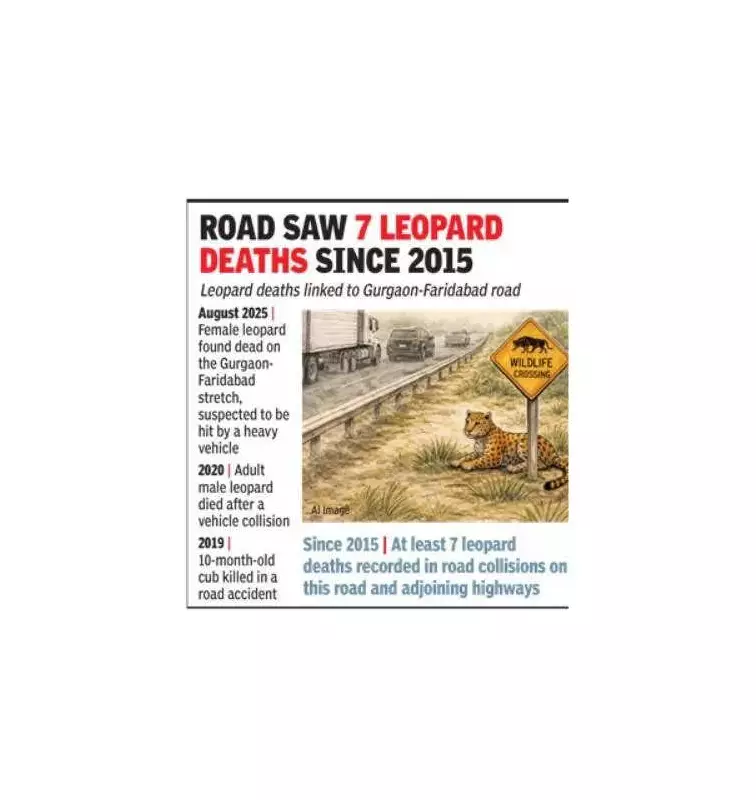
In a decisive move to prevent further wildlife tragedies, Haryana's wildlife department has formally requested the National Highways Authority of India (NHAI) to redesign the Gurgaon-Faridabad Road as a dedicated wildlife corridor. This urgent push comes after a distressing series of leopard fatalities in road accidents along the Aravali stretch.
Official Directive Calls for Feasibility Study and Redesign
Principal Chief Conservator of Forests and Chief Wildlife Warden Vivek Saxena identified the road as a high-risk zone for both animals and motorists. In a communication sent last week to NHAI chairperson Santosh Kumar Yadav, Saxena called for a comprehensive feasibility study. This study, to be conducted alongside wildlife experts and local authorities, will map animal movement zones and plan specific interventions.
The directive explicitly asks for planning in line with the Union environment ministry's guidelines for eco-friendly linear infrastructure. The goal is to integrate safeguards commonly found in other wildlife corridors across India, which are currently missing on this highway cutting through active leopard territory.

Blueprint for a Safer Passage: Proposed Interventions
The department's proposal outlines a multi-pronged strategy to mitigate collisions. Key measures include constructing wildlife underpasses and overpasses at identified animal crossing points. The plan also recommends installing fencing along vulnerable sections of the road to prevent animals from straying onto the asphalt.
To control vehicle speed, the proposal advocates for stricter enforcement of lower speed limits, potentially using detectors. Additionally, clearer warning signage and distinctive red table-top road markings are suggested to alert drivers when they are entering sensitive patches. The communication also mentions exploring concrete barriers for the most dangerous stretches.
Conservator of Wildlife (South Haryana) Subhash Yadav stated, "We have formulated a plan to prevent more accidents." He added that immediate actions include cleaning existing culverts to ensure wildlife can use them for safe passage.
A History of Loss and an Urgent Need for Action
The demand for a corridor is grounded in grim statistics. Official records and field reports indicate at least seven leopards have been killed in vehicle collisions on this road and adjoining highways since 2015.
The most recent casualty was reported in August 2025, when a two-and-a-half-year-old female leopard was found dead on the Gurgaon-Faridabad stretch. Her injuries were consistent with a high-speed impact, likely from a heavy vehicle.
The Aravali hills in south Haryana are home to a resident leopard population, along with species like jackals, hyenas, and nilgai. Conservationists have repeatedly warned that rapid urbanisation and increasing traffic volumes on this corridor are squeezing animal movement routes, elevating the risk of fatal encounters.
The wildlife department cited successful precedents, such as the reduced speed limits on tiger corridors along NH44 and the wildlife-safe crossings, fencing, and visual alerts implemented on NH45 in Madhya Pradesh. These examples serve as a model for the transformative changes now being sought for the Gurgaon-Faridabad Road, aiming to harmonise infrastructure development with ecological preservation.