

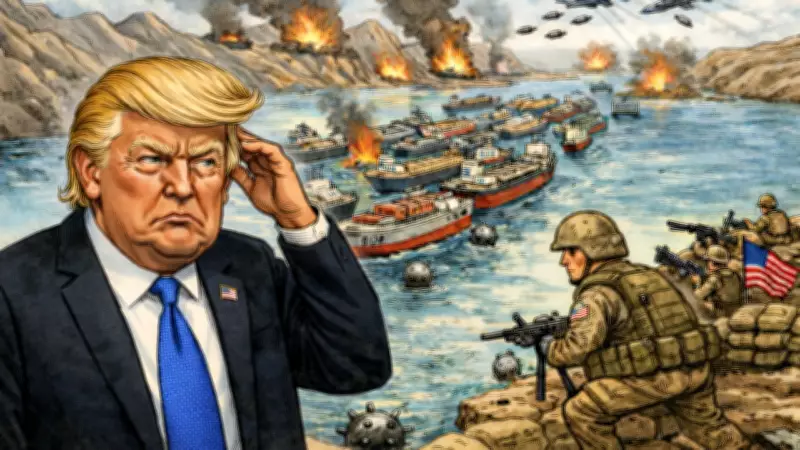
Iran's Mines, Mobile Missiles, Drones & Geography: Why Reopening Strait of Hormuz Is No Easy Task
The Strait of Hormuz has transformed from a bustling shipping lane into a high-stakes pressure point in the escalating Middle East conflict. As tensions surge, this narrow waterway is now at the center of a global standoff, where geography, military power, and energy flows collide dramatically.
A Maritime Chokepoint Under Siege
The narrow sea lane, effectively squeezed by Iran, has become the world's most tense maritime chokehold. This move is Tehran's robust response to the US-Israel offensive launched on February 28, which also resulted in the death of long-serving Supreme Leader Ayatollah Ali Khamenei. In retaliation to the combined military pressure from Washington and Tel Aviv, Iran has not only fired missiles across the region but also played its strongest card: throttling the Strait of Hormuz, the busiest petroleum artery globally.
At either end of the Strait, hundreds of ships from various nations sit idling in a live war zone, shadowed by incoming missiles. The chokepoint isn't merely blocked; it's gasping for breath. However, Tehran has strategically left a narrow passage open for "friendly nations," including India, China, Russia, Pakistan, and Iraq, granting them cautious leeway through these tense waters. Iranian Foreign Minister Abbas Araghchi explicitly stated, "We have permitted passage through the Strait of Hormuz for friendly nations including China, Russia, India, Iraq, and Pakistan." He added, "The Strait of Hormuz is open; it is only closed to tankers and ships that belong to our enemies."

Meanwhile, a visibly agitated Donald Trump has vowed to force the waters open "one way or another," as Washington pushes to bring Tehran back to diplomatic talks, hoping to cool what the sea has already set ablaze.
Why Reopening the Strait Is So Challenging
At either end of this critical energy artery, tankers remain frozen in the waters, silent and waiting. The Strait of Hormuz, once a relentless conveyor belt of global oil, is now a suffocating chokehold. Iran, responding to the joint military push by US President Donald Trump and Israeli Prime Minister Benjamin Netanyahu against the Khamenei order, now under Mojtaba's control, has effectively stifled these waters. Sea tensions are driving oil prices sky-high, shaping global economic realities.
Trump's vow to reopen the route faces immense hurdles. Even before the conflict spiraled, Washington and Tehran had cycled through multiple rounds of nuclear talks without resolution. Relations have remained brittle since Ayatollah Ali Khamenei's rise around 40 years ago. With Tehran rejecting Washington's 15-point peace proposal, especially after pressure around Hormuz, the path to de-escalation appears anything but smooth. As The New York Times reports, cracking open the Strait again may prove far harder than it sounds.
Where Geography Becomes a Weapon
The Strait's geography is its greatest asset for Iran. Narrow and shallow, it forces ships to pass within striking distance of Iran's rugged, mountainous coastline in the Musandam Peninsula, terrain ideal for asymmetric warfare. "The Iranians have thought a lot about how to utilize the geography to their benefit," said Caitlin Talmadge, a professor at the Massachusetts Institute of Technology who studies Gulf security issues.
The weapons may be relatively small, but that allows Iran to hide them in cliffs, caves, and tunnels, deploying them at close range along the coastline. "The sheer proximity of Iran and width of the strait is what makes it so difficult," noted Jennifer Parker, a former naval officer now at the National Security College of Australian National University. A vessel under attack in the waterway has very limited time to react, with response windows potentially shrinking to mere minutes.

The Invisible Arsenal Along the Coast
Trump has floated ideas like joint control of the Strait, but viable options lean heavily on military force. The first step would be neutralizing Iran's ability to strike ships. Yet, since the war began in late February, as many as 17 vessels have already been hit, according to maritime data firm Kpler. Despite thousands of US and Israeli strikes on Iranian targets, the threat persists. "They have many places where they could put missile batteries," said Mark F. Cancian, a senior adviser at the Center for Strategic and International Studies. "And because the missile batteries are mobile, it's hard to find and target them."
Naval escorts for commercial tankers are considered, but they would require a massive, multi-layered military operation involving minesweepers, aircraft overhead, and warships. However, sending in warships brings its own risks, as defensive systems are not designed for the close-in combat of the strait.
Mines, Missiles, and Minutes to React
If missiles and drones shrink reaction windows, mines stretch the danger indefinitely. "If there's a seriously credible threat of mines being in the water, that changes things completely," said Jonathan Schroden, an expert at CNA. Mine-clearing operations could take weeks, exposing crews to harm and keeping global supply chains on edge.
War Doesn't Stop at Sea
Beyond the water, risks deepen on land. US Marines are moving into the region, with analysts suggesting they could be used for limited ground operations, raids, or air defence deployments. Given Iran's ground forces, any such move would likely be cautious, possibly limited to islands in the Strait. "If the ground forces are killed or captured, it changes the dynamics completely," Parker told The New York Times.
The Limits of Success
Even a large-scale military operation offers no guarantees. All it takes is one successful strike to shatter fragile confidence. Currently, most tanker operators are unwilling to risk the passage, with nearly 500 tankers idle in the Persian Gulf, according to S&P Global Market Intelligence. Before the war, roughly 80 vessels crossed daily. "The important thing is to reassure the shipping companies and insurance markets that the risk is low enough," said Kevin Rowlands, a naval expert at the Royal United Services Institute. But reassurance is hard to manufacture in a live conflict zone, and escort operations would stretch US military resources.
Trump's Tense Stance
Days ago, Trump issued a stern 48-hour ultimatum to Iran to "fully open" the Strait, threatening to hit power plants. However, he has since struck a more measured tone, pausing military strikes for five days and describing talks with Tehran as "productive." In a Truth Social post, he stated, "I am pleased to report that the United States of America, and the country of Iran, have had, over the last two days, very good and productive conversations..."
A 'Toll Booth' at Sea?
Adding complexity, a report by Lloyd's List suggests Iran's Islamic Revolutionary Guard Corps may have introduced a de facto "toll booth" system in the Strait. Vessels are required to submit documentation, obtain clearance codes, and transit through an IRGC-controlled corridor under escort. Since March 13, at least 26 ships have reportedly used pre-approved routes, with no vessel using the "normal" route since March 15.
One Strait Choked, Another in Focus
On Thursday, Tehran warned it could also threaten the Bab al-Mandeb Strait, another crucial global shipping route, if the US and Israel escalate the war. This strait, whose name translates from Arabic as "Gate of Tears," connects the Red Sea to the Gulf of Aden. Any disruption there could trigger far-reaching economic consequences, compounding shocks already felt at Hormuz.





