From Giants to Gardens: How Whale Corpses Create Bizarre Deep-Sea Ecosystems
Imagine the ocean's majestic giants, whales, completing their final journey through vast blue highways. When their massive bodies, once hauling tons of life-sustaining energy from surface waters to hidden depths, finally come to rest on the seafloor, they don't simply vanish. Instead, they transform into extraordinary underwater wonderlands, inviting a bizarre parade of deep-sea organisms to a decades-long feast that turns death into vibrant life.
The Phenomenon of Whale Falls
These remarkable events, known scientifically as "whale falls," demonstrate nature's incredible ability to transform endings into new beginnings. According to NOAA's Ocean Service, a single whale carcass delivers an enormous nutrient blast to the deep sea environment—up to 150 tonnes of meat, blubber, and bone. This massive organic input is equivalent to thousands of years of what scientists call "marine snow," the slow drizzle of organic particles that normally sustains deep-sea life.
Greg Rouse from Scripps Institution of Oceanography explains that whale carcasses typically sink along established migration routes, descending to the abyssal plains where they create localized hotspots of biological activity. The carcasses often swell with decomposition gases before finally settling on the seafloor, where they initiate a complex ecological succession that can last for half a century or more.

The Scavenger Rush: First Arrivals at the Feast
The decomposition process begins with what marine biologists call the "scavenger stage," which can last several years. According to Adrian Glover from London's Natural History Museum, this initial phase features a dramatic rush of deep-sea scavengers including:
- Hagfish: These primitive, jawless fish with skulls but no backbones burrow directly into the carcass and release copious amounts of slime as a defensive mechanism against competitors.
- Sleeper sharks: Large, slow-moving predators that methodically strip away flesh from the massive carcass.
- Amphipod shrimp: Tiny crustaceans that swarm the carcass in enormous numbers, consuming soft tissues.
- Rattail fish: Deep-sea fish with large eyes adapted for spotting bioluminescent flashes and whisker-like barbels on their chins that help them locate the feast at depths reaching 4,000 meters.
Bone-Eating Opportunists: The Second Wave
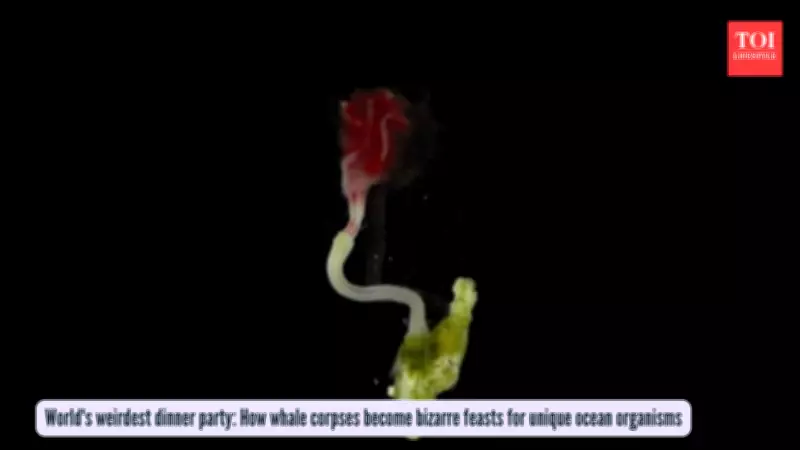
Once the soft tissues have been consumed, a second wave of specialized organisms arrives to exploit the remaining resources. The most remarkable of these are Osedax worms, nicknamed "bone-eating snot-flowers" for their unusual appearance and feeding strategy.
These bizarre creatures swarm the whale bones, injecting acid to liquefy the hard material through symbiotic bacteria living within their tissues. Their feathery plumes extend into the water to capture oxygen while their root-like structures dissolve collagen and lipids directly from the bone matrix.
As Greg Rouse explains in a BBC report, "It's like they're putting their gut inside the bone and absorbing it directly—quite strange." Thousands of these worms can inhabit a single whale skeleton for up to a decade, with their larvae drifting through ocean currents to colonize new whale falls. The softened bones then attract other organisms including deep-sea crabs that pick at the remaining scraps.
Sulphur-Loving Symbiotic Communities: The Final Stage
The decomposition process enters its longest phase—the "sulphophilic stage"—which can persist for up to 50 years. During this period, specialized bacteria break down remaining lipids into hydrogen sulfide, creating chemical energy that supports chemosynthetic microbes. These microbes, in turn, live symbiotically with various host organisms including:

- Tube worms that form dense colonies around the enriched sediments
- Clams and mussels that filter nutrients from the water
- Various polychaete worms and molluscs that thrive in the chemically-rich environment
Adrian Glover expresses continued amazement at these adaptations: "The ability of organisms to evolve to exploit these remarkable, weird, amazing adaptations to these unusual environments... we're constantly surprised."
Ecological Significance: Stepping Stones of the Deep
Whale falls serve as crucial ecological stepping stones in the deep ocean, connecting disparate habitats like hydrothermal vents, cold seeps, and wood falls. These carcass ecosystems facilitate species dispersal across vast distances of otherwise barren seafloor, creating biodiversity corridors in the deep sea.
In both life and death, whales nourish ocean ecosystems through multiple mechanisms. While alive, they transport nutrients vertically through the water column during their feeding and migration cycles. After death, their massive bodies create localized biodiversity hotspots that sustain complex communities for decades. Additionally, whale falls contribute significantly to carbon sequestration, locking away atmospheric carbon in deep-sea sediments for centuries.
This remarkable transformation—from ocean giants to deep-sea gardens—reveals the intricate connections within marine ecosystems and demonstrates how nature efficiently recycles even the largest organisms into new life, creating vibrant communities in the planet's most inaccessible environments.