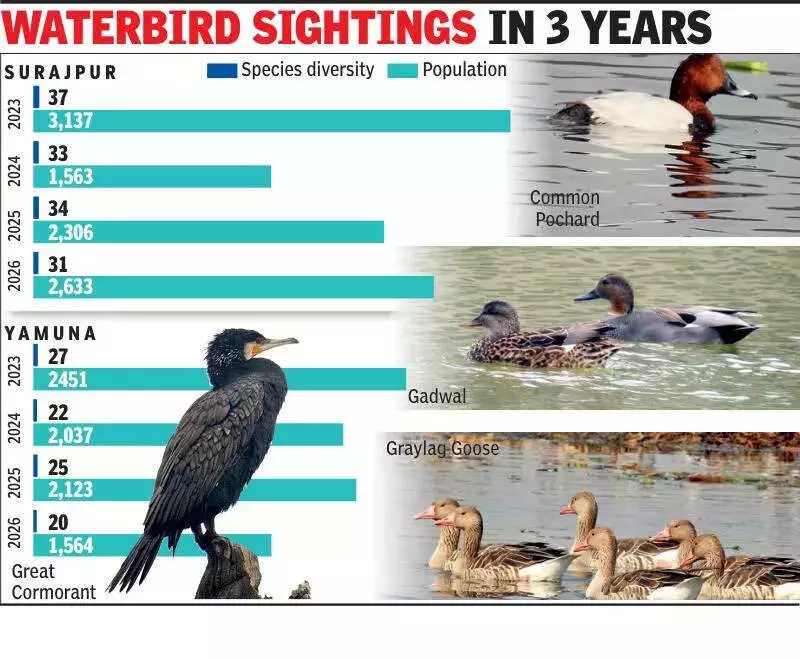
The latest Asian Waterbird Census has delivered alarming news for the National Capital Region's ecology. The 2026 survey indicates a significant and worrying decrease in both the number and diversity of waterbirds across key wetlands in the area, pointing to severe environmental stress.
Concerning Numbers from Key Wetlands
The data reveals a stark contrast compared to just three years ago. At the Surajpur Wetland in Greater Noida, the census team recorded only 2,633 birds from 31 species this year. This is a notable drop from the 3,137 birds from 37 species observed in 2023.
The situation is even more dire at the Yamuna riverine wetland. Here, the count fell drastically to 1,564 birds belonging to 20 species. In 2023, the same area hosted 2,451 birds from 27 different species.

Expert Analysis Points to Human Causes
The census, which is part of the International Waterbird Census spanning 27 Asian and Australasian countries, was conducted over two weeks in January and February. This year marked its 40th edition. Birders and IUCN field staff carried out the survey at the two sites under the supervision of TK Roy, the Delhi state coordinator for the census.
Roy identified multiple human-induced factors behind the decline. At Surajpur, he cited growing human intervention and poor management of the reserve forest as primary reasons. One stream feeding the wetland was diverted for local use, causing it to dry up. Although the forest department later opened a new channel on expert advice, it is now heavily polluted.
"The polluted water interferes with the food base of birds. Moreover, opening it for tourists and visitors deprives the birds of the serenity and peace they look for," Roy explained.
Migratory Patterns Disrupted, Habitats Degraded
The census also noted disrupted migration patterns. Except for Greylag Geese, all other winter migratory species arrived late this year, and their overall numbers were lower. Roy attributed this to a delayed monsoon and the late onset of winter, which only began by mid-December.
Disturbance from tourism had a direct impact, with a large flock of Bar-headed Geese leaving Surajpur due to the unfavourable habitat conditions. The plight of the Yamuna wetland is directly linked to pollution. Roy stated that the river is "gradually dying" due to 21 drains discharging chemicals and sewage into it.
"No fish or aquatic creatures can survive in that highly polluted water, and eventually the birds have nothing to feed on," he added.
A Mixed Bag Within the Data
Of the 31 species found at Surajpur this year, 16 were winter migrants and 15 were resident species. The data showed some increases for certain long-distance migrants compared to 2025:
- Northern Shoveller: 404 (up from 123)
- Northern Pintail: 295 (up from 40)
- Common Teal: 238 (up from 185)
However, these gains were offset by steep declines in other key species:
- Bar-headed Geese: 21 (down from 150)
- Greylag Geese: 834 (down from 981)
- Common Coot: 63 (down from 127)
The overall trend remains negative, underscoring an urgent need for targeted conservation action to protect these critical avian habitats from further degradation.