

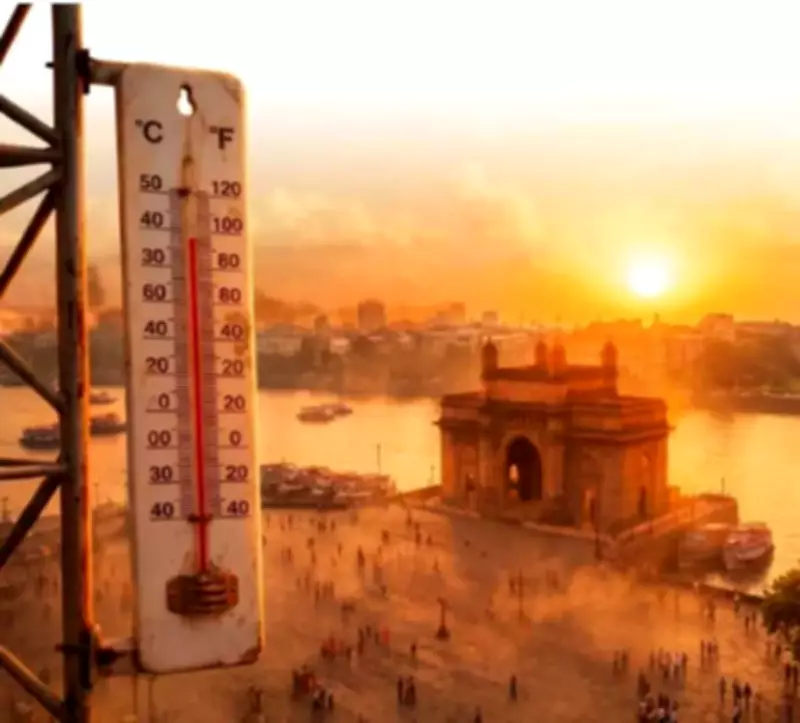
Mumbai is experiencing a significant increase in both hot days and warm nights, driven by a combination of global warming and urbanisation. However, warm nights have risen much more sharply, according to an analysis of India Meteorological Department (IMD) data by the Council on Energy, Environment and Water (CEEW).
Rise in Unusually Warm Nights
The number of ‘unusually warm nights’ in a year more than doubled from an average of 12 nights in the period 1981–2010 to 26 nights in 2011–2024, the CEEW analysis revealed. Unusually hot days also increased, but at a slower pace, rising from an average of 12 days per year to 18 days per year over the same period. An unusually hot day or warm night is defined as a day or night when local temperatures exceed those recorded on 90% of days or nights during the baseline period of 1981–2010.
Implications for Health and Productivity
This trend has serious implications for the health and productivity of Mumbai's residents. Vishwas Chitale, an analyst at CEEW, explained, “Poor nighttime cooling disrupts sleep and recovery, especially for people doing physically demanding outdoor work.” In coastal cities like Mumbai, high humidity makes it even harder for the body to cool itself through sweating. “Warmer nights prevent recovery from intense daytime heat, increasing the risk of heat exhaustion and heat stroke while worsening conditions such as diabetes and hypertension,” Chitale added.

Global and Local Factors
Globally, temperatures are rising due to greenhouse-gas emissions from burning coal, oil, and gas. India’s mean temperature has increased by about 0.9°C since 1901. Urbanisation amplifies this warming through the ‘urban heat island’ effect, where asphalt and concrete trap heat during the day and release it at night. Across India, the rise in warm nights has been greatest in densely populated districts housing tier 1 and tier 2 cities like Mumbai, Delhi, Chennai, and Jaipur, according to CEEW.
Seasonal Trends
The analysis also reveals a seasonal trend for Mumbai. While minimum temperatures rose across all seasons, the increase was sharpest in the post-monsoon months from October to December. In summer, average minimum temperatures rose by around 0.5°C in 2011-2024 compared to 1981-2010, similar to the daytime maximum increase of 0.4°C. However, in the post-monsoon months, average minimum temperatures rose much more sharply — by 0.8°C, compared to a 0.1°C rise in daytime maximum.
Several reasons could explain this. “Global climate science shows that warming is often more pronounced during colder periods and in cooler regions, a pattern that is also emerging in India,” said Chitale. Post-monsoon humidity may also play a role, along with urbanisation. “After the monsoon, the atmosphere retains significant moisture, and water vapour traps outgoing heat during the night, reducing cooling,” he explained. Climate scientist Raghu Murtugudde added that changes in monsoon withdrawal and lingering south-westerly winds are increasing humidity in October, affecting nighttime temperatures.
Consistency with National Trends
The Mumbai findings are based on district-level IMD temperature records available through CRAVIS, a climate-data platform recently launched by CEEW. The local trends are consistent with national ones, according to experts. “A lot of previous research has shown that hot night trends are increasing over India from 1975 onwards with recent years showing a higher rate of increase,” said Chandni Singh, a climate researcher at the Indian Institute of Human Settlements. A 2018 study from IIT-Gandhinagar found hot day and hot night events across India increasing between 1975-2015, with hot nights increasing faster. Most projections for the future similarly point to much warmer nights, Singh said.
Future Projections for Mumbai
CEEW’s projections for Mumbai show that even in a moderate global warming scenario, unusually warm nights could almost double from 26 nights per year today to 48 to 49 nights per year by 2031-2050. Meanwhile, the number of unusually hot days would remain more stable, according to these projections.

Solutions and Recommendations
The trends also point to potential solutions. The main lesson, said Chitale, is that “heat risk is not driven only by daytime temperatures, but also by warm nights, humidity, land-use change, and local socio-economic vulnerabilities”. To reduce heat, experts said cities should implement a range of measures from short-term protections for outdoor workers to long-term expansion of green cover and water bodies, often called “blue and green infrastructure”.
Studies have shown that Mumbai neighbourhoods with more green cover are as much as 10°C cooler than those without. Green spaces are especially important for low-income communities who cannot afford air conditioning. In fact, Singh noted, “access to green cover might just be as important to heat management as PDS is to food security — it has to be accessible to the poorest in our cities”.





