The Overlooked Cooling Power of Volcanic Eruptions
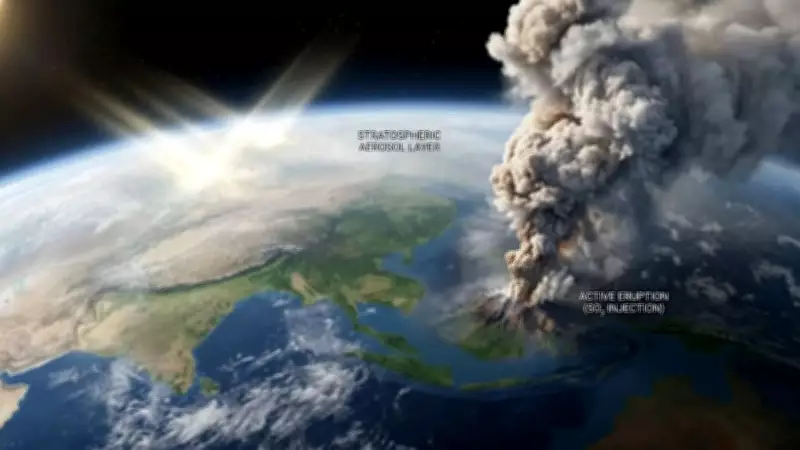
While volcanic eruptions are often associated with destructive lava flows and immediate environmental damage, their ability to cool the Earth's climate is a frequently underestimated phenomenon. These explosive events propel vast quantities of volatiles and tephra into the atmosphere, releasing significant amounts of sulfur dioxide gas. This gas plays a crucial role in altering global temperatures over extended periods.
The Science Behind Volcanic Cooling
When sulfur dioxide enters the upper atmosphere, specifically the stratosphere, it undergoes a chemical transformation. It converts into extremely small, liquid droplets of sulfuric acid. These microscopic aerosols act as a stratospheric mirror, effectively increasing the Earth's albedo—the planet's reflectivity to solar radiation.
Key Mechanism: The tiny sulfuric acid droplets reflect the sun's energy back into outer space. This solar reflection results in an overall reduction in the Earth's surface temperature, a phenomenon known as the parasol effect. Unlike volcanic ash, which is heavier and settles to the ground within days or weeks, sulfur dioxide-derived aerosols can remain suspended in the atmosphere for several years, forming a persistent haze layer that enhances solar reflectivity.

Historical Examples of Volcanic Cooling
Mount Pinatubo (1991): The eruption of Mount Pinatubo in the Philippines served as a pivotal case study for scientists. It injected approximately 15–20 million tons of sulfur dioxide into the stratosphere, which spread globally and acted as an effective blocking agent for solar radiation. According to NASA Earth Observatory, this led to a measurable decrease in the average global temperature by about 0.5 degrees Celsius from 1992 to 1993. This event highlighted how natural aerosols help maintain the Earth's complex thermal balance and demonstrated the utility of satellite data in quantifying solar energy blockage from volcanic activity.
Mount Tambora (1815): The eruption of Mount Tambora in Indonesia represents the most dramatic instance of volcanic cooling in recorded history. The aerosols produced were sufficient to create 'volcanic winter' conditions worldwide, leading to the 'Year Without a Summer' in the Northern Hemisphere in 1816, as noted by the National Oceanic and Atmospheric Administration (NOAA). Climate shifts included frost and snow in July in New England and icy rains in Europe. The resulting temperature drop caused widespread crop failures and livestock deaths across North America and Europe, underscoring the devastating impacts on human civilization and agriculture alongside the scientific interest.
Why Volcanic Cooling Cannot Counteract Greenhouse Warming
It is essential to contextualize the cooling effects of volcanoes within the broader climate change narrative. While volcanoes do emit carbon dioxide, the amount is negligible compared to human activities. A study published in Climate indicates that annual carbon dioxide emissions from all volcanoes range from 0.13 to 0.44 gigatons, whereas industrial emissions from humans surpass this in just a few days to weeks.
Limitations: The cooling effect from sulfate aerosol emissions typically lasts only 1-3 years on average before the particles are washed out of the atmosphere through precipitation. Consequently, this temporary cooling cannot offset the long-term warming driven by the accumulation of greenhouse gases from anthropogenic sources. Thus, while volcanoes provide valuable insights into natural climate processes, they are not a solution to global warming.
Implications for Climate Science
Understanding volcanic cooling mechanisms enhances our grasp of Earth's climate system. It illustrates how natural events can induce significant temperature variations, offering parallels and contrasts to human-induced climate change. Researchers continue to study these eruptions to refine climate models and predict future environmental responses.

In summary, volcanoes serve as powerful natural agents of climate modulation through sulfur dioxide emissions, with historical eruptions like Pinatubo and Tambora providing clear evidence of their cooling capabilities. However, their transient effects highlight the urgency of addressing persistent greenhouse gas emissions to mitigate long-term global warming.