

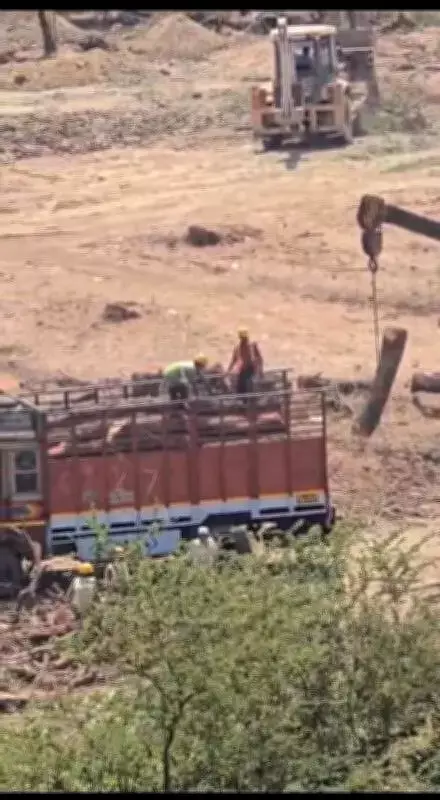
Massive Tree Felling at Vikhroli Hillside Sparks Outcry Among Environmentalists
In a shocking development that has left nature lovers deeply concerned, the large-scale cutting of trees at the Godrej Garden on the Vikhroli (West) hillside in Mumbai has triggered urgent calls for intervention. Environmental activists are demanding that the Brihanmumbai Municipal Corporation (BMC) immediately stop further axing and launch a thorough inquiry into what they describe as severe green damage.
Government Permission and Environmental Impact
According to government sources, a construction firm has received official permission to cut over 180 trees and transplant an additional 920 others as part of developmental works in the area. However, environmentalists have raised alarms, alleging that since April 1, approximately 50 large trees—some of which are over 60 years old—have already been chopped down along the route leading towards Kailash Complex and Hiranandani.
D Stalin, an environmentalist from the NGO Vanashakti, emphasized the gravity of the situation. "A formal complaint has been lodged with BMC's N ward office and also with the local police, since over 1,000 trees will be impacted at the Vikhroli hillside," he stated. "This is a sad reflection of how development prevails over trees." As the complaint was filed recently, BMC officials have not yet provided their feedback on the matter.

Criticism of Development Practices
Stalin further expressed his dismay, highlighting broader issues with Mumbai's urban planning. "It is really sad to see Mumbai lose its green cover to so-called developmental activities," he remarked. "Both infrastructure projects of the government and construction projects of private developers are stripping away Mumbai's tree cover." He suggested alternative approaches, such as providing Transfer of Development Rights (TDR) to land owners for use in non-ecologically sensitive areas of the Mumbai Metropolitan Region, rather than removing trees.
He warned of dire consequences if such practices continue unchecked. "At this rate, Mumbai's temperatures will keep shooting up. We need to protect every single tree standing in Mumbai," he asserted. Stalin also criticized the concept of compensatory afforestation, calling it "humbug" and claiming that an independent audit would reveal an 85% failure rate in transplantation efforts. "Sadly, the greed to make profits has made people forget their connection with nature," he added.
Call for Public Participation and Sustainable Planning
Activist B N Kumar of the NatConnect Foundation echoed these concerns, stressing the need for community involvement in decision-making processes. "While the permission to cut or transplant trees has already been given, the suggestions and objections of the local residents should also be taken," he insisted. Kumar pointed out that Mumbai appears to be on a "hectic tree-cutting and mangrove-cutting spree," which exacerbates the city's already critical green cover deficit.
Kumar provided stark statistics to underscore the urgency of the issue. "Mumbai's per capita tree cover is abysmally low—about one tree for every four persons—against a global benchmark of three trees per person," he explained. He advocated for the adoption of the 3-30-300 rule by urban planners, which calls for:
- Every resident to see at least three trees from their home.
- Living in a neighbourhood with a minimum 30% tree canopy cover.
- Having access to a green space within 300 metres.
Broader Implications and Heritage Loss
Nature lovers have expressed fears that once trees are removed and the ground is covered with concrete, developers might rebrand the areas with fancy names like "green view" or "urban forest" to mask the environmental degradation. They argue that Mumbai's natural heritage is being systematically decimated, with little being done to preserve it.
This incident highlights a growing tension between urban development and environmental conservation in one of India's most populous cities. As Mumbai continues to expand, the balance between progress and sustainability remains a critical challenge for policymakers, developers, and citizens alike.






