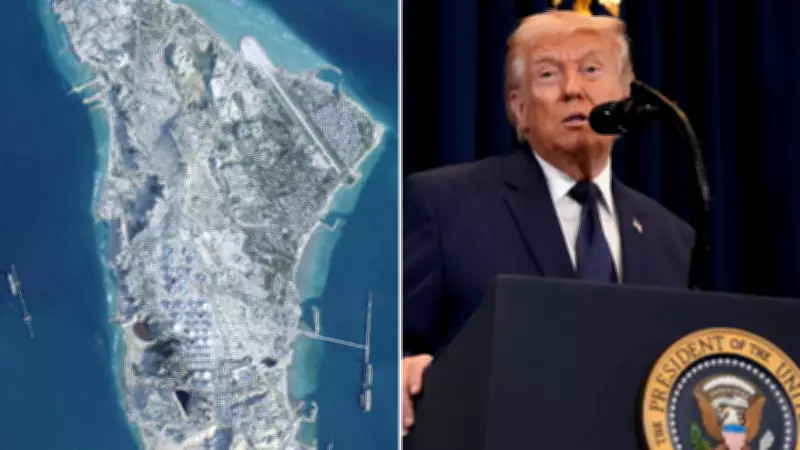
US Launches Strikes on Iran's Kharg Island, Escalating Regional Tensions
In a significant escalation of hostilities, US President Donald Trump declared on Saturday that American forces had executed targeted strikes on Iran's pivotal oil export hub at Kharg Island. The operation, as described by the president, focused on critical military installations linked to Iran's energy sector, though it deliberately avoided direct hits on the oil infrastructure itself. Trump emphasized that this action was a strategic move to address what he termed a "cancer threatening us all," while issuing a stark warning that future interference by Iran in shipping through the Strait of Hormuz could lead to the destruction of its energy facilities.
Strategic Importance of Kharg Island in Iran's Economy
Kharg Island, situated approximately 30 kilometers off the Iranian mainland in the Persian Gulf near Bushehr, serves as Iran's economic lifeline. Despite its modest size of about eight kilometers in length, the island handles an astonishing 90 percent of Iran's crude oil exports. Oil from major offshore fields, including Aboozar, Forouzan, and Dorood, is transported via subsea pipelines to Kharg, where it is stored and loaded onto supertankers primarily destined for Asian markets. The island's deep-water surroundings make it uniquely suited for this role, unlike many shallow Gulf ports.
Over decades, Iran has developed Kharg into one of the world's largest oil terminals, with a peak capacity of up to seven million barrels per day. Current exports, however, hover around 1.6 million barrels daily. This concentration of export infrastructure renders the island a critical vulnerability; any sustained disruption could severely cripple Iran's oil revenues, which are essential for funding key institutions like the Islamic Revolutionary Guard Corps and supporting the national economy.

US and Israeli Calculations in Avoiding Direct Oil Infrastructure Strikes
Historically, the United States and Israel have refrained from directly attacking Kharg Island's oil infrastructure due to the profound economic and geopolitical repercussions. Energy analysts caution that targeting these facilities would instantly halt most of Iran's crude exports, potentially provoking a severe retaliation. Iran has already demonstrated its capability to disrupt maritime traffic in the Strait of Hormuz, through which about one-fifth of the world's traded oil and liquefied natural gas passes, via recent missile and drone attacks.
Tehran has repeatedly issued warnings that any damage to its oil infrastructure would trigger an "eye for an eye" response, possibly including assaults on energy facilities in neighboring Gulf states. This risk explains why the latest US strikes were limited to military installations on the island. Trump acknowledged this strategic calculation, stating that he had chosen not to destroy the energy infrastructure to avoid broader conflict escalation.
Historical and Military Significance of Kharg Island
Beyond its economic role, Kharg Island holds considerable military and historical value. Heavily fortified and guarded by Iran's Revolutionary Guards, the island has been a coveted asset for centuries. European powers, such as the Portuguese and Dutch, once sought control over it due to its strategic position along historic Gulf trade routes. During the Iran-Iraq War in the 1980s, Iraqi forces repeatedly bombed Kharg in efforts to cripple Iran's oil exports, though the facilities were later rebuilt and expanded.
Today, the island remains a tightly controlled zone with limited civilian presence, dominated by oil terminals, pipelines, and military installations. The recent strikes underscore its ongoing significance in regional conflicts and global energy dynamics.
Iran's Response and Regional Implications
Following the US announcement, Iranian officials issued a stark warning, indicating that any further attacks could lead to the destruction of oil and energy infrastructure across the region. This threat comes amid rising tensions between Washington and Tehran, fueled by a series of military exchanges in recent days. The situation is further complicated by reports of two Indian nationals killed and ten injured in an Iranian drone attack in Oman, highlighting the broader humanitarian impact of the conflict.

As the standoff intensifies, the international community watches closely, concerned about potential disruptions to global oil supplies and the stability of the Persian Gulf. The US strikes on Kharg Island mark a critical juncture in this ongoing geopolitical struggle, with implications for energy markets and regional security worldwide.