

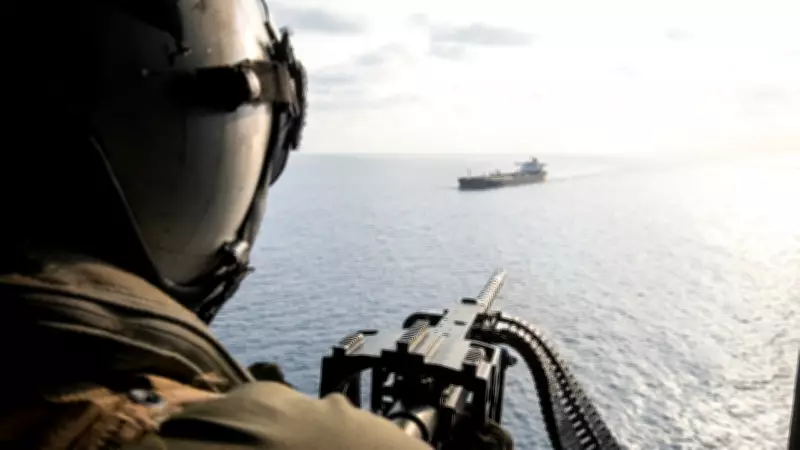
US Helicopter Gunner Issues Stern Warning to Cargo Ship Near Iranian Ports
The United States military has released dramatic footage showing a machine gunner aboard a helicopter issuing a forceful radio warning to a cargo vessel detected near Iranian ports. This incident occurred as US forces continue to enforce a stringent maritime blockade amid rapidly escalating tensions with Iran.
Video Footage Reveals Tense Confrontation
The video, shared by United States Central Command (CENTCOM) on social media platform X, captures a US serviceman aiming a heavy-calibre machine gun from the helicopter while delivering a clear message to the vessel. The radio warning stated, "This is United States Warship 115. You are entering an area of a military blockade. This blockade of Iranian ports will be enforced and applies to all vessels regardless of flag."
The warning continued with an explicit threat: "Any vessel with further intent to enter or exit an Iranian port will be subject to the right of visit and search in accordance with international law. If you attempt to run [from] the blockade we will compel compliance with force. Over."

27 Vessels Directed to Turn Around
According to CENTCOM, US forces have directed a total of 27 vessels to either turn around or return to Iranian ports since the blockade of ships entering or exiting Iranian coastal areas began. This enforcement action highlights the military's determination to restrict maritime traffic in the region.
Strait of Hormuz Traffic Severely Disrupted
The release of this military footage coincides with significant disruptions to maritime traffic in the strategically vital Strait of Hormuz. Vessel tracking data cited by international news agencies indicates that shipping through this narrow chokepoint has become increasingly restricted, with both the United States and Iran enforcing separate blockades that have complicated commercial movement throughout the Gulf region.
Iran had briefly announced the reopening of this critical waterway, but the United States maintained restrictions on vessels bound to or from Iranian ports. During this brief opening, dozens of ships transited the strait before Tehran later warned that any approaching vessel would be treated as a target and reclosed the passage.
Minimal Ship Movement Through Critical Corridor
Since the reclosure, only a handful of ships have managed to cross the Strait of Hormuz. Marine tracking firm Kpler reported that just four vessels had passed through in either direction since Sunday. Among these was the Iranian-flagged Nova Crest, which is sanctioned by the United States and was observed leaving the Gulf and continuing through the Gulf of Oman.
The US enforcement of the blockade has typically been applied when vessels approach Iran's maritime boundary near Pakistan. Several ships, including tankers and container vessels tracked in the region, have reportedly been ordered to alter course or return.
Iranian Response and Escalating Tensions
Iran has simultaneously moved to assert control over the strait, with incidents involving vessels flagged by different countries adding to tensions in this busy shipping lane. Some ships have reported damage or been forced to change course amid the ongoing disruptions.
Tracking data indicates that hundreds of commercial vessels remain active in the Gulf despite these restrictions, underscoring continued but constrained traffic through one of the world's most critical energy corridors.
US Marines Board Iranian-Flagged Vessel
In a related development, United States Central Command also released footage showing a maritime operation in which US Marines boarded the Iranian-flagged container vessel Touska in the Gulf of Oman. The video, shared by CENTCOM on X, shows Marines launching from the USS Tripoli, an amphibious assault ship, and approaching the vessel by helicopter before fast-roping onto its deck to carry out the boarding operation.
The footage captures the tactical sequence as personnel descend from the aircraft and secure access to the ship, occurring amid heightened monitoring of commercial shipping lanes in the region.

Iran Accuses US of Maritime Piracy
Iran's Hazrat Khatam al-Anbiya military headquarters later confirmed this incident, describing it as an attack on an Iranian commercial vessel in the Sea of Oman. Tehran accused the United States of "violating the ceasefire and committing maritime piracy" by firing on the ship and "disabling its navigation system by deploying several of its terrorist marines on the deck," while confirming that the vessel had been seized.
Following this incident, the Iranian military issued a warning of retaliation, stating, "We warn that the Armed Forces of the Islamic Republic of Iran will soon respond to and retaliate against this armed piracy by the US military." This statement further escalates tensions between the two countries, which have been in conflict since February 28 and are currently under a fragile ceasefire.
The situation in the Gulf region remains volatile as both nations continue to enforce maritime restrictions that significantly impact global shipping through one of the world's most important strategic waterways.





