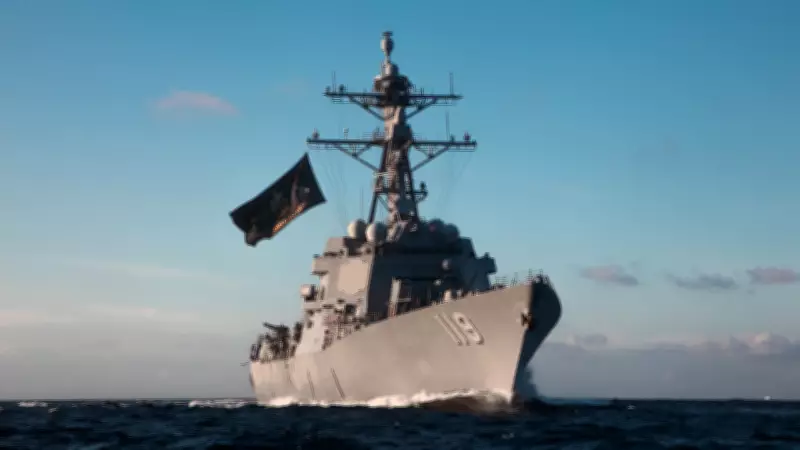
The United States Navy has significantly enhanced its military presence in the Middle East with the deployment of an additional warship, as confirmed by a US official to Reuters on Thursday. This strategic move occurs during a substantial military buildup in the region, driven by escalating tensions and diplomatic pressures.
Increased Naval Strength in the Region
An official, speaking anonymously, revealed that the USS Delbert D. Black entered the Middle East within the past 48 hours. This deployment raises the total number of destroyers in the area to six, complementing an existing aircraft carrier and three other littoral combat ships. The expansion underscores the US's commitment to maintaining a robust naval force in the volatile region.
Trump's Warning and Diplomatic Calls
This development came just a day after US President Donald Trump announced that a "massive Armada" was heading toward Iran. In a statement, he emphasized its capabilities, saying, "It is moving quickly, with great power, enthusiasm, and purpose. It is a larger fleet, headed by the great Aircraft Carrier Abraham Lincoln, than that sent to Venezuela. Like with Venezuela, it is ready, willing, and able to rapidly fulfill its mission, with speed and violence, if necessary."

Trump further urged Iran to negotiate, stating, "Hopefully Iran will quickly 'Come to the Table' and negotiate a fair and equitable deal - NO NUCLEAR WEAPONS - one that is good for all parties. Time is running out, it is truly of the essence! As I told Iran once before, MAKE A DEAL! They didn’t, and there was 'Operation Midnight Hammer,' a major destruction of Iran. The next attack will be far worse! Don’t make that happen again. Thank you for your attention to this matter!"
Military Options and Diplomatic Efforts
According to officials, Trump has not yet approved military action or selected from the options presented by the Pentagon. They indicated that he remains open to a diplomatic solution, acknowledging that publicly signaling the potential for military force is partly intended to push Iran toward negotiations. In recent days, Trump has also been considering whether pursuing regime change in Iran is a realistic option, as reported by The New York Times.
US Demands and Iranian Resistance
However, officials expressed doubt that Tehran would agree to the conditions set by the US. These demands include:
- A permanent halt to all uranium enrichment
- Surrendering existing nuclear stockpiles, starting with over 960 pounds of uranium enriched to near weapons-grade levels
Much of this material is believed to be buried under debris from strikes carried out in June.
The US demands extend beyond nuclear issues to encompass:
- Restrictions on the range and number of Iran's ballistic missiles
- A complete end to its support for proxy groups across the Middle East, including Hamas, Hezbollah, and the Houthis in Yemen
This multifaceted approach highlights the complexity of the ongoing standoff, with military posturing and diplomatic channels both playing crucial roles in the high-stakes geopolitical landscape.