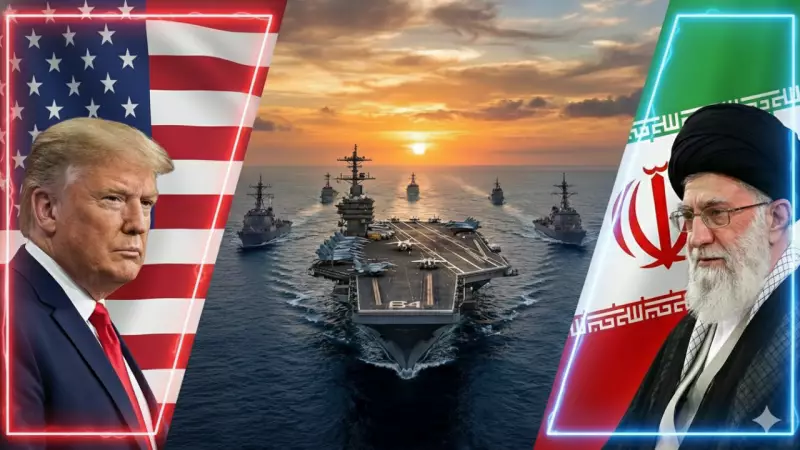
Trump Announces US 'Armada' Deployment to Iran Amid Escalating Tensions
US President Donald Trump has declared that the United States is dispatching a formidable "armada" toward Iran, even as he expressed hope that military action would not be necessary. This statement renews stern warnings to Tehran concerning the violent suppression of protesters and the potential revival of its nuclear programme.
Military Buildup in the Middle East
Trump's remarks were delivered on Thursday as he returned from the World Economic Forum in Davos, Switzerland. They form part of an intensifying standoff triggered by internal unrest in Iran and escalating tensions over its nuclear ambitions.
According to US officials who spoke anonymously to Reuters, the aircraft carrier USS Abraham Lincoln and several guided-missile destroyers are anticipated to arrive in the Middle East within the coming days. Washington is also contemplating deploying additional air-defense systems to safeguard US forces and bases in the region, highlighting a reinforced military posture.

"We have a lot of ships going that direction, just in case … I’d rather not see anything happen, but we’re watching them very closely," Trump informed reporters aboard Air Force One. He emphasized that the deployment aims to deter Iranian actions, adding, "We have an armada. We have a massive fleet heading in that direction. Maybe we won't have to use it. We'll see."
Renewed Nuclear Warnings and Protest Claims
The US President reiterated warnings to Tehran against restarting its nuclear programme, asserting that the US would respond decisively if Iran resumed uranium enrichment activities. "If they try to do it again, they have to go to another area. We'll hit them there too, just as easily," he stated.
Trump also repeated his controversial claim that Iran halted nearly 840 planned executions of protesters following his threats. "I said: 'If you hang those people, you're going to be hit harder than you've ever been hit. It'll make what we did to your Iran nuclear (program) look like peanuts,'" he recounted.
These statements emerge against a backdrop of heightened tensions, fueled by nationwide protests in Iran that erupted in late December over economic grievances. The demonstrations have faced a severe crackdown, with rights groups reporting thousands of fatalities.
Iran's Firm Response and Military Readiness
Iran has responded robustly to the mounting US pressure. General Mohammad Pakpour, commander of Iran’s Islamic Revolutionary Guard Corps (IRGC), cautioned the United States and Israel against "miscalculations," declaring that the Guards have their "finger on the trigger" and are prepared to execute orders from the supreme leader if threatened.
"The Islamic Revolutionary Guard Corps and dear Iran have their finger on the trigger, more prepared than ever, ready to carry out the orders and measures of the supreme commander-in-chief," Pakpour affirmed in a statement cited by state television, as reported by AFP.
Another senior military official, General Ali Abdollahi Aliabadi, head of the Iranian joint command headquarters, warned that any US attack would render "all US interests, bases, and centers of influence" as legitimate targets for Iran's military forces.
Disputed Protest Death Toll Amid Internet Blackout
Iranian authorities released their first official death toll from the recent protests on Wednesday, stating that 3,117 people were killed. The figures, issued by Iran’s foundation for martyrs and veterans, categorize 2,427 as "martyrs"—defined as security forces or innocent bystanders—while labeling others as US-backed "rioters."
President Masoud Pezeshkian remarked on Thursday that protest is "the natural right of citizens," but stressed a distinction must be made between protesters and those "whose hands are stained with the blood of innocent people," according to AFP.
However, rights groups contest these official numbers, suggesting the actual toll could be significantly higher. Iran Human Rights (IHR) has verified at least 3,428 killings, while the US-based Human Rights Activists News Agency (HRANA) documents 4,902 deaths. HRANA also reports at least 26,541 arrests.

Independent verification of the crackdown's scale has been obstructed by a nationwide internet shutdown, now extending over two weeks, as noted by internet monitor Netblocks. IHR director Mahmood Amiry-Moghaddam asserted that emerging evidence indicates the real death toll is "far higher than the official figure," questioning the credibility of the authorities' data.