

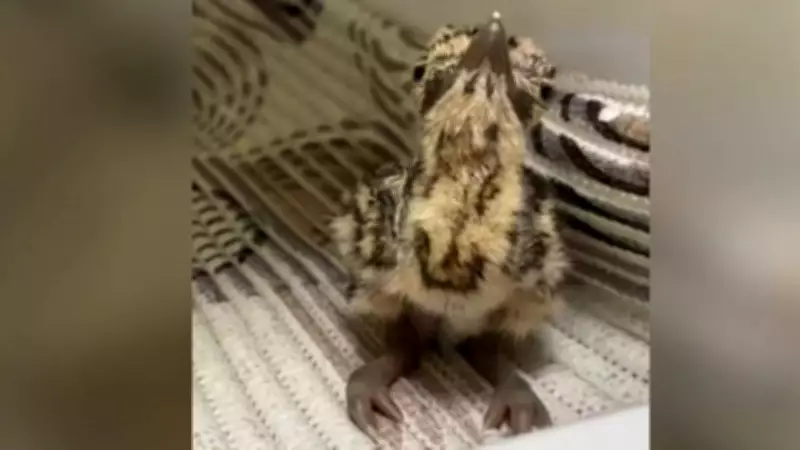
Artificial Insemination Breakthrough Produces Three New Great Indian Bustard Chicks in Jaisalmer
A significant conservation milestone has been achieved at the national level through breeding centers located in Jaisalmer, Rajasthan. Utilizing advanced Artificial Insemination (AI) technology, three new chicks of the critically endangered Great Indian Bustard (GIB) have successfully hatched. This development elevates the total population across these specialized facilities to 76 individuals, marking a crucial step forward in preserving this Schedule I protected species.
Modern Science Fuels Hope for Rajasthan's State Bird
This encouraging news from the arid landscapes of Rajasthan injects renewed optimism for the survival of the state bird, locally revered as Godawan. The population increase is not merely a natural occurrence but a direct result of sophisticated scientific interventions. Specifically, on Wednesday and Saturday, a total of three GIB chicks emerged at two breeding centers managed by the Wildlife Institute of India in Jaisalmer.
This accomplishment stems from persistent efforts under "Project Bustard," a collaborative initiative between the Wildlife Institute of India and the Rajasthan Forest Department. Detailed breakdown reveals that two chicks were born at the Sudashri Godawan Breeding Centre, while one chick arrived at the Ramdevra Godawan Breeding Centre, all through artificial insemination techniques. Consequently, the current counts stand at 52 GIBs at Ramdevra and 24 at Sudashri.

Expert Insights on AI's Role in Conservation
According to Brijmohan Gupta, Deputy Conservator of Forests for the Desert National Park, AI technology has demonstrated exceptional effectiveness in GIB conservation efforts. He emphasized that this method enables reproduction under circumstances where natural breeding is unfeasible, thereby serving as a vital lifeline for a species teetering on the edge of extinction. The Great Indian Bustard is recognized as one of the world's most endangered avian species.
Historically widespread across desert regions of Rajasthan, Gujarat, and Pakistan, its wild population had plummeted to merely a few dozen. In this critical context, the breeding centers in Jaisalmer are authoring a new narrative of success and recovery.
Detailed Birth Records and Parentage
Gupta provided specific details regarding the recent births. On April 1 and 2, three GIB chicks were born at the Ramdevra and Sudashri centers. The sequence of events is as follows:
- On April 1, a chick was born at Ramdevra via artificial insemination, originating from a female GIB named Corena and a male named Parv.
- On April 2, two chicks were born at Sudashri—one from the pairing of Aman (female) and Oran (male), and another from Karki (female) and Suda (male).
Specialized Care and Monitoring Protocols
Suthirto Dutta, the WII GIB expert and coordinator for both breeding centers, confirmed that these AI-born chicks are under continuous observation by a dedicated team. Specialized attention is being directed towards their dietary needs, health parameters, and natural behavioral patterns to ensure they can eventually adapt successfully to wild habitats. This comprehensive approach is emerging as a potential model for conservation efforts not only in Rajasthan but across the entire nation.
Broader Implications for Wildlife Conservation
This achievement holds profound significance within the wildlife conservation domain, showcasing effective collaboration between central and state governmental bodies to rescue a species from oblivion. The success is driven by a coordinated application of expert knowledge, cutting-edge technology, and rigorous scientific methodologies.
Conservation experts identify several primary factors behind the historical decline of GIB populations, including:
- Fatal collisions with high-tension power lines
- Illegal poaching activities
- Adverse shifts in environmental conditions
In response, the Forest Department implemented a strategic plan focusing on protecting the species within controlled environments and promoting scientifically-guided breeding programs.

A Symbol of Renewed Hope and National Pride
These births represent far more than the arrival of three chicks; they symbolize three new rays of hope for biodiversity. The desert sands now resonate with the promise of new life, and the potential resurgence of the Great Indian Bustard stands as a source of pride for Rajasthan and the entire country.
In a related conservation triumph, a successful inter-state effort culminated in the hatching of a Great Indian Bustard chick in Gujarat after a decade-long gap. This followed the transportation of a GIB egg from the Jaisalmer breeding center on March 21, underscoring the expanding scope and collaborative nature of these preservation initiatives.





