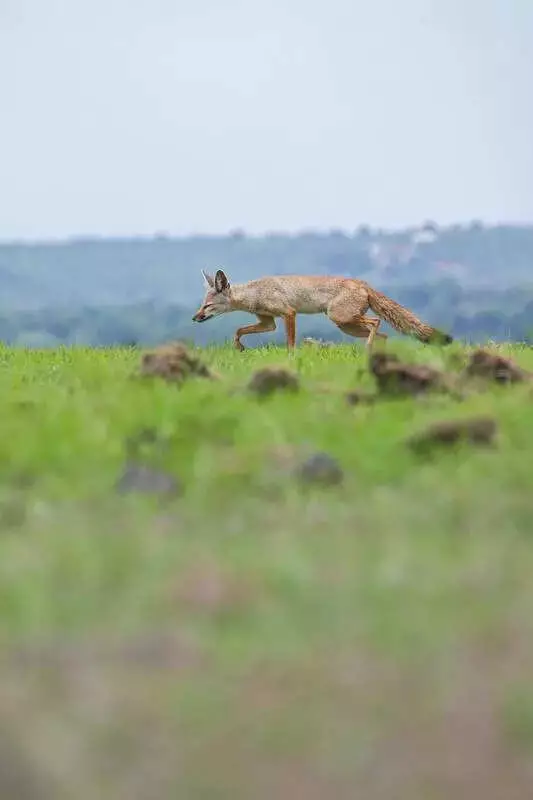
Vast stretches of natural grasslands in Telangana, crucial habitats supporting endangered wildlife like the Indian fox and the blackbuck, continue to exist outside any formal conservation framework. This is despite specific proposals submitted as far back as 2022 to bring them under legal protection.
Proposals Pile Up, But Protection Lags
In Vikarabad district, open landscapes around Ramanathgudapalle, Yenakathala, and grassland tracts near Mominpet were identified by researchers and wildlife groups as priority sites needing immediate conservation. However, no formal protection has been announced by authorities so far. Instead, these ecosystems face relentless pressure from expanding human settlements, quarrying, increasing vehicle movement, and infrastructure projects.
A major hurdle is their official classification. Conservation groups point out that as these areas are recorded as "wastelands" in government records, they can be diverted or altered for non-forest use with minimal scrutiny. Telangana has approximately 12,881 square kilometres of open natural ecosystems, including grasslands and savannas, which is roughly 11.5% of the state's total area.

Alarmingly, about 6,452 sq km of these open systems—over half—has been targeted for tree-based restoration to increase tree cover. Conservationists warn that without a clear policy distinguishing natural grasslands from genuinely degraded land, such schemes risk converting functioning savannas into plantations and scrub, destroying their unique ecological character.
Ramnathgudapalle: A Test Case for Telangana's Future
Against this backdrop, ecologists and local groups have focused on one landscape—the Ramnathgudapalle grassland in Vikarabad—as a critical test case that could decide the fate of open ecosystems across Telangana.
The push for legal protection here began in December 2022, with a proposal submitted to the Vikarabad district collector requesting the habitat be declared a conservation reserve. This was followed by a detailed proposal to the state forest department in February 2023, again seeking reserve status. An all-NGO meeting was also organised that month to build a collective platform for grassland protection.
With no official notification forthcoming, campaigners widened their strategy. In February 2025, they sent representations to the Union Ministry of Environment, Forest and Climate Change (MoEFCC) and to the principal secretary of Telangana's forest and environment department.
Rethinking 'Kanchas': They Are Not Empty Lands
Wildlife ecologist and grassland researcher Pranay Juvvadi identifies the core problem as societal and official perception. "We need to change the way we look at grasslands. We should value these natural open ecosystems as much as we value forests," he says. "They are not empty land parcels. They are not degraded forests. They are ecosystems in their own right."
In Telangana, these open landscapes are popularly known as ‘kanchas’. Pranay notes that Hyderabad once had many such kanchas around the city, but most have vanished. Unlike forests, these systems are shaped and maintained by key ecological processes: fire and grazing by herbivores.
According to Chinnaboina Pradeep Kumar, founder of WildTelangana and VWolves Foundation, the Ramnathgudapalle grassland in Vikarabad covers about 2,100 acres (approximately 8.96 sq km). "This is one of the few remaining large contiguous natural grassland patches in Telangana," he stated. He argues that with formal protection and careful management, this area could support low-impact ecotourism and "grassland safaris", citing successful examples like Blackbuck Resort in Bidar and Velavadar National Park in Gujarat.
Amid intensifying pressures over the past decade, forest officials have begun acknowledging the need to treat grasslands as a distinct category. Principal Chief Conservator of Forests Ch Suvarna told TOI that the Ramnathgudapalle grassland would be brought into the compensatory afforestation land bank for use in future forest land diversion proposals. Suvarna added that measures would be taken to protect and manage grasslands both inside and outside reserve forest areas.