

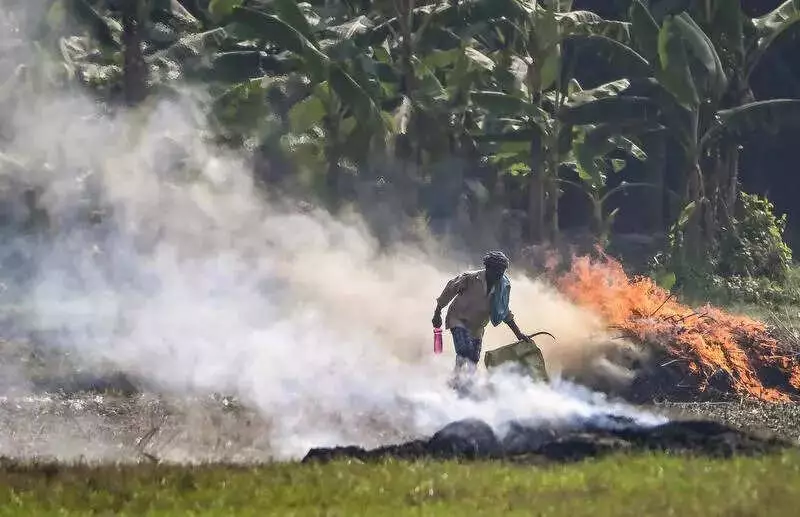
A dramatic and welcome decline in stubble burning cases across Punjab and Haryana this year is being hailed as a significant environmental victory. While the relentless efforts of farmers are rightly praised, data reveals a crucial financial catalyst behind this positive shift: substantial central government funds allocated for crop residue management (CRM) machinery.
Central Funds Fuel the Green Transition
According to data presented in the Lok Sabha by Union Minister for Environment, Forest and Climate Change, Bhupender Yadav, the Centre has released a total of Rs 3,120.2 crore from the 2018-19 financial year until November 17 of this year. This funding was specifically earmarked for farmers and community groups to purchase CRM machines, which help convert paddy and wheat straw into usable bales instead of being set ablaze.
The minister shared these details in response to a question posed by Jalandhar MP Charanjit Singh Channi. The state-wise breakdown shows that Punjab received Rs 1,963.45 crore, while Haryana was allocated Rs 1,156.71 crore over this seven-and-a-half-year period.

Machines on Ground Lead to Fire Reduction
This substantial investment has directly translated into a massive deployment of machinery in the fields. With the central funds, 1,59,194 CRM machines were distributed in Punjab and 1,08,729 in Haryana. The impact of this infrastructure is starkly visible in the fire counts.
Compared to 2022, the two agrarian states have collectively recorded an astonishing 80% to 90% reduction in farm fires. In Punjab, stubble burning incidents plummeted from 49,922 cases in 2022 to just 5,114 this year. Haryana witnessed a similar trend, with cases falling from 3,661 in 2022 to 662 this year, marking an 81% drop.
Addressing Delhi's Air Quality and Machine Utilisation
MP Channi's question also highlighted concerns that despite the reduction in farm fires, Delhi-NCR's Air Quality Index (AQI) had still crossed the severe mark of 450. In his response, Minister Yadav acknowledged that air pollution in the capital region is a complex issue resulting from multiple factors.
He listed high anthropogenic activities in densely populated areas, vehicular and industrial pollution, construction dust, biomass and waste burning, alongside meteorological conditions. Stubble burning in the neighbouring states during winter was identified as an episodic event that significantly aggravates the AQI.
Recognising that the deployment of machines alone is not enough, the government has directed a review of the ground-level utilisation of CRM machines provided through Custom Hiring Centres (CHCs). The focus is now on intensifying efforts for their optimum use during the peak harvesting season.
Furthermore, authorities have been instructed to conduct assessments of paddy stubble supply chains. Flying squads are to inspect thermal power plants, biomass pellet plants, and 2G ethanol plants to ensure proper storage facilities and fix accountability for any inadequacies. This holistic approach aims to create a sustainable system for stubble management beyond just the provision of machinery.






