Forest officials from Pune and surrounding regions have undergone specialized training from South African wildlife experts to combat a severe spike in human-leopard conflicts. This urgent capacity-building initiative follows a series of fatal attacks in the Junnar division and multiple leopard sightings within Pune city limits, highlighting a growing crisis.
Escalating Conflict and Tragic Losses
The Shirur range in the Junnar Forest Division has become a critical flashpoint, witnessing a sharp increase in dangerous encounters. Between October 12 and November 1, three people were killed in separate leopard attacks. The victims included two children: five-year-old Shivanya Bombe on October 12 and 13-year-old Rohan Bombe on November 1. A 70-year-old woman, Bhagubai Jadhav, also lost her life on October 22. Several others were injured in these incidents, which occurred in the villages of Pimparkhed and Jambut.
Public anger over these tragedies boiled over into protests. Villagers from Junnar, Shirur, Ambegaon, and Khed talukas blocked the Belhe–Jejuri Road on October 12 and 22. Following Rohan's death, agitation intensified, leading to a blockade of the Pune Nashik Highway at Manchar on November 3. In a severe act of defiance, an angry mob set fire to a Forest Department patrol vehicle and a local base camp building on November 2, causing significant damage.

International Knowledge Exchange in Pune
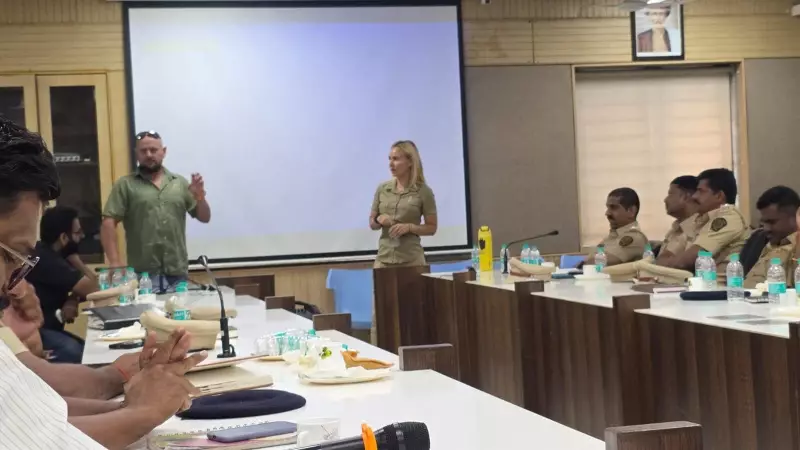
In response to this crisis, the Maharashtra Forest Department, in collaboration with the Resq Charitable Trust, organized a critical training session on December 5 in Pune. The session featured renowned experts from South Africa: Hein Schoeman, a wildlife capture and operations specialist, and Dr. Josephine Skaarup Petersson, a wildlife veterinarian, from the Legacy Wildlife Foundation and VetX.
Over 40 officers from the Sahyadri Tiger Reserve and the forest divisions of Junnar, Pune, and Solapur attended the interactive workshop. These officials are directly responsible for managing forest boundaries and handling complex human-wildlife situations. The experts shared global perspectives on contemporary wildlife management, with a focus on:
- Conflict mitigation strategies
- Advanced population management
- Modern capture techniques
- Practical field applications and welfare safeguards
- Ecosystem-level management approaches
Building Capacity for Future Challenges
The session was marked by high engagement and in-depth technical discussions, reflecting a shift towards science-led wildlife management. Ashish Thakare, Conservator of Forests, Pune Circle, acknowledged the differences between South African and Indian ecosystems but emphasized the value of shared principles. "Mr. Hein and Dr. Josephine shared practical experiences and global perspectives that were relatable to our work here in Maharashtra," he stated.
Tuhin Satarkar, Director of Wildlife Operations at Resq Charitable Trust, highlighted the importance of such cross-border knowledge exchange. "These interactions allow us to build connections that can help address real-world problems, regardless of differences in geography or policy frameworks," he said.
The training comes at a crucial time, as leopard presence has also been reported from Pune city areas like the airport premises, Aundh, Bavdhan, and Pashan-Sutarwadi during November and December. This urban wildlife challenge adds another layer of complexity to the conflict, making the newly acquired skills in population management and capture techniques even more vital for forest personnel on the ground.