

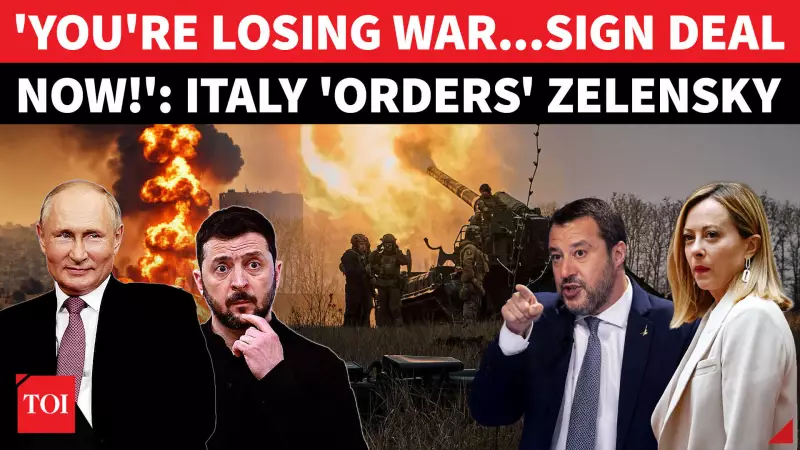
Italian Deputy Prime Minister's Explosive Comments Expose Deepening European Divide Over Ukraine Conflict
In a dramatic escalation of tensions within Europe, Italy's Deputy Prime Minister Matteo Salvini has issued a blunt and controversial demand for Ukrainian President Volodymyr Zelensky to immediately sign a peace agreement, effectively calling for surrender. This explosive statement has revealed significant fractures within Italy's own government and across the European Union regarding continued support for Ukraine's war effort against Russian aggression.
Salvini's "Ungrateful" Accusation and Peace Ultimatum
Matteo Salvini, who serves as Deputy Prime Minister in Giorgia Meloni's government, launched a scathing attack on President Zelensky, accusing him of squandering Western military and financial assistance while prolonging what Salvini characterized as a losing conflict. The Italian leader's remarks represent one of the most direct challenges from within Europe to Ukraine's war strategy and leadership.
The confrontation intensified following Zelensky's recent criticism of the European Union during his appearance at the World Economic Forum in Davos. Italy's Foreign Minister Antonio Tajani subsequently branded Zelensky's comments as "ungrateful," further exposing the growing diplomatic rift between Rome and Kyiv at a critical juncture in the conflict.

Contradictions Within Italy's Ruling Coalition
This internal conflict highlights the complex political dynamics within Italy's ruling coalition. While Salvini has consistently opposed sending weapons to Ukraine, his political party paradoxically voted to extend aid packages to the war-torn nation—though with the crucial stipulation that such assistance be restricted to civilian purposes only.
This contradictory position underscores the delicate balancing act facing Prime Minister Giorgia Meloni's government, which struggles to present a unified front on foreign policy while managing competing political interests within its coalition. The Salvini-Zelensky confrontation has brought these internal tensions to the surface at a particularly sensitive moment for European solidarity.
Broader Implications for European Unity
The escalating debate over Ukraine policy is creating significant challenges for European unity as the conflict enters its fourth year. Several key developments are emerging:
- Growing skepticism among some European political factions about the sustainability of continued military support for Ukraine
- Increasing diplomatic friction between European capitals and Kyiv over war strategy and peace negotiations
- Heightened concerns about the economic impact of prolonged conflict on European economies
- Political divisions within individual EU member states that could influence broader European policy decisions
As Prime Minister Meloni attempts to navigate these turbulent political waters, the Salvini-Zelensky confrontation serves as a stark reminder of the fragile consensus supporting Ukraine within Europe. The incident raises fundamental questions about the future of European assistance and diplomatic relations with Kyiv at a pivotal moment in the conflict's trajectory.
The timing of this diplomatic crisis is particularly significant, coming as European leaders prepare for crucial discussions about continued military and financial support for Ukraine. The Salvini-Zelensky exchange has injected new uncertainty into these deliberations, potentially influencing the European Union's collective approach to the ongoing war and future peace negotiations.






