

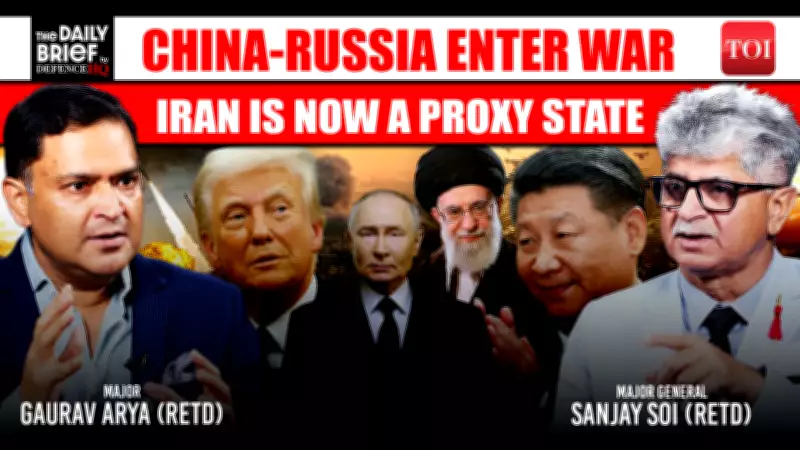
Russia and China's Strategic Moves: Is Iran Becoming Their Proxy in Middle East Conflict?
In a detailed analysis on The Daily Brief by DefenceHQ, Major Gaurav Arya and retired Major General Sanjay Soi examined the intensifying confrontation between the United States and Iran. The discussion focused on the ongoing missile and drone exchanges across the Middle East, raising critical questions about the sustainability of such high-intensity warfare.
Military Stockpiles and Defense Systems Under Strain
The experts explored whether Iran could potentially exhaust its missile arsenal in a prolonged conflict. Continuous strikes are putting significant pressure on both sides' military stockpiles and defense systems. This depletion of resources could fundamentally alter the strategic balance in the region, forcing nations to reconsider their engagement timelines and tactical approaches.
Russia and China's Expanding Role in the Conflict
Major General Sanjay Soi provided crucial insights into the growing involvement of Russia and China in the US-Iran confrontation. Reports indicate that Russian intelligence is actively supporting Iran, potentially providing critical information and strategic guidance. Meanwhile, China appears to be exploring supply routes through regional networks that could sustain Iran's military operations despite international sanctions and blockades.

The analysis suggests that both Moscow and Beijing view the Middle East conflict as an opportunity to challenge American influence while advancing their own geopolitical interests. This triangular relationship creates complex dynamics where Iran might increasingly serve as a proxy through which Russia and China can exert pressure on Washington without direct confrontation.
Iran's Broader Strategic Objectives
The episode further examined Iran's comprehensive strategy that extends beyond immediate military exchanges. Tehran appears focused on:
- Targeting critical energy routes to disrupt global oil supplies
- Raising economic pressure on the United States and its allies
- Increasing American casualties to erode domestic political support for continued engagement
This multi-pronged approach aims to create substantial political and economic costs for Washington while prolonging the conflict to drain US resources and resolve. By engaging in asymmetric warfare and leveraging regional proxies, Iran seeks to offset its conventional military disadvantages against American technological superiority.
The Geopolitical Implications of Extended Conflict
The discussion highlighted how the involvement of Russia and China transforms what might have been a regional confrontation into a broader geopolitical contest. With Moscow providing intelligence support and Beijing potentially facilitating supply routes, Iran gains access to resources that could significantly extend its capacity to wage prolonged warfare.
This development raises fundamental questions about whether Iran is evolving into a strategic proxy for Russian and Chinese interests in the Middle East. As the conflict continues to escalate, the alignment of these major powers could reshape regional alliances and global power dynamics for years to come.






