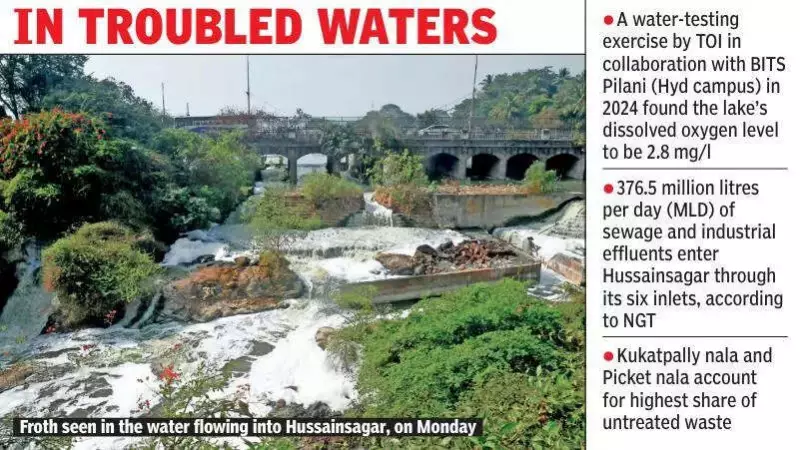
Hyderabad's historic Hussainsagar Lake continues to drown in pollution, with over Rs 1,200 crore spent on its revival over the past two decades failing to yield significant results. Environmentalists and residents allege that untreated sewage and industrial effluents still flow freely into the water body, creating a persistent environmental and public health crisis.
A Lake Choking on Waste
A recent visit to the Tank Bund stretch, from the Marriott Hotel to the GHMC office, revealed a grim sight: froth flowing out of the lake's outlets on both sides. This visual evidence aligns with multiple reports from the pollution control board and the Comptroller and Auditor General (CAG), which have consistently flagged alarmingly low dissolved oxygen (DO) levels in Hussainsagar.
In several instances, DO levels have plummeted below 3 mg/l, rendering the water unfit for any domestic use. Shockingly, some stretches have recorded oxygen levels as low as 0.5 mg/l. For perspective, the United Nations Environment Programme (UNEP) recommends an optimum DO level of 10 mg/l, while India's Central Pollution Control Board prescribes levels above 6 mg/l for healthy water bodies.

Health and Livelihood Impacts Mount
The human cost of this neglect is severe and growing. Residents of bastis along the banks, in areas like Raj Bhavan Road, MS Maqta, and BS Maqta, still depend on the lake for daily needs, even as the stench has become unbearable over the years.
"The smell is so intense that we cannot keep our windows open," said Lakshmi Devi, a homemaker from BS Maqta. "It makes cooking and eating at home a difficult task, and on some days, the odor causes nausea."
Health concerns, especially among children, are skyrocketing. Parents report frequent cases of fever, cough, diarrhea, skin rashes, and recurring stomach infections. "It feels like we are living with poison," said Mohammed Rafiq, a long-time resident and businessman, noting that a child in his lane falls sick almost every week.
A 2024 water-testing exercise conducted in collaboration with BITS Pilani's Hyderabad campus found the lake's dissolved oxygen level at a critically low 2.8 mg/l. "Very little has changed on the ground. The condition has only worsened in my 20 years here," lamented Noorsultana Begum, a daily wage worker from a nearby settlement.
Systemic Failures and Official Response
Environmentalist Subba Rao, who has filed numerous petitions over three decades, points to the Kukatpally nala as a primary culprit. "Industrial waste from here remains a biggest contributor. The constant froth near Necklace Road is a clear sign of failed interception and treatment," he stated.
According to the National Green Tribunal (NGT), a staggering 376.5 million litres per day (MLD) of sewage and industrial effluents enter Hussainsagar through its six inlets. The Kukatpally and Picket nalas are responsible for the largest share of this untreated waste.
Despite more than 100 petitions and complaints filed over the years, accountability appears fragmented. When contacted, GHMC officials stated that lake maintenance falls under the irrigation department's purview. A GHMC lake division official acknowledged the challenge, saying, "Tracking the high-volume sewage inflow is extremely difficult. We need to re-examine the inlets to identify which ones are still letting pollutants in, despite existing diversion channels and treatment plants."
The story of Hussainsagar is now a stark symbol of failed promises and ecological neglect, where massive financial investment has not translated into a cleaner, healthier lake for Hyderabad's citizens.