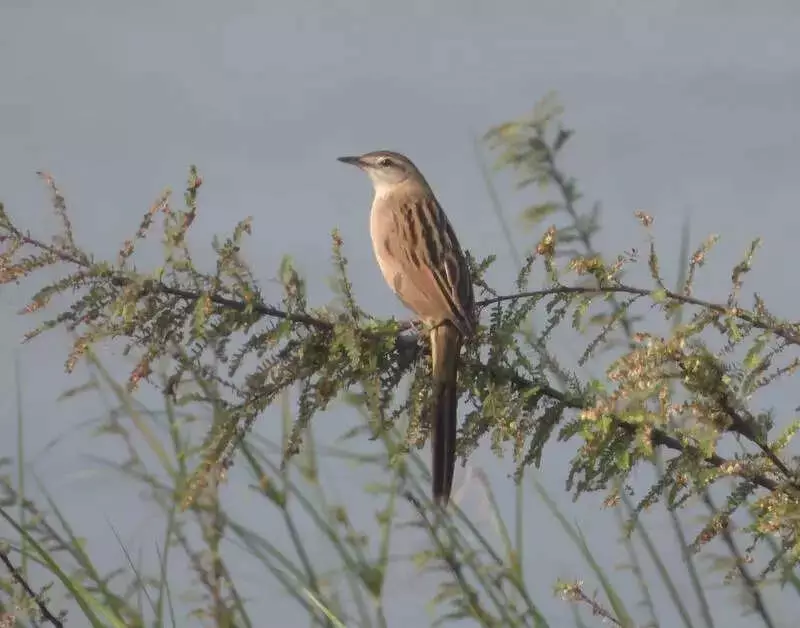
In a significant ornithological discovery, a rare striated grassbird has been documented within the Chaprala Wildlife Sanctuary in Gadchiroli district, Maharashtra. This sighting represents a major range extension for the species in the state and its southernmost known record in India.
A Historic Sighting After a Century
The discovery was made during a two-day citizen science bird survey conducted on November 29 and 30. A team, spearheaded by ornithologists Raju Kasambe and Mangesh Balapure, recorded two individual birds in tall grasses along the banks of the Pranhita River. This finding is exceptionally rare for eastern Maharashtra.
Prior to this, the species had only one earlier documented record from the Tapi basin in Jalgaon district and a single recent sighting reported from Chandrapur on an online platform. The last historical reference for this bird in the broader region dates all the way back to 1923, when E.A. D'Abreau, the then curator of the Central Museum in Nagpur, noted its presence in the former Central Provinces and Berar.

Chaprala Sanctuary Reveals Rich Avian Diversity
Beyond the headline-grabbing grassbird, the survey painted a promising picture of the sanctuary's health. Teams recorded a robust presence of several threatened riverine bird species, including the river lapwing, oriental darter, and black-headed ibis. In total, more than 140 bird species were identified during the event.
The diverse checklist included notable species such as:
- Orange-breasted green pigeon
- Pin-striped tit-babbler
- Forest wagtail
- Indian scops owl
- Brown hawk owl
Birdwatchers from Nagpur and Hyderabad contributed valuable photographic evidence of these key species.
Significance and Future of Exploration
This was the first-ever citizen science bird survey conducted within the Chaprala Wildlife Sanctuary. The sanctuary, spanning 134.78 square kilometres, is managed under the Tadoba-Andhari Tiger Reserve (TATR). It is strategically located between the Pranhita and Wainganga rivers and is known to support a variety of wildlife including tiger, leopard, sloth bear, giant squirrel, four-horned antelope, and Indian tree-shrew.
The initiative was led by Mangesh Balapure under the guidance of TATR Field Director Prabhu Nath Shukla and DFO Sachin Shinde. Field support was provided by RFO Ganesh Landge, with scientific inputs from Raju Kasambe and Anil Mali. Encouraged by the success, officials have confirmed that more seasonal surveys will be organized to comprehensively map the avifaunal diversity of this relatively unexplored ecological landscape.
The documentation of the striated grassbird not only fills a century-old gap in records but also highlights the critical importance of continued scientific exploration and community involvement in understanding and conserving India's rich biodiversity.