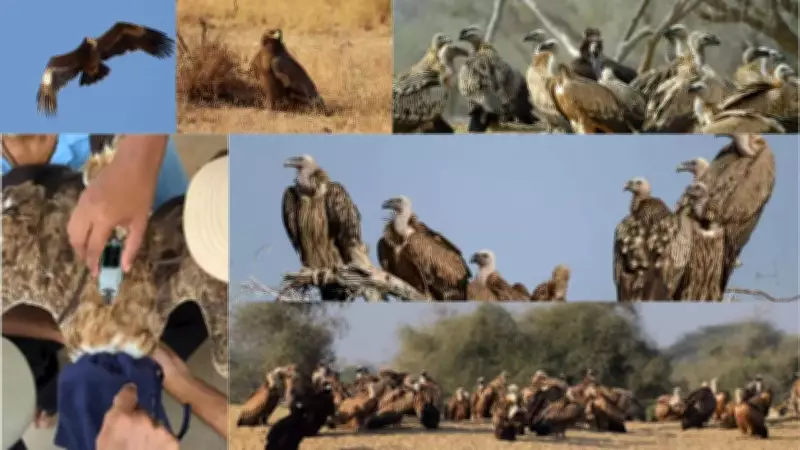
Unprecedented Raptor Presence in Jaisalmer's Desert National Park Sparks Scientific Inquiry
Jaisalmer's Desert National Park is currently experiencing a remarkable and unusual phenomenon: a significant surge in the population of raptors, particularly threatened and Schedule I species such as the Steppe Eagle and various vulture species. This unexpected congregation has been documented not only within the park but also across Jaisalmer and its adjoining border regions, with forest officials reporting a clear and noticeable increase in numbers compared to previous years.
Migratory Delays and Potential Causes Under Investigation
A substantial number of these migratory birds, including Steppe Eagles, have notably failed to return to their native habitats as expected. Researchers and wildlife experts are actively investigating several plausible explanations for this behavioral shift. Primary factors under consideration include the relatively cooler weather conditions resulting from continuous rainfall, the exceptionally favorable habitat conditions within Desert National Park, and potential disruptions to traditional migratory routes caused by ongoing conflicts in Gulf and Middle Eastern regions.
Brajmohan Gupta, Deputy Conservator of Forests at Desert National Park, elaborated on the situation. He stated that the park provides an ideal habitat for these migratory birds, which may be a key reason for their increased presence. "Due to western disturbances, the weather has remained relatively cool, and the availability of food and water is adequate—leading to delays in their return," Gupta explained. He further noted that some vultures did not migrate back last year and have successfully adapted to the park's environment, even establishing nests there.

Thar Raptor Ecology Project: A Comprehensive Conservation Study
Under the ambitious Thar Raptor Ecology Project, researchers from the Wildlife Institute of India (WII) are conducting an in-depth study to investigate the decline in raptor populations in the Thar Desert, specifically around Desert National Park. The project aims to develop targeted conservation measures based on scientific findings.
As part of this critical research effort, experts have deployed advanced tracking technology. To date, they have tagged four vultures with GPS transmitters within the Jaisalmer DNP region. Additionally, researchers have fitted GPS transmitters on two Tawny Eagles (Aquila rapax) and two Egyptian Vultures (Neophron percnopterus). This technology allows scientists to meticulously study movement patterns and habitat use, with the ultimate goal of identifying priority conservation areas for these vulnerable species.
Geopolitical Factors and Altered Migration Patterns
Forest Department officials have highlighted that Steppe Eagles are typically migratory birds that arrive in the region during winter. However, their higher-than-usual presence this year has raised significant questions about potential alterations in their migration patterns. Officials monitoring the situation believe this trend could be linked to external environmental or geopolitical factors affecting traditional migratory routes.
District Forest Officer Devendra Singh Bhati provided further insight. "Field observations and inputs from colleagues indicate a slight increase in the number of Steppe Eagles in the region," he said. Bhati added that many of these birds typically migrate through parts of the Middle East—such as Israel, Iraq, and surrounding regions—which are currently affected by conflict. While not yet confirmed, it is being speculated that disturbances in these areas may be contributing to delays in their migration.
Studying Ecological Competition and Community Engagement
WII researcher Manas Shukla explained the broader scope of the Thar Raptor Ecology Project. The study examines competition at carcass sites within the desert ecosystem to understand how food availability is affected among various scavenger species. The research is primarily centered around Desert National Park, where interactions among different "guilds" are being tracked.
These guilds include:

- Six vulture species: White-rumped, Red-headed, Egyptian, Cinereous, Himalayan Griffon, and Eurasian Griffon.
- Three eagle species: Tawny, Steppe, and Imperial.
- Mammalian scavengers: Wild pigs, white-footed foxes, and free-ranging dogs.
The project aims to comprehend how competition for limited resources influences ecological balance and the broader food chain. As part of the tagging initiative, the study integrates ecological monitoring with proactive community engagement. Camera traps have been strategically installed at carcass sites to observe visitation patterns of raptors and their interactions with other scavengers like migratory vultures, feral dogs, and pigs.
Simultaneously, comprehensive awareness programs are being conducted to encourage local communities to adopt practices that reduce threats to raptors. These initiatives include promoting the use of non-toxic alternatives to harmful NSAIDs in livestock treatment and conserving khejri trees, which serve as crucial nesting sites for these birds.
Overall, the ongoing study in the Jaisalmer desert continues to meticulously examine how competition at carcass sites influences food availability among scavengers, with a primary focus on the delicate ecosystem surrounding Desert National Park. The unusual congregation of raptors presents both a conservation challenge and a unique opportunity for scientific discovery.