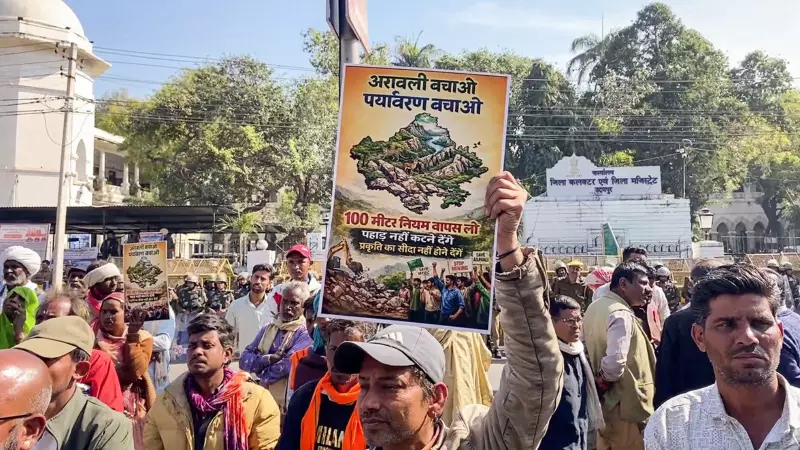
Rajasthan is witnessing a wave of intense public demonstrations as a controversial new legal definition of the ancient Aravalli hills threatens to open up over 90% of the ecologically sensitive range to potential mining and construction activities. The flashpoint has united citizens, activists, and opposition leaders against a move they fear will cause irreversible environmental damage.
Supreme Court Decision Triggers Statewide Outrage
The core of the controversy lies in a November 20 decision by the Supreme Court to accept a new, uniform definition for the Aravalli hills. The definition, recommended by a panel led by the central government, states that only landforms with an elevation of 100 metres or more above the local relief will be considered part of the Aravalli Hills.
This technical shift has massive practical implications. Environmentalists and experts warn that this criteria would leave a staggering more than 90% of the 692-km-long Aravalli range outside the protective legal umbrella. With 550 km of the range situated in Rajasthan, the state stands to be the most affected.

The decision has triggered immediate backlash. On Monday, protests erupted in several cities including Jodhpur, Udaipur, and Sikar, leading to clashes with police. In Jodhpur, police used baton charges and detained several protesters, while in Sikar, agitators scaled the 945-metre Harsh Mountain, a part of the Aravallis, to voice their dissent.
Political Reactions and Assurances
As public anger mounted, Rajasthan Chief Minister Bhajan Lal Sharma sought to calm tensions. Speaking in Jhalawar, he asserted that his government would not allow any tampering with the Aravalli range. He also took a swipe at former CM Ashok Gehlot, who had changed his social media display picture to 'Save Aravali'.
"Merely changing your DP to 'Save Aravali' is not going to do anything on the ground. These are mere theatrics," Sharma said. "We have to work with strong willpower. I assure every one of you that we will not touch the Aravali ranges nor will any illegal mining continue there."
Meanwhile, Union Environment Minister Bhupender Yadav addressed the issue for the second time, clarifying that mining would be permitted in only 0.19% of the Aravalli hills and no new leases would be granted until a detailed study is completed.
Environmentalists Decry 'Death of the Aravalli'
Activists and rights organisations have condemned the move in strong terms. Kavita Srivastava, national president of the People's Union for Civil Liberties (PUCL), urged the state government to file a review petition in the Supreme Court. "...or it will be the death of the Aravali," she told The Indian Express, adding, "There is no way this judgment is acceptable."
Magsaysay award-winning environmentalist Rajendra Singh, in his book 'Aravali Par Naya Sankat', highlighted that defining conservation zones only above 100 metres would be catastrophic. He provided a stark breakdown of the Aravalli landscape:
- Area up to 20 metres: 1,07,494 sq km
- 20-40 metres: 12,081 sq km
- 40-60 metres: 5,009 sq km
- 60-80 metres: 2,656 sq km
- 80-100 metres: 1,594 sq km
- Above 100 metres: Only 1,048 sq km (just 8.7% of total area)
Singh warned that this definition, "in the name of sustainable development of the mining industry, is creating a new threat to our ancient heritage." He recounted the long history of the fight to save the Aravallis since the 1980s, when about 28,000 mines were operational before a successful legal battle virtually made the ranges mining-free by 1993.
The fear is that the new definition will not only devastate the ecology but also severely impact tribal and local communities, whose homes, farms, and cultural sites are predominantly located in areas below the 100-metre threshold.
With the Congress and other opposition parties mobilising public support, including rallies in Jaipur, the protests are expected to intensify in the coming days, setting the stage for a major environmental and political battle in Rajasthan.