

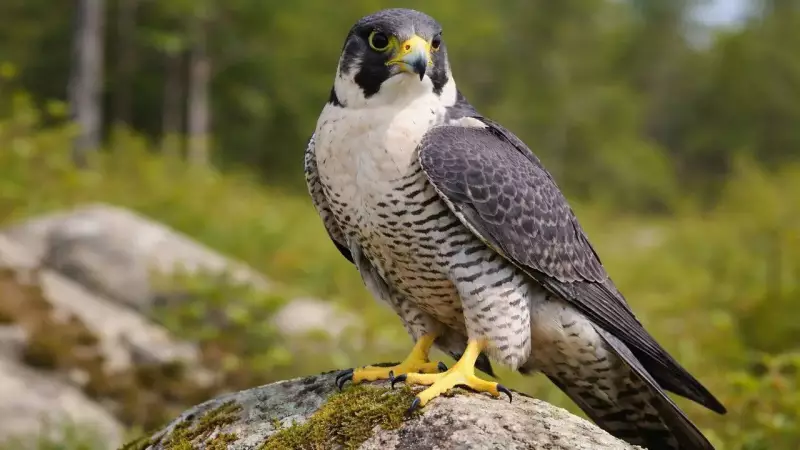
The Peregrine Falcon: Nature's Master of Speed and Precision
One of the most breathtaking spectacles in the natural world is witnessing a peregrine falcon in pursuit of its prey. Initially appearing as a mere speck against the vast sky, this magnificent bird transforms into a blur of motion, descending with astonishing velocity and pinpoint accuracy. Within mere seconds, the falcon accelerates to speeds that rival high-performance sports cars, striking its target before it can even react. This incredible predator is not merely the fastest bird on Earth; it represents the culmination of millions of years of evolutionary refinement, honing its abilities for speed, control, and survival. Scientists and bird enthusiasts alike continue to marvel at the extraordinary capabilities of this aerial hunter.
How the Peregrine Falcon Achieves Speeds Exceeding 300 km/h
In the realm of nature, the peregrine falcon holds an unparalleled title. During its hunting dive, known as a stoop, it can exceed speeds of 300 kilometers per hour. No terrestrial creature, nor even the swiftest marine predators, can match this velocity. The falcon cleverly utilizes gravity as part of its strategy, tucking its wings close to its body and streamlining its form to minimize air resistance. This approach differs significantly from animals that rely solely on muscular power.
This remarkable speed is not merely a display of raw power; it is accompanied by exceptional control. The falcon maneuvers adeptly through the air, adjusting its trajectory and pulling up at the precise moment to deliver a decisive strike. The peregrine's prowess as a hunter stems from its unique combination of rapid movement and surgical accuracy.

The bird's physiology is perfectly adapted for high-speed flight. Its pointed wings reduce drag, while its robust and flexible tail functions as a rudder, enabling sharp turns even at tremendous velocities. Powerful chest muscles facilitate rapid wing beats, and a lightweight yet durable skeleton withstands the intense forces experienced during dives.
Even the falcon's nostrils contribute to its aerodynamic efficiency. Specialized structures within its lungs regulate airflow, protecting the respiratory system from damage at extreme speeds. Its vision is equally impressive, allowing it to spot small birds from hundreds of meters above the ground with remarkable clarity.
Hunting Techniques and Adaptation to Urban Environments
Peregrine falcons primarily prey on other birds, such as pigeons, starlings, and waders. The hunt typically commences high above the ground, where the falcon circles patiently, scanning for movement below. Upon identifying a target, the bird ascends to a greater height before initiating its dive.
The stoop is swift, silent, and highly effective. The falcon strikes its prey mid-air, either killing it instantly or incapacitating it before capturing it during the fall. For the unsuspecting prey, there is little warning; for observers, the event concludes almost as quickly as it begins.
The peregrine falcon is one of the most widespread bird species globally, inhabiting every continent except Antarctica. It thrives in diverse environments, from bustling urban centers to remote coastal cliffs. Interestingly, modern cities have proven beneficial for the species in several ways. Skyscrapers mimic natural cliff faces, and abundant pigeon populations provide a reliable food source.
Consequently, peregrines have become common residents in areas where few would anticipate encountering such a formidable wild predator. They have seamlessly adapted to human-altered landscapes, nesting on bridges, office buildings, and cathedrals while retaining their hunting prowess.
Conservation Efforts That Saved the Peregrine Falcon
Despite its resilience and adaptability, the peregrine falcon faced near extinction in the mid-20th century. Widespread use of the pesticide DDT led to thinning eggshells, resulting in widespread breeding failures. The species vanished entirely from certain regions, and populations collapsed across Europe and North America.

The falcon's recovery is a testament to successful conservation initiatives. The ban on DDT, coupled with dedicated breeding programs and captive rearing efforts, facilitated a gradual resurgence. Today, the bird has reclaimed its status as a common sight in many parts of the world. Many experts regard its comeback as one of the most triumphant conservation stories in history.
The peregrine falcon's allure extends beyond its sheer speed. What truly distinguishes it is the perfect balance of power, precision, and adaptability. It hunts with equal efficacy over wild coastlines and congested city streets, maintaining traditions that span millennia.
Each stoop serves as a reminder that nature often surpasses human engineering. Despite our advancements in supercars and jet aircraft, the peregrine falcon remains the undisputed champion of the open skies, guided solely by instinct, physics, and evolution.





