

Dark Clouds Gather Over the Middle East as Pakistan Faces Strategic Crossroads
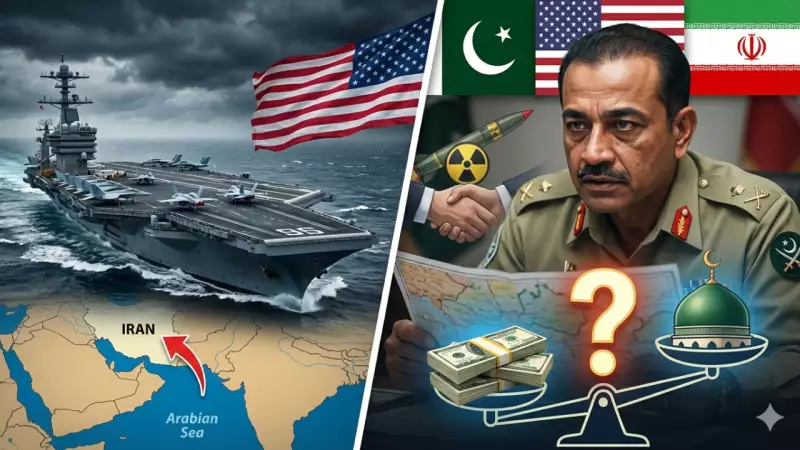
Once again, ominous war clouds are gathering over the arid landscapes of the Middle East. As President Donald Trump's formidable "American Armada"—spearheaded by the USS Abraham Lincoln Carrier Strike Group—cuts through the Arabian Sea toward Iran's coastline, the resulting geopolitical tremors are being felt acutely in Rawalpindi, home to Pakistan's military headquarters. With Tehran's internal crackdown reportedly claiming over 6,000 lives and Trump publicly assuring Iranian protesters that American assistance is imminent, Pakistan finds itself confronting a painfully familiar and blood-stained dilemma at this critical juncture.
The Historical Context: Pakistan's Enduring Strategic Balancing Act
To the international community, Pakistan's current hesitation represents a replay of a decades-old geopolitical script. Since its very foundation, Islamabad has perfected the delicate art of leveraging its strategic geography for Western financial support while simultaneously employing the powerful rhetoric of the "Ummah"—the global Muslim community—to maintain domestic political legitimacy and popular support.
The most telling historical example emerged during the post-9/11 era. Pakistan famously positioned itself as a "Frontline State" for the United States' war in Afghanistan, receiving billions of dollars in Coalition Support Funds (CSF) for facilitating operations against its Muslim neighbor. Yet, in a masterclass of geopolitical duplicity, while Islamabad provided crucial logistical support to Washington, it simultaneously offered sanctuary to Osama bin Laden in Abbottabad—a location situated alarmingly close to its premier military academy. This dual-track strategy enabled Pakistan to maintain financial solvency through American support while preserving its "strategic assets," including elements of the Taliban, to safeguard its long-term regional interests.

The Economic Imperative: Operation Sindoor's Aftermath and the Dollar Pivot
Why is Pakistan so determined to re-engage with the United States at this precarious moment? The answer lies in the complex aftermath of Operation Sindoor. Following India's surgical missile strikes on terror hubs in Muridke and Bahawalpur, the resulting strains in U.S.-India relations—exacerbated by President Trump's repeated but unverified claims of mediation between the nuclear-armed neighbors—created a strategic opening for Islamabad.
The Trump administration's transactional perspective toward New Delhi, particularly regarding India's approach to purchasing Russian energy during the Ukraine conflict and delays in trade agreements, further widened this window of opportunity. Pakistan recognized a chance to reclaim its historical position as Washington's indispensable regional partner.
Seizing this moment, under the leadership of Chief of Army Staff General Asim Munir and Prime Minister Shehbaz Sharif, Pakistan has aggressively repositioned itself as a stabilizing regional proxy in exchange for crucial debt relief. According to CEIC data, Pakistan's external debt ballooned to $134.5 billion by September 2025. Confronted with this staggering, unsustainable debt burden and an economic growth rate languishing around 2-3%, securing American "Dollars" has transformed from a strategic choice into an absolute necessity for national survival.
The Ideological Facade: Selective Outrage and Complicated Iran Relations
On the global stage, Pakistan consistently portrays itself as the "Fortress of Islam" and the "Saviour of the Ummah." This religiously charged rhetoric forms a cornerstone of its diplomatic identity, yet it frequently reveals itself to be hollow upon closer examination. While Islamabad vocally champions the causes of Kashmir and Palestine, it maintains conspicuous silence regarding China's treatment of Uighur Muslims in Xinjiang, effectively prioritizing economic "Yuan" over religious "Quran."
Pakistan's relationship with Iran follows a similarly pragmatic pattern of convenience. Despite sharing both a border and Islamic identity, their history is characterized by deep-seated mutual mistrust. Iran was the first nation to recognize Pakistan's independence in 1947, yet by the 1990s, the two countries found themselves supporting opposing factions in the Afghan civil war.

The most recent and violent rupture in this fragile relationship occurred in January 2024, when the neighbors engaged in an unprecedented tit-for-tat military exchange. On January 16, 2024, Iran's Revolutionary Guard (IRGC) launched missile and drone strikes into Pakistan's Panjgur district, claiming to target the Sunni militant group Jaish al-Adl. Pakistan, stunned by what it termed a blatant violation of sovereignty, bypassed diplomatic channels entirely.
Within forty-eight hours, Islamabad launched Operation Marg Bar Sarmachar. The Pakistan Air Force deployed JF-17 fighter jets and Chinese-made Wing Loong II drones to strike targets deep inside Iranian territory near Saravan. This marked the first successful foreign military strike on Iranian soil since the conclusion of the Iran-Iraq War in 1988, dramatically escalating tensions.
Pathways to Involvement: How Pakistan Could Be Drawn into US-Iran Conflict
The risk of Pakistan being drawn into a potential U.S.-Iran confrontation is not a question of "if" but rather "how." Historically, Pakistan has navigated dangerous waters by proclaiming neutrality while providing tactical support to the highest bidder. During the 1980s Iran-Iraq War, Pakistan maintained official ties with Tehran while secretly permitting U.S. intelligence operations in the region. However, the geopolitical landscape of 2026 presents far more lethal complexities.
With key Gulf nations—including the United Arab Emirates, Qatar, and Saudi Arabia—formally denying the United States permission to use their territories for offensive strikes against Iran, the Pentagon may be compelled to seek an alternative "Eastern Flank." Pakistan's geographical proximity to Iran's vulnerable Sistan-Balochistan province, considered the IRGC's soft underbelly, offers the U.S. a strategic launchpad that traditional Gulf allies may no longer provide.
For Pakistan, the potential incentives are twofold. First, the immediate economic imperative: American financial support is essential to prevent the complete collapse of its ailing economy. Refusing Washington could trigger an immediate sovereign default. Second, the strategic narrative: by positioning itself as Washington's "East-side Hammer" against Iran, Islamabad hopes to secure American silence—or even active support—for renewing its anti-India narrative. Following the perceived humiliation of Operation Sindoor, General Asim Munir likely views a strengthened U.S. alliance as the only viable path to rebalancing the regional power equation against New Delhi, especially given the visible cooling of U.S.-India ties under Trump's transactional diplomacy.
The Domestic Divide: Elite Priorities Versus Public Sentiment
While the world observes Islamabad's tactical maneuvers with deep skepticism, Pakistan's domestic reality reveals a story of carefully manufactured consensus. According to a Gallup Pakistan Public Pulse Survey conducted in May 2025—shortly after the ceasefire following Operation Sindoor—a staggering 97% of Pakistanis rated the military's performance as "good or very good." This surge in popularity, with 93% of respondents reporting an improved image of the army, has provided General Asim Munir with a unique "security mandate."
However, this mandate remains brittle. The same survey exposes a widening chasm between elite priorities and public sentiment. While military and political elites focus on securing American dollars for national survival, public affinity remains firmly tethered to the concept of the Ummah. In post-conflict sentiment analysis, Pakistan's friendship with Iran experienced a significant positive boost among the general populace. Conversely, the United States emerged as the most polarizing ally, with only 39% of Pakistanis viewing the relationship favorably. This dynamic points toward what analysts term the 'General's Gamble,' wherein Munir utilizes a mandate built on anti-India sentiment to advance a pro-U.S. policy that the Pakistani public instinctively distrusts.
The Borderland Crisis: Refugees, Rebels, and a Security Sandwich
The tension between ideological Ummah and pragmatic Dollars manifests most physically at the Taftan border crossing. The Iranian Rial's catastrophic collapse to approximately 1,093,048 against the U.S. dollar has devastated the multi-million-dollar barter trade that serves as Balochistan's economic lifeline, creating a ghost economy.
Pakistan now confronts a severe 'sandwich' security nightmare. Already contending with a hostile Taliban-led Afghanistan on its northern border and the perpetually tense eastern frontier with India, opening a third conflict front with Iran to the west would stretch security forces to a breaking point. Furthermore, a full-scale war in Iran would likely trigger a catastrophic refugee crisis, with millions of displaced Iranians surging across the 900-kilometer porous border into Pakistan's Balochistan province.
This scenario creates a potential self-goal for Pakistan. Authorities might attempt to exploit the chaos to eliminate Baloch rebel groups (such as the BLA and BLF) that operate on both sides of the border. However, just as the Afghan refugee crisis historically fueled the rise of the Tehrik-i-Taliban Pakistan (TTP), a massive Iranian influx could provide fresh recruits and human shields for the Baloch insurgency, transforming a tactical opportunity into a decade-long security quagmire for Rawalpindi.
The Sectarian Dimension: Navigating the Shia Factor
If the "Dollar" dictates state policy, the "Ummah" continues to drive street-level sentiment. Pakistan is home to the world's second-largest Shia population, estimated between 17 and 26 million people according to the Encyclopaedia Britannica, representing approximately 15-20% of the national population. Openly siding with the United States against Iran isn't merely a foreign policy shift; it constitutes a domestic explosive with profound sectarian implications.
However, a crucial deterrent has emerged that may prevent widespread religious revolt: The Fear of Economic Collapse. A Gallup Pakistan Public Sentiment Survey from the fourth quarter of 2025 revealed that an overwhelming 80% of Pakistanis—regardless of sectarian affiliation—identified 'economic collapse resulting from regional war' as their primary fear. This survivalist instinct acts as a powerful restraining force. While Shia communities in cities like Parachinar and Quetta feel a deep religious affinity toward Tehran, the traumatic memory of 40% inflation and the 2023-24 economic brinkmanship has created a "pragmatic pause."
Research suggests that for a population where 49% now self-identify as 'poor,' the fear of a total cutoff of American financial support and the subsequent humanitarian crisis often overrides sectarian loyalty. This 'stomach over sect' reality is precisely what the Munir-Sharif administration is banking on. By voting "No" on a recent UN resolution condemning Iran to pacify domestic religious sentiment, while quietly advancing U.S. strategic interests to keep International Monetary Fund assistance flowing, the state is performing a perilous high-wire act. Their calculation is that as long as American dollars prevent total economic blackout, the Ummah may protest, but it will not instigate widespread rebellion.
The Saudi Complication: Treaty Obligations and Nuclear Paradox
The strategic dilemma grows even more complex due to the September 2025 Strategic Mutual Defense Agreement (SMDA) signed with Saudi Arabia. This NATO-style pact explicitly states that an attack on one signatory constitutes an attack on both. If a cornered Iran retaliates against the U.S. by striking American bases or oil assets on Saudi soil, Pakistan would be treaty-bound to intervene militarily.
This leads directly to a Nuclear Paradox. During the June 2025 tensions, an Iranian official claimed Pakistan had promised its "nuclear umbrella" would protect Tehran against Israel. Pakistani Finance Minister Ishaq Dar swiftly moved to reassure Western powers, telling Parliament that Pakistan's nuclear arsenal is "solely for Islamabad's defense." This was likely a calculated diplomatic retreat designed to reassure the Trump administration and Israel that Pakistan would not become the world's first 'Islamic Nuclear Martyr' for a neighbor it fundamentally distrusts.
The Diplomatic Tightrope: Pakistan as Potential Mediator
Ultimately, Pakistan's most viable escape route from this dilemma may be its unique diplomatic positioning. At 1250 23rd Street NW in Washington, D.C., the Pakistani Embassy continues to house the Iranian Interests Section. This building physically embodies Pakistan's geopolitical double life. This distinctive diplomatic infrastructure makes Pakistan the only nation capable of directly mediating between a vengeful Trump administration and a cornered Iranian leadership.
In June 2025, reports surfaced of General Asim Munir holding clandestine meetings with Trump administration officials to discuss Iran-Israel tensions. By positioning itself as an indispensable bridge, Pakistan may hope to maintain the flow of American dollars without completely burning its bridges with the Islamic Ummah. But as the USS Abraham Lincoln assumes its strategic position in the Arabian Sea, the window for effective mediation is closing rapidly. Pakistan is no longer merely balancing competing interests; it is standing on a razor's edge, where every decision carries monumental consequences for its future stability, economic survival, and regional standing.





