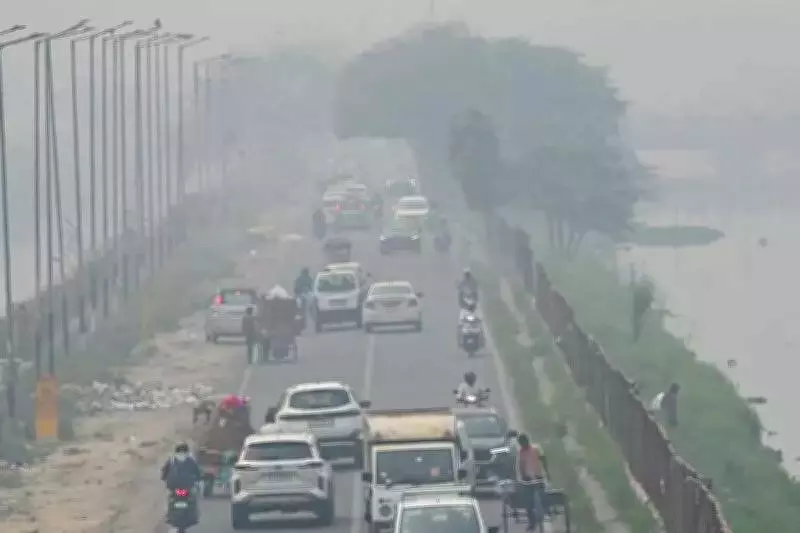
Ground-Level Ozone Transforms into Year-Round Health Hazard in Delhi
New Delhi is confronting a disturbing new reality as ground-level ozone, historically considered a seasonal summer pollutant, has evolved into a persistent year-round threat. An extensive analysis of Central Pollution Control Board (CPCB) data reveals that ozone dominated the daily Air Quality Index (AQI) on 16 out of 28 days in February 2026, marking a significant escalation compared to previous years.
Alarming Data Trends Across Multiple Years
The CPCB analysis paints a concerning picture of ozone's growing dominance. In February 2026, ozone was the primary pollutant on 16 days, followed by 8 days in March and twice in January. This represents a dramatic increase compared to historical patterns. For instance, ozone was the main pollutant on only nine days in February 2025, two days in February 2024, 2021, and 2020, and just once in February 2022. Notably, it wasn't the dominant pollutant at all in February 2023.
While ozone typically peaks during summer months, especially between April and June, this new data indicates elevated levels are now being recorded consistently throughout other seasons. A striking example occurred in October 2025, which was the coolest October in three years with a mean maximum temperature of 31.7 degrees Celsius, yet ozone emerged as the lead pollutant for 11 days.

Expert Warnings and Health Implications
Anumita Roychowdhury, executive director of research and advocacy at the Centre for Science and Environment, emphasized that ozone pollution has escalated into a serious year-round public health concern. "Once a seasonal problem triggered by summer sunlight, toxic ozone levels now persist across all seasons due to high and continuous emissions of gases. Without urgent action to drastically cut gaseous pollutants from vehicles and industries, this highly reactive gas will increase public health risk," she warned.
A review of hourly ozone data for February reveals particularly worrying trends. The gas exceeded 101 micrograms per cubic metre for 29 hours in February 2026 and 18 hours in February 2025. In stark contrast, hourly concentrations did not cross the 100 micrograms per cubic metre mark even once during any February between 2020 and 2024, according to data analyzed by Envirocatalysts, an environmental think tank.
Though the national hourly standard for ozone stands at 180 micrograms per cubic metre, experts note that the number of hours showing elevated levels this year is significantly higher than in previous years.
Changing Patterns and Contributing Factors
Sunil Dahiya, founder and lead analyst at Envirocatalysts, explained that while average temperatures in February remained similar to previous years, ozone levels peaked dramatically this year. "It means that primary precursors like oxides of nitrogen (NOx) and volatile organic compounds (VOCs) are driving ozone levels, as there is no direct correlation between ozone and temperatures. We have also seen that the gas has started turning into a main pollutant during winter and pre-summer months, which was not the case a few years ago," said Dahiya.
He stressed the need for systematic intervention focused on reducing the emission load of all pollutants. While ground-level ozone pollution has started rising in other months, it continues to remain consistently high across the Delhi-NCR region during summer. A study conducted by the Centre for Science and Environment last year revealed that the eight-hour concentration exceeded 100 micrograms per cubic metre on each of the 92 days between March 1 and May 31, 2025.
Formation Mechanisms and Health Consequences
Unlike primary pollutants, ozone is not emitted directly from any source. Ground-level ozone forms through complex chemical reactions between NOx and VOCs, which are emitted from vehicles, power plants, factories, and other combustion sources. In the presence of sunlight, these pollutants undergo cyclic reactions that generate ozone at surface level. VOCs can also originate from natural sources, including vegetation, according to CSE.

The Centre for Science and Environment study emphasized that ozone is a highly reactive gas that poses serious health risks. "It can inflame and damage airways, increase susceptibility to infections, and worsen respiratory conditions such as chronic bronchitis and emphysema. Children with underdeveloped lungs, older adults, and individuals with existing respiratory conditions are particularly vulnerable. Ozone exposure increases the frequency and severity of asthma attacks, often leading to higher rates of hospitalization," the study stated.
Government Response and Future Outlook
In December last year, the Union Environment Ministry informed the National Green Tribunal that it will constitute a four-member expert panel to study ground-level ozone pollution, mitigation strategies, and associated health impacts. This move comes as Delhi faces mounting evidence that what was once a seasonal nuisance has transformed into a persistent environmental and public health challenge requiring immediate and comprehensive action.