How October 7 Reshaped Global Politics: From Hamas Attack to Trump's Return
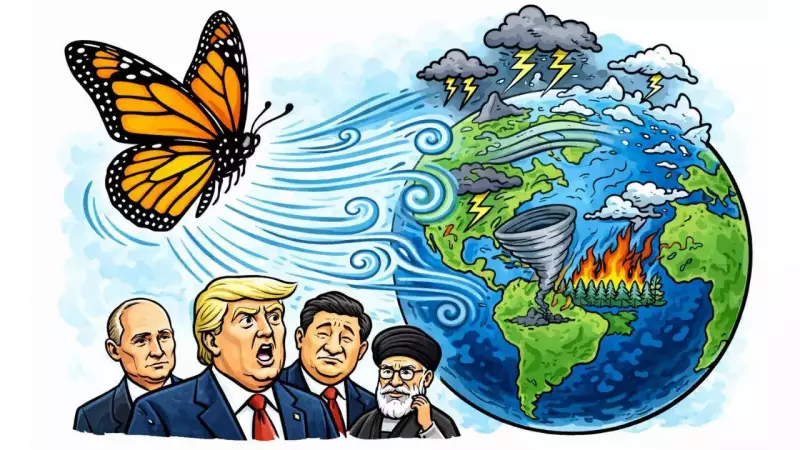
The Butterfly Effect is a forgettable early 2000s movie starring Ashton Kutcher. Yet it popularized a chaos theory concept that escaped mathematics and invaded LinkedIn posts. The idea suggests a butterfly's wing flap could cause a tornado elsewhere. In real-world terms, October 7, 2023 serves as the perfect case study. That day created ripples across the globe, big and small.
A terrorist organization paraglided into a music festival that day. Their desire to imbibe culture ended up rewriting the world order. The following story could have been directed by Quentin Tarantino. It was gory, non-linear, with interconnected threads and perverts thrown in. Israel's furious response, with American help, dismantled Iran's Axis of Resistance. It tangentially hastened Donald Trump's return to the White House. The events reminded Russia, China, and Europe who holds real power.
Chapter 1: Axis of No Resistance
Benjamin Netanyahu promised Hamas leaders were dead men walking. At the time, it sounded like typical political rhetoric for cameras and adrenaline. Politicians seldom keep such words. Netanyahu went above and beyond.

With hindsight, it echoed George Bush's crude warning about smoking enemies from caves. Modern states pretend to have outgrown such language. Sun Tzu once said you wait by the river to see your enemy's corpse float by. After October 7, Israel stopped waiting.
Israel eschewed all notions of constraint. International bodies and nations condemned the actions, but Israel proceeded. It set about dismantling, dismembering, and decimating the Axis of Resistance. Air power erased entire neighborhoods. Commanders were hunted across Palestine, Iran, Qatar, and Yemen.
Leaders of Hamas, Houthis, and Hezbollah faced tactics from John Wick and James Bond playbooks. The pager attack that maimed Hezbollah fighters displayed sheer audacity. By early 2026, Iran tottered. Internal protests threatened Ayatollah Khamenei's once-impregnable regime.
If Khamenei's rule unravels, October 7 will be remembered as the red-letter day. It dragged the Axis into the open, forced an unprepared confrontation, and turned Iran's proxies into the Axis of No Resistance.
Chapter 2: The Don Returns
We live in interesting times, an ostensible Chinese curse popularized by Austen Chamberlain. History obliged with Donald Trump's return to the White House. October 7 alone did not cause his return, but it was a crucial straw. It broke the carefully crafted coalition that brought Democrats to power in 2020.
Other factors contributed. Democrats failed to recognize their President could not speak without falling asleep. His successor could not complete interviews without breaking into laughter. The party obsessed over identity signaling, pronouns, and moral performance over material reality and prices.
Economic gaslighting insisted everything was fine while voters' bills said otherwise. Speech policing turned free expression into grievance. Democrats assumed entire voter blocs had nowhere else to go. Trump distilled this into a brutal campaign line: Kamala is for they/them, I am for you.
Democrats kept sleeping at the wheel. Unlike a caterpillar struggling from its cocoon, they forgot how to be pugilistic. They grew accustomed to manufacturing consent in post-Obama years. October 7 shattered that illusion.
Older Democrats were aghast as younger ones celebrated Hamas as freedom fighters. Younger voters could not understand why Biden did not stop Israel's American-funded war machine. Harris inheriting the nomination worsened things.
To progressives, Harris sounded like Biden with softer tone but same substance. To foreign-policy hawks, she sounded hesitant and insufficiently forceful. She occupied the narrowest, most uncomfortable position in American politics. Not progressive enough for the left, not hawkish enough for the right.
Her campaign ran contradictory messages. One ad in Michigan highlighted Gaza humanitarian suffering. Another in Pennsylvania emphasized unwavering support for Israel's military response. Her abject performance showed in Michigan, where Arab American and Muslim voters hold sway.

Many backed Trump, believing he might act on the war. Others opted for third-party candidates or abstained. This collapse reflected deeper structural drift within the Democratic Party. Trump did not need to win hearts. He merely needed Democrats to lose them.
That loss ushered in a return of American imperialism in an unexpected form. One that China, Iran, and Russia had not prepared for.
Chapter 3: China and Russia Who? Uncle Sam Is Back
MAGA once claimed to dismantle the neoconservative Republican wing. That illusion is gone. Neocons said America does not want to be the Global Policeman. Under Trump, it now wants to be the world's hafta collector. Trump stripped American foreign policy of pretending to do good. In its own way, that is refreshing.
The Trump Doctrine rests on five beliefs. First, Trump does not believe in a rules-based international order. International law is a fiction sustained by people without power. Second, Trump views foreign policy as transactional. Every relationship is a deal.
Third, Trump is driven by revenge. Anyone who slighted him or America will not be spared. Fourth, Trump believes in his own hubris. Expertise is secondary. Doubt is weakness. Finally, Trump believes America should act without apology. As one staffer said: We are America, b****. That is the Trump Doctrine.
At home, this meant abandoning constitutional restraint. It tested how much power lies with the executive. American citizens faced deportation to random countries on flimsy evidence like tattoos. ICE took to streets like mildly menacing White Walkers, tangling with local law enforcement and suburban mothers.
Removal errors, due process gaps, chaotic deportations, and undertrained ICE officers flooded the system. The DOJ weaponized against political opponents, from former FBI officials to national security advisers. Woke policies were purged from federal government and corporate America.
Big Tech, which deplatformed Trump after January 2021, was brought to heel. It promised to fund Trump's personal projects. Federal media funding was cut. Major outlets were acquired by Trump allies. Universities faced grant cut threats, with federal money as carrot and stick.
Washington transformed into St Petersburg, a living embodiment of the Peter Principle. Loyalists understood fealty matters more than competence. The VP is a millennial untroubled by ideological whiplash, even with racist attacks on his own family.
The Department of Defence was rechristened the Department of War. It is led by a former Fox News host with a drinking problem who struggles with pull-ups. Homeland Security is headed by a grandmother unable to protect her handbag. The White House press secretary dismisses all critics as leftists.
The Director of National Intelligence was sidelined. Insiders joke DNI now stands for Do Not Invite. The FBI chief is a former podcast bro who uses federal resources to spend time with his country singer girlfriend. Unfortunately, America's dysfunction never stays contained. Problems from the Shining City on the Hill always trickle down.
Random tariffs based on incorrect formulae threatened the global economy. Tariffs bullied allies to the point no one knows what they are paying. These actions stripped emerging powers like China and Russia of the illusion they could challenge American hegemony. That belief was optimism bordering on foolishness.
Bashar al-Assad survived years with Russian backing. Yet Putin was powerless when Syrian rebels overran Damascus. A former Al Qaeda militant, once on the FBI's most-wanted list, now heads the state. Trump calls him beautiful.
Similarly, China and Russia could do nothing when Trump decided Nicolás Maduro's dancing went too far. Maduro was picked up like a neighborhood delinquent. This was not terrorist extraction but detention of a sitting head state backed by nuclear powers. Trump even accepted the Nobel Peace Prize awarded to Venezuelan opposition leader Machado.
Iran may be next. Trump's first foreign policy exposure came during the Tehran hostage crisis. He could not fathom how powerful America failed to protect its people. He never forgot that humiliation.
It was evident on June 25, 2025. Trump borrowed from Top Gun: Maverick, sending B-2 stealth bombers to strike three Iranian nuclear sites. Iran's response attacked an American base in Qatar. Casualties were zero, appearing choreographed by all sides.
The doctrine expanded to America's allies. Canada was labelled the 51st state. Europe was told to call Trump Daddy. Denmark was threatened over Greenland. Zelenskyy was humiliated publicly. Keir Starmer was made to bend, literally.
France moved the G7 summit because Trump wanted a White House birthday party with an MMA spectacle. Trump postures endlessly, announcing ceasefires where there is no firing and no ceasing. Truth is irrelevant compared to the story in his head.
To borrow Albert Einstein's words: Future generations will scarcely believe such a man once walked the earth. But would that walking and talking have been possible without Hamas paragliding into Israel?
That question will haunt us. It is a cruel mathematical equation whose solution began on October 7. If history is written by victors, October 7 may be remembered not as war's beginning but as the moment the post-World War 2 rules-based order illusion collapsed.
One reckless act, one miscalculated terror spectacle, set off a chain reaction. It stripped away moral language, exposed power as power, and revealed the world never really moved on. The butterfly flapped its wings, and what followed was not chaos, but clarity.