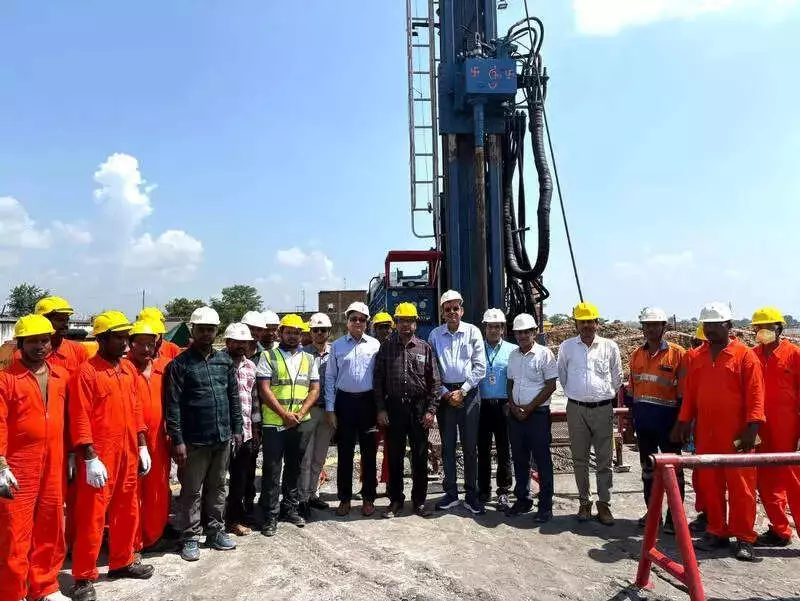
In a landmark achievement for India's clean energy transition, state-owned power giant NTPC and the Indian Institute of Technology Bombay (IIT-Bombay) have successfully completed drilling the nation's first-ever geological well dedicated to testing underground carbon dioxide (CO2) storage. This pioneering project, located in Jharkhand, marks a critical step in developing indigenous solutions for Carbon Capture, Utilisation and Storage (CCUS) to combat climate change.
A Pioneering Academia-Industry Collaboration
The successful drilling is the result of a strategic collaboration facilitated by NITI Aayog in November 2022, bringing together NTPC's research wing NETRA and the Department of Earth Sciences at IIT-Bombay. IIT-Bombay served as the implementation agency for this ambitious project. The partnership initially focused on building India's first geological storage atlas for coalfields rich in coalbed methane, laying the groundwork for this practical step.
In September 2025, the teams commenced the historic drilling operation in the Hazaribagh area, targeting a depth of 1,200 metres near a coal mining region. The primary objective was to assess the feasibility of storing CO2 deep underground in geological formations. This first well was completed last month. Encouraged by its progress, the consortium initiated drilling a second monitoring well on December 21 to study the behaviour and containment of injected CO2 using advanced techniques.

Addressing India's Gigaton-Scale Emission Challenge
Professor Vikram Vishal, the project lead from IIT-Bombay, underscored the project's national significance. He highlighted that India emits approximately 2.95 billion tons of CO2 annually, with the power sector contributing nearly one-third. While renewables and clean tech are vital, certain industrial processes will continue to generate CO2 emissions.
"Capturing this carbon is only part of the solution," explained Prof. Vishal. "Conversion into useful chemicals is limited by market scale. At the volumes India must manage—hundreds of millions to a billion tonnes—geological storage becomes unavoidable. Storing CO2 deep underground is essential for industries and the country to meet net-zero targets."
Preliminary studies are promising, indicating substantial storage potential in the North Karanpura coalfield. The Pakri-Barwadih block alone is estimated to potentially hold up to 15.5 million tonnes of CO2 over a decade of injection.
Roadmap for a Decarbonised Future
The project will now generate detailed feasibility and risk assessments for full-scale carbon capture and storage (CCS) development, including a commercial deployment plan. Studies are also underway to evaluate the potential for similar wells in other regions, including the offshore Mumbai High area.
Celebrating this translational research, Prof. Shireesh Kedare, Director of IIT-Bombay, emphasised its role in architecting India's energy transition roadmap. This successful drilling not only positions India closer to large-scale, homegrown carbon mitigation technologies but also sets a powerful precedent for future academia-industry partnerships in solving the nation's most pressing environmental challenges.