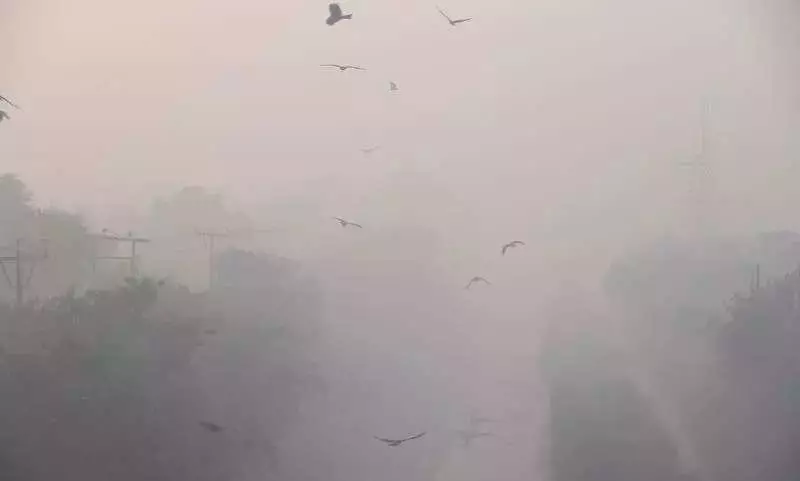
Noida and Ghaziabad Suffer Severe Air Pollution, Topping National Charts
The air quality in Noida and Ghaziabad took a drastic turn for the worse on Sunday. Both cities plunged into the severe category after spending five consecutive days in the very poor range. This marked their first severe air days of the entire year.
AQI Readings Spike Across Key Locations
Noida recorded an alarming Air Quality Index of 430 on Sunday. This represented a significant jump from Saturday's reading of 338. Greater Noida also saw a sharp deterioration, with its AQI climbing to 402 from 332.
Ghaziabad faced even more critical conditions. The city's AQI reached 458, up from 394 the previous day. According to data from the Central Pollution Control Board's portal, Ghaziabad recorded the worst air quality in the entire country on Sunday.

Delhi Also Experiences Pollution Surge
Delhi's air quality mirrored the troubling trend. The capital's AQI stood at 440 on Sunday, compared to 428 on Saturday. This reading represents the highest January measurement since January 14, 2024, when the index touched 447. It also equals the joint-worst record for the second half of January, matching the 440 reading from January 17, 2019.
Monitoring Stations Paint Grim Picture
Data reveals that all air monitoring stations in Noida recorded severe air quality on Sunday. Sector 1 reported the worst conditions with an AQI of 460. Other stations followed closely: Sector 116 at 443, Sector 62 at 410, and Sector 125 at 406.
In Greater Noida, Knowledge Park V recorded severe air with an AQI of 431. Knowledge Park III remained in the very poor range at 372.
Ghaziabad's situation appeared equally dire. All four of its air monitoring stations registered severe air quality. Loni recorded the worst AQI at 479, followed by Vasundhara at 475, Indirapuram at 456, and Sanjay Nagar at 422.
Weather Conditions Worsen Pollution
Calm winds associated with a western disturbance, combined with dense fog, caused the air quality to plummet sharply. The Centre's Decision Support System identified key pollution contributors. Delhi's own transport sector accounted for 12.5% of pollutants. Emissions from GB Nagar followed at 12%, with Ghaziabad contributing 9.4% and Bulandshahr adding 8.34%.
Visibility Drops and Temperatures Fluctuate
Visibility remained extremely poor during morning hours, dropping to as low as 100 meters in some areas. The minimum temperature recorded on Sunday was 5.3 degrees Celsius. This reading fell two notches below normal but showed a slight increase of 0.9°C from Saturday's minimum.
Cold wave conditions have begun easing across the region. Forecasts predict minimum temperatures will rise to around 9°C to 11°C by January 23.
Forecast and Regulatory Actions
The Centre's Air Quality Early Warning System predicts some improvement. Air quality should move back to the very poor category on Monday and remain within that range through Tuesday.
The Indian Institute of Tropical Meteorology expects partly cloudy skies on Monday. Moderate fog will appear at many places, with dense fog possible at isolated locations during morning hours. Predominant surface winds will likely come from the northeast. These calm conditions may reach up to 5 kmph in the morning before increasing to around 12 kmph in the afternoon. Wind speeds should then decrease to about 8 kmph during evening and night hours.
Delhi might receive very light rain on January 23 due to a fresh western disturbance, according to meteorological officials.
In response to the worsening pollution levels, the Commission for Air Quality Management implemented Stage IV of the Graded Response Action Plan on Saturday.