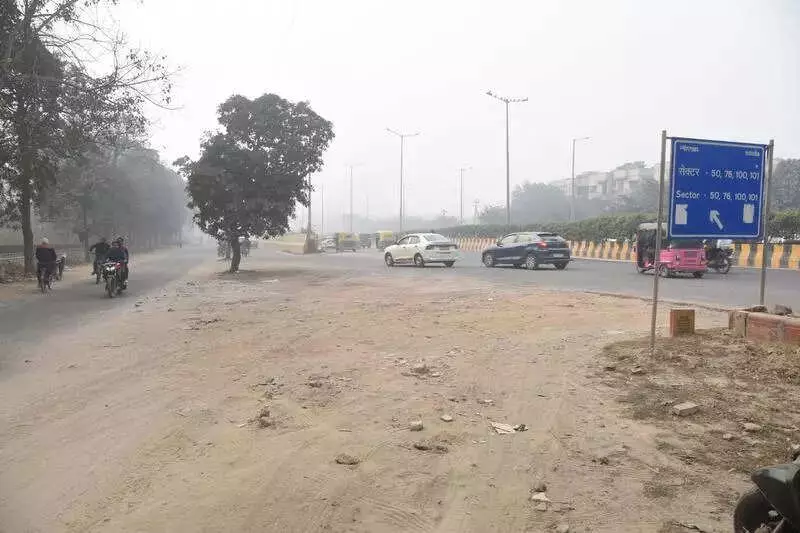
In a significant development for one of the National Capital Region's most polluted cities, a recent inspection has revealed a surprisingly positive trend regarding road dust in Noida. The Commission for Air Quality Management (CAQM) conducted surprise checks on Monday, assessing 142 road stretches across the city, and found that a majority showed low or no visible dust.
Inspection Reveals Encouraging Dust Control Scenario
Ten teams from CAQM and the Uttar Pradesh Pollution Control Board (UPPCB) fanned out across key areas as part of 'Operation Clean Air'. They inspected major arterial roads including the stretches from Rajnigandha Chowk to Sectors 12 and 22, Film City to Sector 60, and Kalindi Kunj to City Centre. Internal roads across 7x sectors and along the Noida Expressway were also covered.
The findings were compiled into a consolidated report using geo-tagged and time-stamped photographs from each site. Out of the 142 stretches inspected, 48 were found to be completely dust-free, while 66 were categorised as having low dust intensity. Only four road stretches showed high levels of visible dust, and 24 recorded moderate dust. "The findings indicate an encouraging overall scenario," stated the commission's report.

Targeted Action Needed at Identified Hotspots
Despite the overall positive picture, the inspection teams flagged specific locations where dust levels remained problematic. Higher dust was observed in parts of Sector 122, largely attributed to ongoing construction activity in the surrounding areas. Excess dust was also found under the newly opened Bhangel elevated road.
Another significant dust hotspot identified was the Yamuna Pushta road, which officials noted is in poor condition and damaged at several points. The Noida Authority clarified that jurisdiction for this road lies with the irrigation department. The CAQM report noted that stretches with high dust were often linked to waste accumulation, particularly under flyovers and along metro corridors, where regular sweeping and dust suppression measures tend to be less effective.
"These observations underline the need for focused attention on identified hotspots to prevent the re-accumulation of dust and waste," the report emphasized, calling for targeted sweeping and suppression measures at these locations.
Sustained Efforts and Resident Concerns
Noida Authority officials linked the positive results to sustained ground efforts. SP Singh, General Manager (Health) of Noida Authority, stated, "Every day, we deploy 19 mechanical sweeping machines and cover around 340 km of roads." He added that the inspection feedback shows these efforts are yielding results in keeping Noida clean and green. Most of the inspected stretches are reportedly those that undergo regular mechanical sweeping.
However, residents presented a contrasting view, claiming that several stretches across the city still have cracked patches, potholes, and loose gravel that make daily commutes difficult and kick up dust clouds. A daily commuter specifically mentioned the Sector 71 underpass, where clouds of dust rise every time a vehicle passes.
The drive focused on identifying key contributors to particulate pollution: visible road dust, accumulation of municipal solid waste, construction and demolition waste, and instances of open burning. Road dust is the second largest contributor to Delhi-NCR's PM2.5 pollution, accounting for about 18% of the deadly particulate matter, according to a 2018 study by TERI and the Automotive Research Association of India.
The CAQM has stated that similar inspection and enforcement drives under 'Operation Clean Air' will continue across the NCR to ensure strict compliance with statutory directions and Graded Response Action Plan (GRAP) measures aimed at dust mitigation and preventing open burning.