

NGT Bhopal Bench Takes Suo Motu Action on Plastic Recycling Hazards
The National Green Tribunal's Bhopal bench has taken suo motu cognisance of alarming media reports highlighting severe health and environmental risks emanating from unregulated plastic waste recycling activities at Bhopal's notorious "Kabadkhana" junkyard. In a decisive move, the tribunal has issued a series of directives aimed at curbing this public menace and safeguarding community well-being.
Immediate Actions Ordered for State Authorities
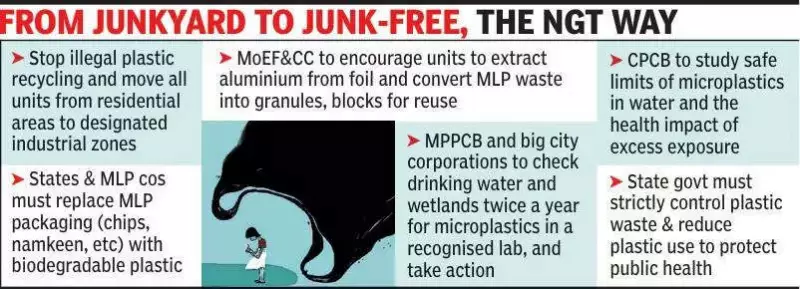
The bench, comprising judicial member Sheo Kumar Singh and expert member Sudhir Kumar Chaturvedi, has mandated the Madhya Pradesh government to take immediate and effective control over illegal plastic-recycling operations. A key directive involves the formulation of a comprehensive policy to relocate all functioning units from densely populated residential neighborhoods to designated industrial zones. This urgent measure addresses the serious safety concerns posed to local residents living in proximity to these hazardous facilities.
Specific orders have been issued to the principal secretary of environment, the Madhya Pradesh Pollution Control Board (MPPCB), and the collectors and municipal corporations of six major cities: Bhopal, Indore, Jabalpur, Gwalior, Rewa, and Ujjain. These authorities are instructed to:

- Take all necessary steps to halt illegal plastic recycling operations immediately.
- Ensure the systematic relocation of such units to appropriate industrial areas.
- Examine existing plastic waste disposal facilities and implement remedial measures.
Broader Directives for Sustainable Plastic Management
Beyond immediate relocation, the tribunal has outlined a forward-looking strategy for sustainable plastic waste management. The state government has been directed to ensure that the Multi-Layered Plastic (MLP) industry proactively works towards replacing non-degradable plastic components in MLP packaging with biodegradable alternatives. This initiative aims to reduce the long-term environmental footprint of plastic products.
Furthermore, the Ministry of Environment, Forest and Climate Change (MoEF&CC) has been instructed to encourage industries to adopt advanced dissolution techniques. These methods are crucial for efficiently extracting aluminium from foils and separating plastic components. The goal is to convert MLP and metalized plastic waste into valuable resources like laminated waste, granules, and blocks, which can be utilized in manufacturing value-added products, promoting a circular economy.
Comprehensive Monitoring and Research on Microplastics
Recognizing the insidious threat of microplastic pollution, the tribunal has mandated rigorous monitoring protocols. The MPPCB and the municipal corporations of the six specified cities are required to periodically monitor the quality of drinking water and wetlands in and around municipal areas. This monitoring must be conducted twice a year in recognized laboratories, with a specific focus on detecting microplastic contamination, and necessary public health precautions must be implemented based on the findings.
To bolster scientific understanding and response, the Central Pollution Control Board (CPCB) has been directed to form an expert team. This team, comprising members from CPCB, the Indian Council of Medical Research (ICMR), the Central Institute of Plastics Engineering & Technology (CIPET), and other relevant institutions, will undertake a comprehensive study on microplastic pollution. Their mandate includes recommending standards and suggesting remedial steps for municipal areas grappling with this emerging contaminant.

Additionally, the CPCB is tasked with studying the sampling and analysis of microplastics in water, establishing permissible limits, and investigating the health effects of consuming water with microplastic levels exceeding those limits. The principal secretary of environment has also been asked to consider engaging researchers from MANIT Bhopal to study the sources of microplastics in freshwater and drinking water, assess the efficacy of existing treatment methods, and evaluate the risk of microplastics re-entering the environment through sludge and biosolids used in agricultural practices.
Oversight and Future Compliance
The tribunal has emphasized the need for the state government to enhance overall plastic waste management, reduce plastic consumption, and minimize pollution, with particular attention to the health risks associated with microplastics in drinking water and the food chain. The principal secretary of environment is entrusted with monitoring the implementation of all directives through state and district-level committees.
A strict compliance timeline has been set. An action-taken report from the principal secretary, MPPCB, collectors, and municipal corporations must be submitted to the tribunal within four weeks. The next hearing in this critical matter is scheduled for 27 March 2026, ensuring continued judicial oversight on this pressing environmental and public health issue.





