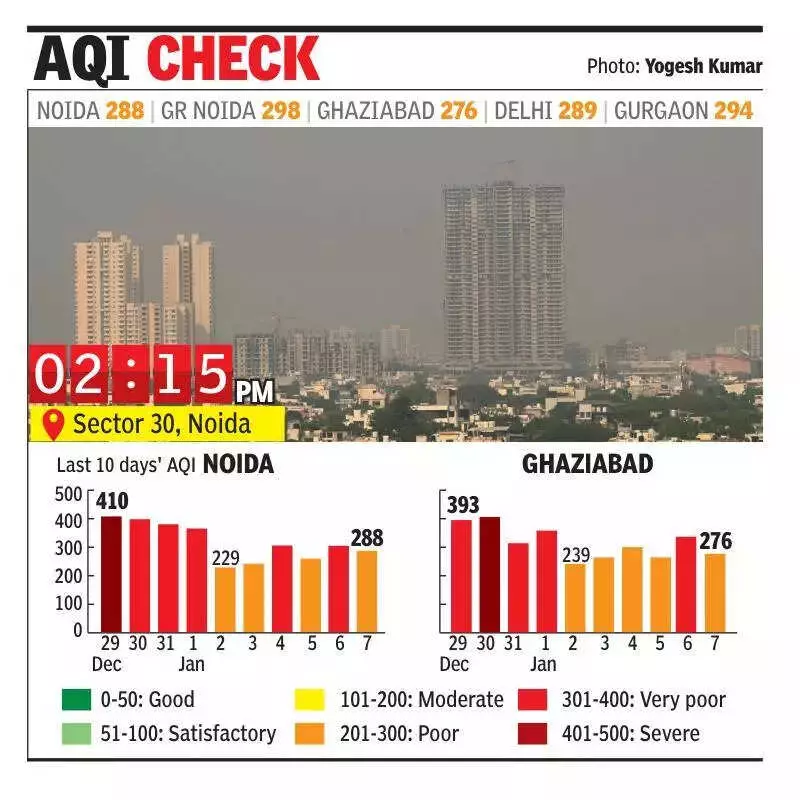
Residents of the National Capital Region (NCR) witnessed a marginal improvement in air pollution levels on Wednesday, as the quality shifted from the 'very poor' category recorded a day earlier back to 'poor'. However, morning fog significantly hampered visibility across the region.
AQI Readings Show Marginal Relief
According to the latest data from the Central Pollution Control Board (CPCB), Noida logged an Air Quality Index (AQI) of 288 on Wednesday, which falls under the 'poor' category. This marks an improvement from Tuesday's more severe reading of 341 ('very poor'). The neighbouring area of Greater Noida also saw a similar shift, with its AQI moving to 298 from 320. In Ghaziabad, the AQI was recorded at 276, compared to 322 on the previous day. Delhi's air quality mirrored this trend, remaining in the 'poor' category with an AQI of 289.
Station-Wise Breakdown Reveals Localised 'Very Poor' Spots
Despite the overall 'poor' categorization, data from individual monitoring stations highlighted pockets of more severe pollution. In Noida, the Sector 116 station recorded the worst air in the city with an AQI of 312, placing it in the 'very poor' range. It was followed by Sector 62 (AQI 295), Sector 1 (AQI 293), and Sector 125 (AQI 293), all in the 'poor' category.

In Greater Noida, Knowledge Park V recorded 'very poor' air with an AQI of 316, while Knowledge Park III was 'poor' at 280. The situation in Ghaziabad was mixed, with Vasundhara suffering 'very poor' air (AQI 337), while Sanjay Nagar (AQI 259) and Indirapuram (AQI 233) were both 'poor'. Data from the Loni station was unavailable for the day.
Weather Conditions and Forecast
The day began with dense morning fog that reduced visibility to below 500 metres, causing disruptions before conditions eased later. The minimum temperature settled at 8.6 degrees Celsius, with a maximum of 16.7 degrees. The India Meteorological Department (IMD) has forecast cold day conditions for the area on Thursday.
Wind patterns played a crucial role in pollutant dispersion. According to the Indian Institute of Tropical Meteorology, predominant surface winds blew from the north-west at speeds up to 16 kmph during the afternoon. However, wind speed decreased to less than 10 kmph from the west during the evening and night, limiting further cleansing of the air.
For Thursday, the IMD predicts mainly clear skies with moderate fog in many places and dense fog in isolated areas during the morning. The predominant surface wind is likely to be from the west, with speeds reaching up to 10 kmph in the morning. Wind speed is expected to increase to 16 kmph in the afternoon before decreasing again to less than 5 kmph during the evening and night, which may lead to pollutant accumulation once more.