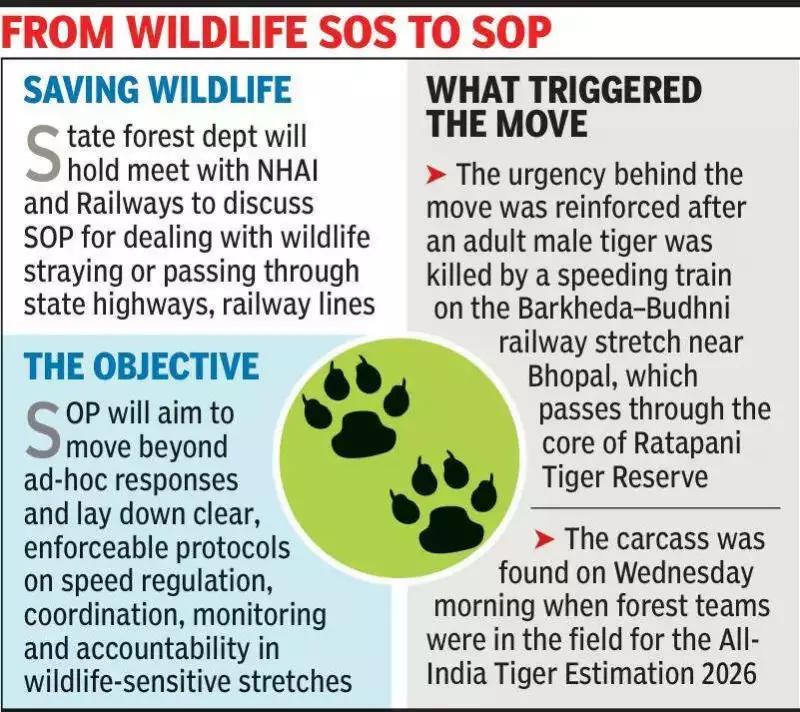
Alarmed by the recent death of a cheetah in a road accident in Gwalior and a string of tiger fatalities on railway tracks, the Madhya Pradesh Forest Department is taking decisive action. The department is planning to convene a crucial joint meeting with the National Highways Authority of India (NHAI) and Indian Railways. The primary goal is to frame a comprehensive Standard Operating Procedure (SOP) for managing wildlife presence and emergencies on highways and railway lines that cut through crucial forest landscapes.
From Ad-Hoc Responses to Systematic Protocol
Senior forest officials have stated that the proposed SOP aims to move beyond temporary, reactive measures. It will establish clear and enforceable protocols covering several critical areas. These include speed regulation, inter-agency coordination, continuous monitoring, and fixing accountability along wildlife-sensitive stretches. "The loss of even a single cheetah is a major setback for our ongoing reintroduction project. Similarly, the repeated tiger deaths highlight systemic gaps that require immediate correction," a senior official emphasized.
The urgency for this framework was amplified by a recent tragic incident. An adult male tiger was killed by a speeding train on the Barkheda–Budhni railway stretch near Bhopal. This line passes directly through the core area of the Ratapani Tiger Reserve. Forest teams discovered the carcass on Wednesday morning while they were conducting fieldwork for the All-India Tiger Estimation 2026.

A Notorious Stretch and Alarming Statistics
Officials revealed that the big cat was hit on a curve that is infamous for repeated wildlife deaths. "The carcass showed signs of being dragged several metres, which indicates the train was at high speed and the driver did not apply brakes," an officer noted. This incident has pushed the death toll on the Barkheda–Budhni line to 18 tiger and leopard fatalities in the past decade.
This is part of a larger, worrying trend. Madhya Pradesh recorded 56 tiger deaths in 2025, the highest in the country. In a previous incident in July 2024, three tiger cubs were struck by a train on the same Budhni–Midghat line, resulting in one death and two critically injured cubs. Frustrated by the recurring tragedies, the Forest Department had even considered seizing the train involved, drawing inspiration from a 2020 Assam case where a locomotive was impounded after killing an elephant.
Warnings Ignored and Mitigation Measures Missing
Internal correspondence reviewed by TOI shows that the dangers were repeatedly flagged. In March 2025, the Chief Wildlife Warden wrote to the state forest secretary, warning about persistent non-compliance by Indian Railways. The warnings concerned conditions set during the approval of the third rail line between Barkheda and Budhni.
Inspection reports documented that trains were consistently exceeding the prescribed speed limit of 60 kmph. Freight trains were clocked at 65 kmph and passenger trains at 75 kmph. Furthermore, mandatory mitigation measures mandated by NTCA guidelines were either missing or incomplete. These included:
- Constructing 30-metre animal passages every 1 km.
- Building a wildlife overpass.
- Installing fencing along the tracks.
- Clearing weeds and removing garbage that attracts prey animals.
In response to this critical situation, the State Forest Research Institute (SFRI) in Jabalpur has been tasked with preparing a special mitigation plan. This plan will focus on railway tracks passing through the Ratapani Tiger Reserve and the vital Satpura Tiger Reserve (STR) corridor, a key wildlife dispersal zone in central India.
The SFRI plan will involve scientific mapping of animal movement patterns, identification of accident black spots, and proposing site-specific solutions. These solutions may include constructing underpasses and overpasses, erecting fencing, deploying sensor-based alert systems, and ensuring strict speed enforcement.

The upcoming joint meeting with NHAI and Railways will integrate these findings to create a unified SOP applicable to both road and rail corridors cutting through forests. Wildlife experts hail this move as a significant shift from post-incident firefighting to proactive, preventive conservation planning.
"Without structural mitigation and clear accountability, linear infrastructure like roads and railways will remain the biggest threat to India's big cats," a senior officer stated. He added that if implemented effectively, Madhya Pradesh's SOP could serve as a national template for protecting wildlife in corridors across the country.