

Scientific Study Overturns 'Moth to a Flame' Myth
The long-standing phrase "like a moth to a flame" has been used for centuries to describe an irresistible attraction to light. However, a groundbreaking scientific study has completely rewritten our understanding of moth behavior, revealing that moths are not drawn to light but are instead profoundly disoriented by it.
How Moth Navigation Actually Works
According to research published in the prestigious journal Nature Communications, moths employ a sophisticated navigation system called the dorsal light response. This instinctive behavior involves moths turning their backs toward the brightest light source to maintain proper orientation during flight.
In natural environments, the brightest light source is typically the sky or moon, which provides a stable reference point. By keeping this light source at a constant angle relative to their bodies, moths can fly in straight lines over considerable distances, an evolutionary adaptation that has served them well for millennia.

Why Artificial Light Creates Confusion
When moths encounter artificial light sources like bulbs or flames, their navigation system fails spectacularly. Unlike celestial light sources that are distant and positioned above, artificial lights are typically closer, brighter, and located at unusual angles relative to the moth's position.
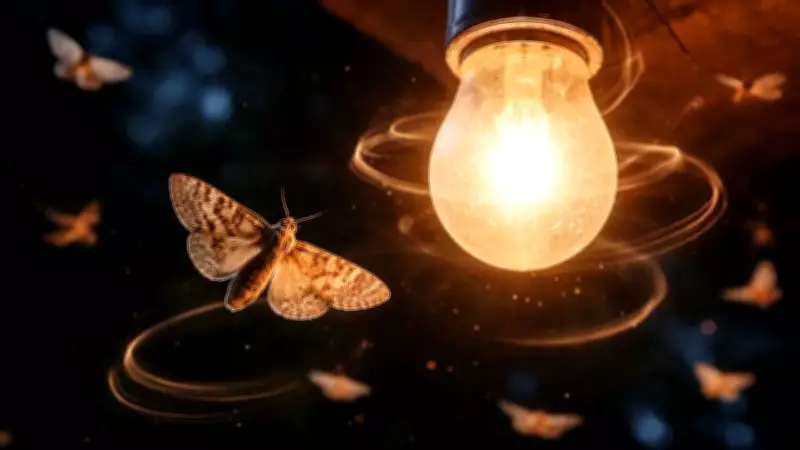
This creates a critical problem: the moth attempts to maintain its dorsal light response by continually adjusting its body to face the artificial light source. Since the light isn't in its expected position (above), this constant adjustment causes the moth to enter a spiral or circular flight pattern.
The moth isn't attracted to the light - it's desperately trying to orient itself using an evolutionary system that doesn't function properly with modern light sources. This explains why moths appear "stuck" to light bulbs or flames; they're trapped in a navigation loop they cannot escape.Evolutionary Advantage Turned Modern Disadvantage
This dorsal light response evolved as a significant advantage in pre-industrial environments where the only light sources were celestial bodies. Moths could travel efficiently, find food sources, locate mates, and avoid predators by maintaining straight flight paths relative to the moon or stars.
However, in our modern world filled with artificial lighting, this once-beneficial system has become a liability. The proximity and positioning of artificial lights create constantly changing angles that the moth's navigation system cannot process effectively.
Serious Consequences for Moth Populations
This disorientation has significant implications for moth survival and ecosystem health:
- Moths caught in endless spiral patterns around light sources become physically exhausted
- Disoriented moths are more vulnerable to predators like bats and birds
- Energy wasted on futile navigation reduces reproductive success
- Collisions with light sources or surrounding structures cause injury or death
Since moths serve crucial ecological roles as pollinators and as important components of the food chain, these disruptions can have cascading effects throughout ecosystems. The misconception that moths are attracted to light has obscured the real problem: artificial lighting is interfering with fundamental insect navigation systems.
A Paradigm Shift in Understanding
This research represents a fundamental shift in how scientists understand insect-light interactions. Rather than interpreting moth behavior around lights as attraction, we must now recognize it as a form of navigational confusion.
The next time you see a moth circling a light source, understand that you're witnessing not attraction but disorientation - an ancient navigation system failing in modern conditions. This new understanding may inform conservation efforts and lighting design to minimize negative impacts on nocturnal insects.






