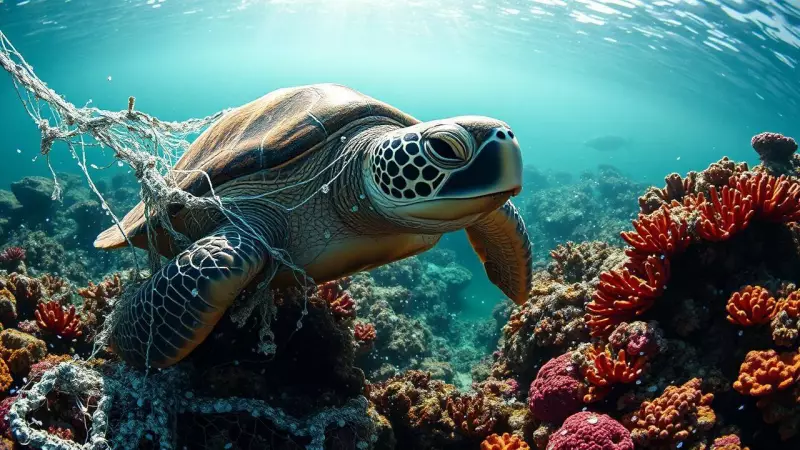
A groundbreaking scientific review has issued a stark warning: the pervasive pollution of microplastics is directly undermining the ocean's crucial capacity to absorb carbon dioxide (CO2), a vital process for regulating the planet's climate. This interference poses a significant, yet often overlooked, threat in the global fight against climate change.
How Microplastics Sabotage the Ocean's Natural Carbon Pump
The study, published in the Journal of Hazardous Materials: Plastics, explains that oceans act as Earth's largest carbon sink through a natural mechanism known as 'biological carbon pumping.' This process involves the transfer of atmospheric carbon into the deep sea layers, effectively locking it away.
However, the research, which analyzed 89 studies from 2010 to 2025, found that microplastics are severely disrupting this system. "Microplastics interfere with this process by reducing phytoplankton photosynthesis and impairing zooplankton metabolism," stated the authors, which included researchers from the University of Sharjah in the United Arab Emirates. These tiny plastic fragments, smaller than five millimeters, are choking the very foundation of the marine food web and its climate-regulating function.

A Dual Crisis: Plastic Pollution Meets Climate Change
The findings establish a dangerous feedback loop. "Oceans are Earth's largest carbon sink. Microplastics are undermining this natural shield against climate change," emphasized lead author Ihsanullah Obaidullah, an associate professor of integrated water processing technologies. The review concludes that microplastic pollution and climate change are inextricably linked, with each exacerbating the other.
The scale of the plastic problem is monumental. To date, over 8.3 billion tonnes of plastic have been produced globally. A staggering 80% of this ends up in landfills or the natural environment, with a mere 9% being recycled. These plastics break down into microplastics, which are now found everywhere—from the deepest ocean trenches to the human body.
The consequences are severe and multifaceted:
- Ingested toxins from microplastics trigger diseases in humans and animals.
- Aquatic ecosystems are disrupted, harming marine life.
- Soil fertility is reduced.
- The ocean's health further deteriorates through warming and acidification.
Call for an Integrated Global Response
The research team advocates for a unified strategy, arguing that the twin challenges of microplastic pollution and climate change cannot be addressed in isolation. They call for coordinated international efforts to develop governance frameworks that tackle both issues simultaneously, focusing on their combined impact on ocean acidification and warming.
Key recommendations to preserve the ocean's carbon-absorbing ability include:
- Drastically reducing the production and consumption of single-use plastics.
- Implementing robust and innovative waste management systems worldwide.
- Prioritizing scientific research into the climate impacts of plastic pollution.
This study makes it clear that tackling plastic pollution is no longer just an environmental issue—it is an urgent and integral part of the battle to stabilize our global climate.