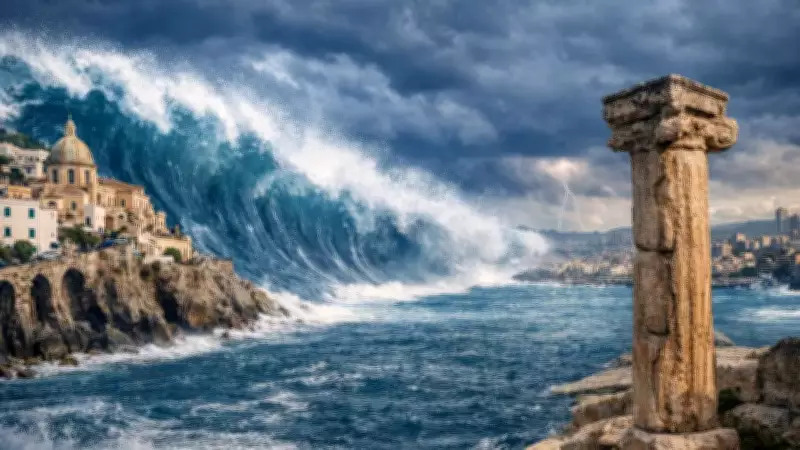
Mediterranean Tsunami Threat: Scientific Studies Reveal Hidden Danger to Coastal Europe
For decades, the Mediterranean Sea has been perceived as a relatively tranquil body of water, largely immune to catastrophic natural events like tsunamis. However, groundbreaking scientific evaluations now challenge this long-held assumption, revealing a significant and underestimated threat lurking beneath its seemingly calm surface.
Reassessing Risk in a Densely Populated Region
The coastal areas of Southern Europe, particularly the highly populated Côte d'Azur and major urban centers such as Nice, exhibit substantial vulnerability to tsunami hazards. This exposure stems from various natural phenomena, including earthquakes, underwater landslides, and volcanic eruptions. Research conducted by the University of Montpellier, in partnership with international organizations like UNESCO, indicates a tangible probability of moderate-intensity tsunamis occurring within brief timeframes, potentially within the next three decades.
Tectonic Activity: The Driving Force Behind the Threat
Despite its reputation for calm compared to oceanic zones like the Pacific, the Mediterranean remains a geologically active region. It serves as a convergence point for multiple tectonic plates, which are susceptible to seismic disturbances. These earthquakes can displace massive volumes of seawater, generating powerful tsunami waves. Historical archives document numerous tsunamis impacting various coastal stretches, including the Côte d'Azur. Although these events are less frequent than in other global hotspots, their potential danger is amplified by the high density of human settlements along the coastline, making them impossible to ignore.

Scientific Predictions and Statistical Analysis
Studies overseen by UNESCO project a high likelihood of a tsunami wave exceeding one meter in height striking the region in the near future. This forecast is not based on a single anticipated event but on rigorous statistical analysis of recurrent geological activities. Frequent underwater earthquakes and landslides in the area provide strong indicators that such a tsunami event is probable, underscoring the need for heightened awareness and preparedness.
Causes and Amplification of Mediterranean Tsunamis
Tsunamis in the Mediterranean typically originate from abrupt seabed disturbances, most commonly triggered by earthquakes. Additional contributing factors include landslides and volcanic activities. When the seafloor shifts suddenly, it sets the overlying water column in motion, generating waves that may travel unnoticed through deep waters but grow substantially upon reaching shallow coastal areas. The enclosed nature of the Mediterranean basin can further magnify these effects, potentially leading to more severe impacts than in open oceans.
Historical Precedents: From Theory to Reality
Past occurrences confirm that Mediterranean tsunamis are not merely theoretical risks but documented events. Historical incidents in the Côte d'Azur region, driven by both near-field and far-field triggers like earthquakes and underwater landslides, have resulted in noticeable sea-level fluctuations, powerful currents, and destructive waves. In some cases, observers reported the sea receding before surging forward—a classic tsunami warning sign—highlighting the real and recurrent nature of this threat.
Enhancing Preparedness and Public Awareness
Modern risk management strategies integrate scientific modeling with public readiness initiatives. Research from institutions such as the University of Montpellier has been instrumental in pinpointing evacuation zones, assessing population exposure, and designing efficient escape routes. Cities like Nice have already incorporated these insights into their urban planning frameworks. While early warning systems are crucial, experts stress that community preparedness is equally vital, especially in areas where evacuation may need to occur within minutes to ensure safety.