Breakthrough Discovery Solves Antarctic Geological Mystery
In a remarkable scientific achievement, researchers from the British Antarctic Survey have unraveled a decades-old geographical puzzle by identifying an enormous granite formation buried deep beneath the West Antarctic Ice Sheet. This discovery not only sheds light on Earth's geological history but also provides critical new data for climate scientists studying global sea level rise.
The Geological Anomaly That Started It All
The investigation began when scientists noticed peculiar pink granite boulders resting atop dark volcanic peaks in the Hudson Mountains of West Antarctica. These exotic "erratic" rocks stood in stark contrast to their volcanic surroundings, sparking intense scientific debate about their origin. Through meticulous analysis, researchers determined these boulders were approximately 175 million years old, dating back to the Jurassic Period when the supercontinent Gondwana began its fragmentation.
According to the research published in Nature, using advanced U-Pb zircon geochronology techniques, scientists established that these pink granite boulders were "plucked" from the valley floor by a much thicker ancient ice sheet and deposited on volcanic peaks as the ice retreated over millions of years.

Uncovering the 'Hidden Giant' Beneath the Ice
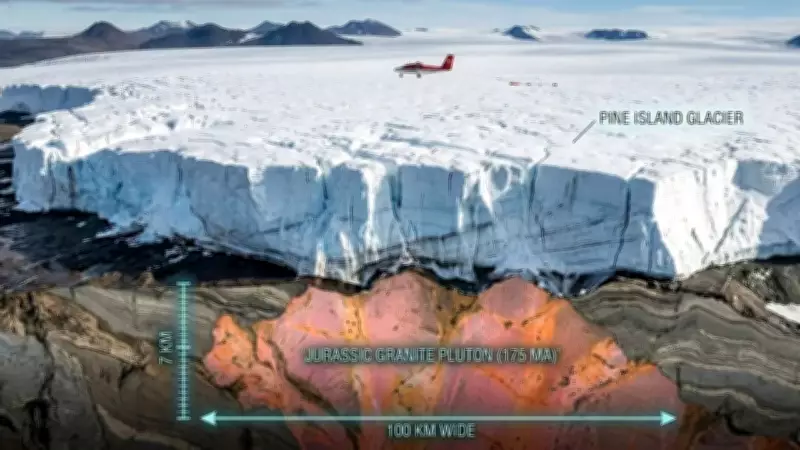
To trace the source of these mysterious pink rocks, the research team employed state-of-the-art airborne geophysical surveys. Flying a specially equipped Twin Otter aircraft over the Pine Island Glacier region, they conducted comprehensive gravity and magnetic surveys to map subsurface density variations.
The results revealed an astonishing geological feature - a massive granite pluton measuring approximately 100 kilometres across and extending 7 kilometres deep beneath the ice. This colossal formation covers a surface area roughly equivalent to half of Wales, making it one of the largest granite bodies ever discovered.
Climate Science Implications: A Game-Changer for Sea Level Predictions
This discovery carries profound implications for climate science, particularly regarding predictions of global sea level rise. The Pine Island Glacier, where this granite formation lies buried, represents one of Antarctica's fastest-melting glaciers and contributes significantly to rising ocean levels worldwide.
The "hidden giant" granite body serves as a structural foundation for the overlying ice sheet. Granite's exceptional density and rigidity create high-friction zones where glaciers grip the bedrock more tightly, potentially slowing ice flow into the ocean. This geological feature will become a crucial variable in computer models predicting sea level changes through the year 2100 and beyond.
A Geological 'Missing Link' in Earth's History
Beyond its climate implications, this granite formation provides valuable insights into Earth's geological evolution. Chemical analysis of the granite boulders indicates they formed during periods of intense tectonic activity and continental rifting, offering geologists a more complete understanding of the West Antarctic Rift System.
The research confirms this region was once an area of substantial magmatic activity, where large volumes of molten rock were injected into Earth's crust and cooled beneath the surface before being concealed by the West Antarctic Ice Sheet millions of years ago. This discovery helps fill significant gaps in our understanding of Gondwana's breakup and Antarctica's geological development.
The British Antarctic Survey's findings represent a major advancement in both geological science and climate research, demonstrating how understanding Earth's deep history can inform our predictions of future environmental changes.